DNA in 3D: The Double Helix Explained
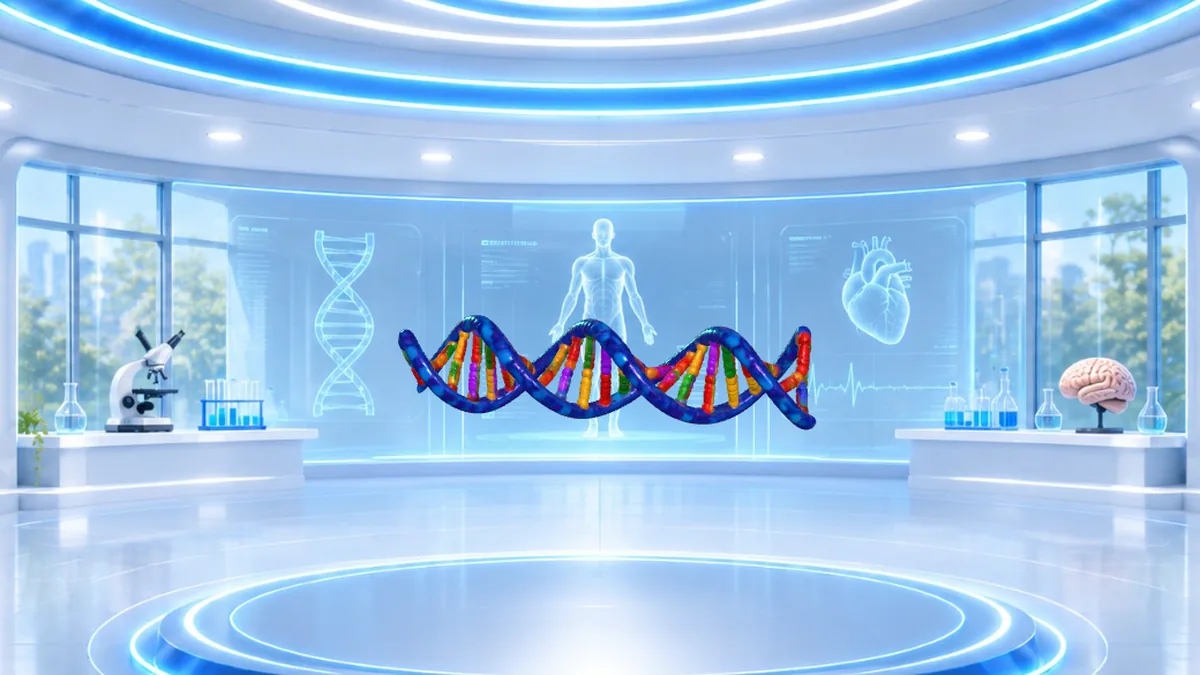
DNA is the set of instructions inside nearly every cell of the body. It is shaped like a twisted ladder called a double helix, and the order of its four bases spells out the genes. In the 3D Anatomy simulator you can open a model of DNA and turn the helix.
 Explore in 3D
DNA quick facts
| Shape | Double helix, like a twisted ladder |
|---|---|
| Bases | A, T, C and G |
| Pairs | A with T, C with G |
| Human genome | About 3 billion base pairs |
| Genes | About 20,000 that code for proteins |
Interesting facts about DNA
- The four bases always pair the same way: A with T and C with G.
- If the DNA in one cell were stretched out, it would be about 2 metres long.
- DNA is packed into 23 pairs of chromosomes in most human cells.
- Its double helix shape was worked out in 1953, using X-ray images made by Rosalind Franklin.
- About 99.9% of DNA is the same in all people.
What you can do in 3D
Open the DNA model to turn the double helix, see the base pairs that make the rungs, and tap each part to learn what it does.
More cells in 3D
Tap any part to open its page.
DNA questions
What is DNA?
A long molecule inside cells that carries the instructions for building and running the body.
What shape is DNA?
A double helix, which looks like a twisted ladder. The rungs are pairs of bases.
What are the four bases of DNA?
Adenine (A), thymine (T), cytosine (C) and guanine (G). A pairs with T and C pairs with G.
How long is the DNA in one cell?
About 2 metres if it were stretched out, tightly packed into chromosomes.
Who discovered the structure of DNA?
James Watson and Francis Crick described the double helix in 1953, using X-ray images made by Rosalind Franklin.
The 3D Anatomy simulator is made by Julian Neagu, a solo founder in London, as part of VisionVix Simulators. It is free to use in the browser on desktop and phone, with no sign-up. This page is for learning and is not medical advice.