Venus Flytrap Anatomy in 3D: Trap, Trigger Hairs and Digestive Glands
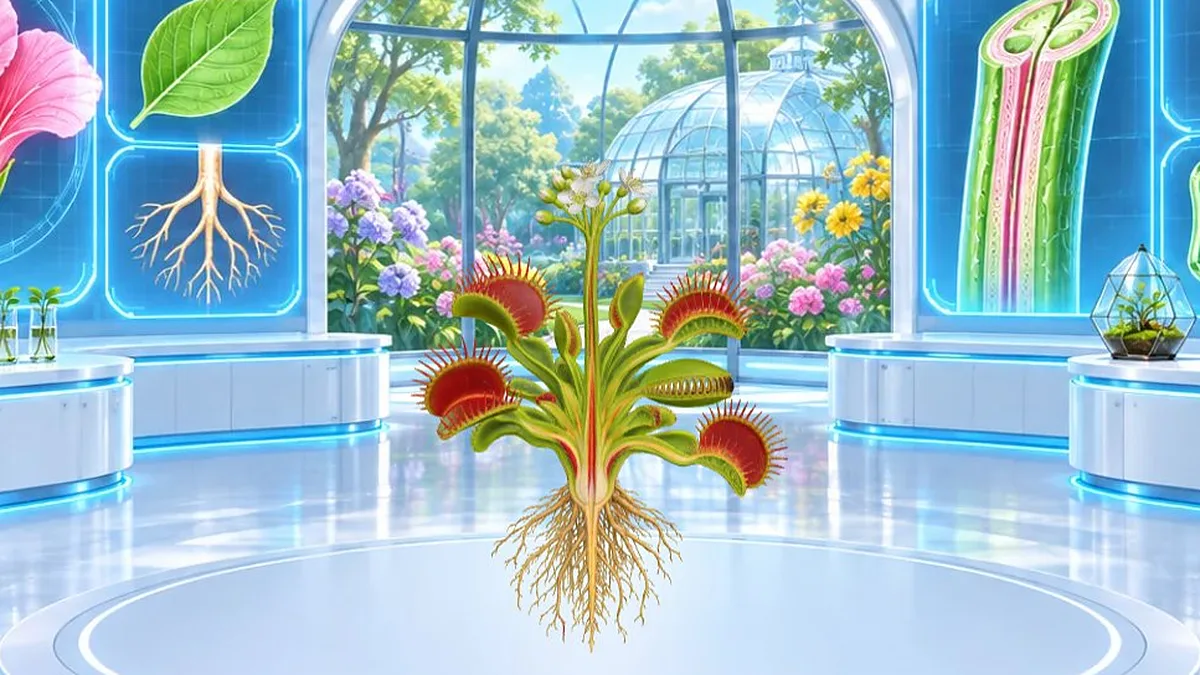
The Venus flytrap is a plant that catches and eats insects, snapping its trap shut in a fraction of a second. In the 3D Plant Anatomy simulator you can turn it around, zoom into each part, slice it open and watch water flow through it in X-ray.
 Explore in 3D
Four ways to see the Venus flytrap
 Whole plant
 Cross-section
 X-ray water flow
Venus Flytrap quick facts
| Plant group | Carnivorous flowering plant |
|---|---|
| Native to | A small area of North and South Carolina, USA |
| Trap closes | In about a tenth of a second |
| Digesting a meal | Around a week |
| Why it eats insects | Its boggy soil is poor in nutrients |
Inside the Venus flytrap
Each trap is a leaf with two hinged lobes. Tiny trigger hairs on the inner surface sense touch, and glands on the inside release juices that digest the insect. Spiky teeth on the edges lock together to keep prey from escaping.
Parts of the Venus flytrap
In the Parts up close view you can tap each of these parts to zoom in:
- Flowers
- White flowers grow high on a tall stalk, well away from the traps, so pollinators are not eaten.
- Trigger hairs
- Touch these hairs twice in a few seconds and the trap snaps shut.
- Trap
- Two hinged lobes close in about a tenth of a second, with spiky teeth locking together.
- Digestive glands
- Red glands inside the trap release juices that slowly digest the insect.
- Roots
- The roots grow in poor, boggy soil, which is why the plant catches insects for extra food.
Interesting facts about the Venus flytrap
- A Venus flytrap snaps shut in about a tenth of a second.
- The trap only closes when the trigger hairs are touched twice, so raindrops do not set it off.
- It digests an insect for around a week.
- It still makes most of its food from sunlight. Insects give it extra nutrients its soil lacks.
- In the wild it grows only in a small area of North and South Carolina in the USA.
More plants in 3D
Venus Flytrap anatomy questions
How does a Venus flytrap catch insects?
When an insect touches the trigger hairs inside the trap twice, the two lobes snap shut in about a tenth of a second.
Why does a Venus flytrap eat insects?
Its boggy soil is poor in nutrients, so insects give it the extra nitrogen it needs.
Where do Venus flytraps grow wild?
Only in a small area of wetlands in North and South Carolina, USA.
How long does it take to digest an insect?
Around a week, after which the trap opens again.
The 3D Plant Anatomy simulator is made by Julian Neagu, a solo founder in London, as part of VisionVix Simulators. It is free to use in the browser on desktop and phone, with no sign-up.