Acid vs Base: pH, Examples and Experiments in 3D
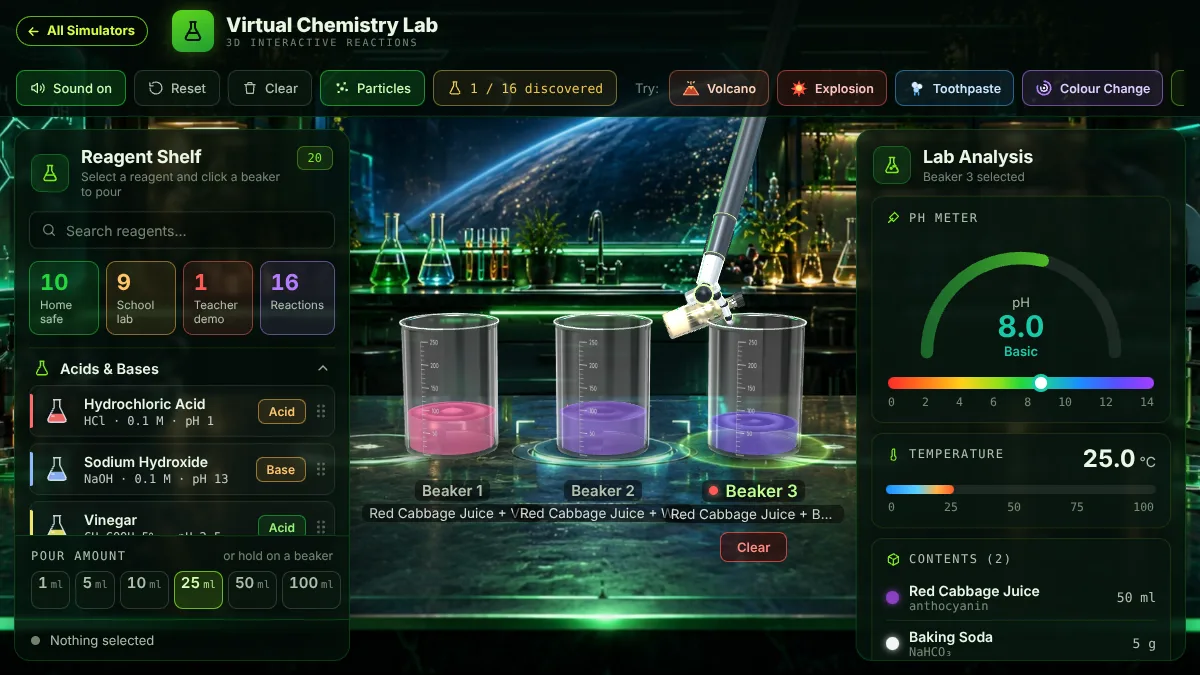
Acids have a pH below 7 and bases have a pH above 7. Acids give away hydrogen ions; bases take them. Mix the two and they cancel each other out in a neutralisation reaction. In the 3D Chemistry Lab, red cabbage juice shows the difference in colour.
Acid vs base at a glance
| Acid | Base | |
|---|---|---|
| pH | Below 7 | Above 7 |
| Hydrogen ions | Gives them away (H+) | Takes them in |
| Litmus paper | Turns red | Turns blue |
| Red cabbage juice | Pink to red | Blue, green or yellow |
| Taste (never test this in a lab) | Sour | Bitter |
| Everyday examples | Lemon juice, vinegar, cola, stomach acid | Baking soda, soap, toothpaste, bleach |
| Strong lab example | Hydrochloric acid | Sodium hydroxide |
The pH scale
pH runs from 0 to 14. Pure water sits in the middle at 7, neutral. Each step down is ten times more acidic, so lemon juice at about pH 2 is around 100,000 times more acidic than pure water. Each step up is ten times more basic. Strong acids and strong bases at either end can burn skin.
Neutralisation
When an acid meets a base, the hydrogen ions from the acid join the hydroxide ions from the base to make water, and a salt is left behind. Hydrochloric acid plus sodium hydroxide gives water and sodium chloride, table salt. In the 3D Chemistry Lab you can run a titration and watch the indicator turn pink at the exact point the acid is used up.
Quick facts
- An alkali is a base that dissolves in water.
- Your stomach acid has a pH of around 1.5 to 3.5.
- Indigestion tablets are bases that neutralise extra stomach acid.
- Pure water has a pH of 7 at 25 °C.
- Rain is naturally a little acidic, at about pH 5.6.
Try it in the 3D lab
Acid vs base questions
What is the difference between an acid and a base?
An acid has a pH below 7 and gives away hydrogen ions. A base has a pH above 7 and takes up hydrogen ions.
What happens when you mix an acid and a base?
They neutralise each other, making water and a salt.
Is baking soda an acid or a base?
A weak base, with a pH of about 8 to 9 in water.
Is vinegar an acid or a base?
An acid. It contains acetic acid and has a pH of about 2.5 to 3.
What is the difference between a base and an alkali?
An alkali is a base that dissolves in water. All alkalis are bases, but not all bases are alkalis.
More face-offs: see all 3D comparisons.
The 3D Chemistry Lab is made by Julian Neagu, a solo founder in London, as part of VisionVix Simulators. It is free to use in the browser on desktop and phone, with no sign-up.