Paracetamol vs Ibuprofen: The Molecules Compared in 3D
Paracetamol and ibuprofen are two of the most used medicines in the world, and they look quite different up close. Paracetamol is a small, flat molecule built on one ring. Ibuprofen is bigger, with a ring and two side chains, and comes in left- and right-handed forms. This page compares the chemistry. For questions about taking either medicine, read the leaflet or ask a pharmacist.
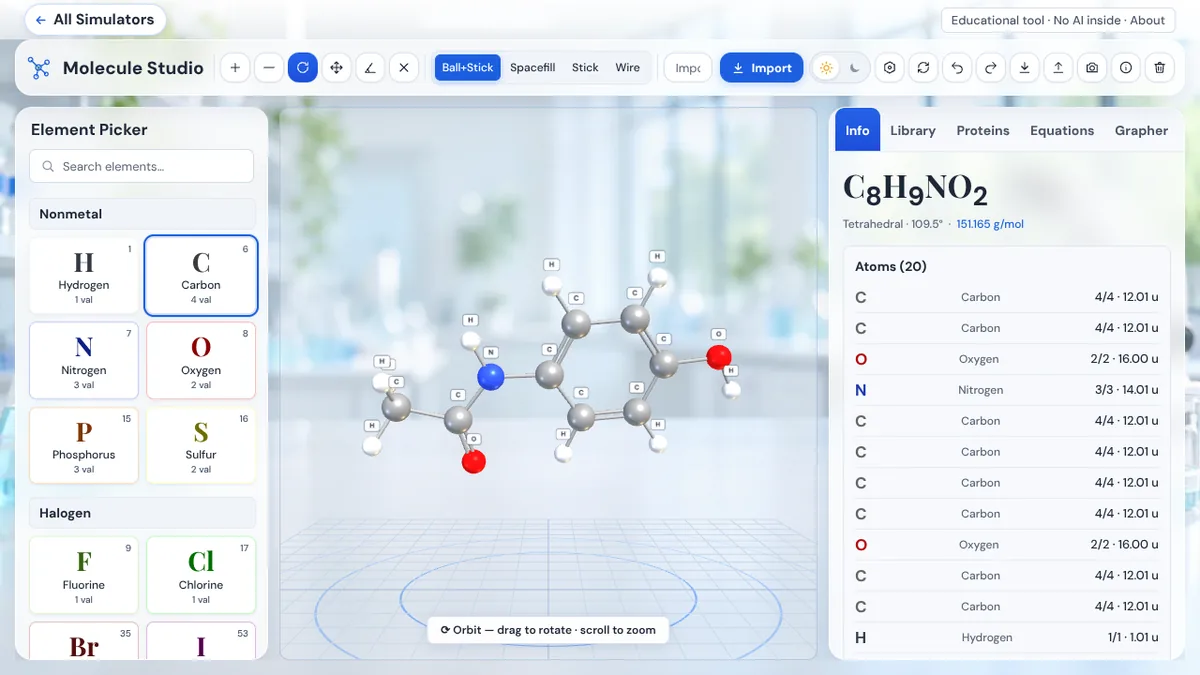
Paracetamol
C8H9NO2. A small, flat ring molecule, called acetaminophen in the US.
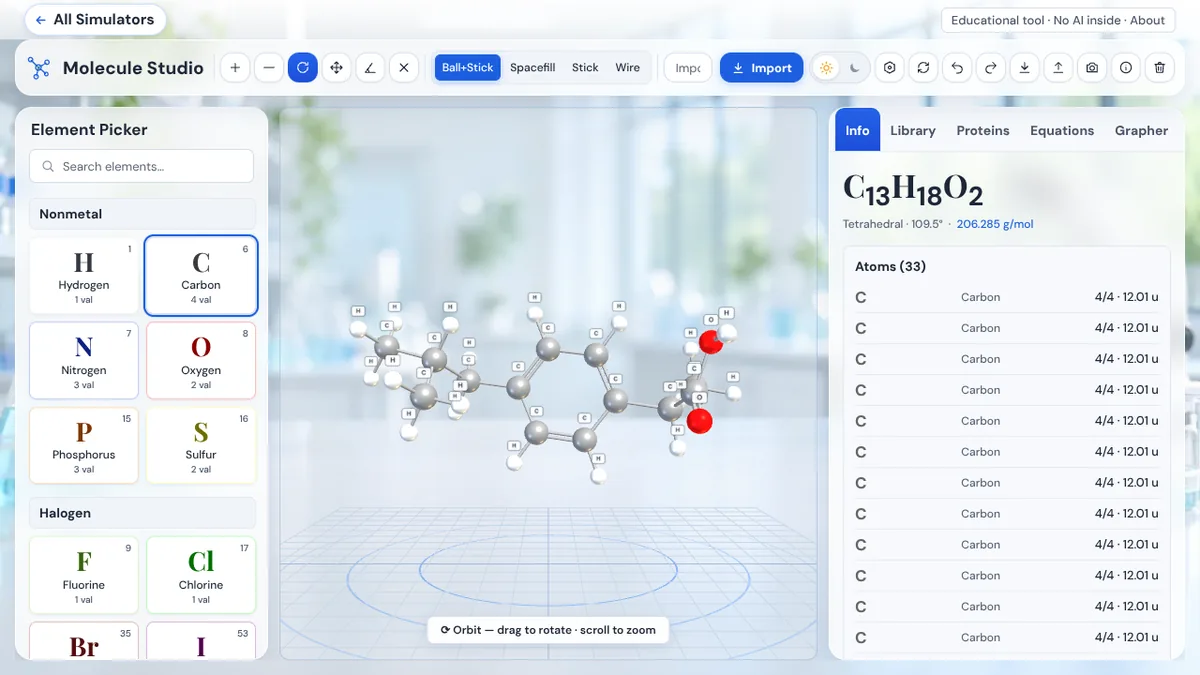
Paracetamol vs ibuprofen: true size
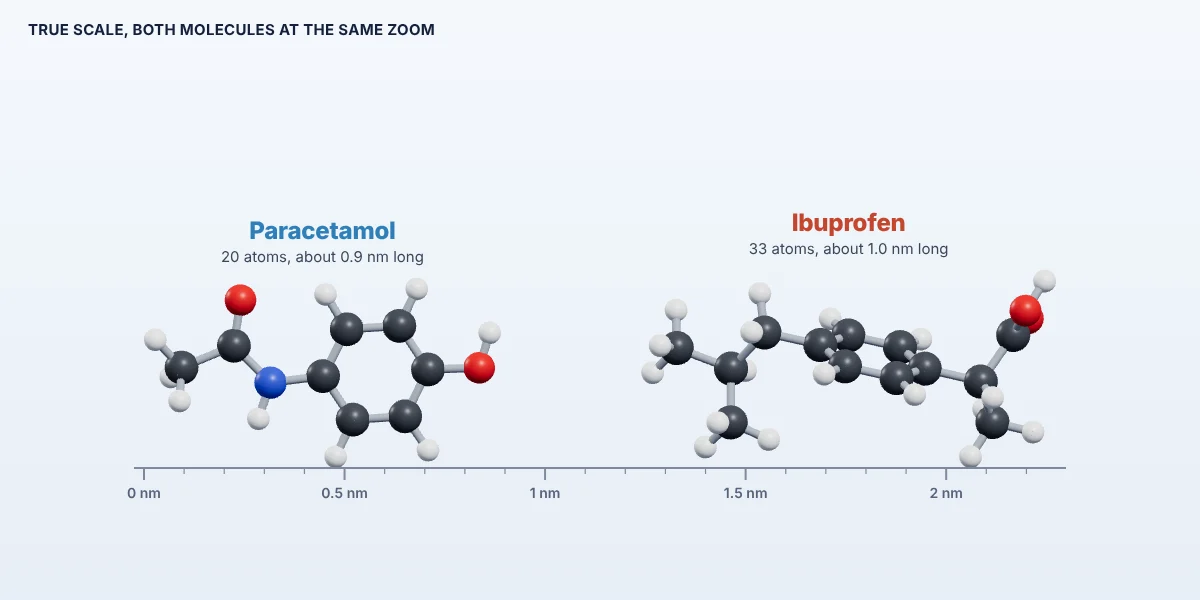
Paracetamol vs ibuprofen at a glance
| Paracetamol | Ibuprofen | |
|---|---|---|
| Formula | C8H9NO2 | C13H18O2 |
| Molar mass | 151.17 g/mol | 206.29 g/mol |
| Atoms in one molecule | 20 | 33 |
| Length of molecule | About 0.9 nm end to end | About 1.0 nm end to end |
| Shape | Flat benzene ring with an OH group and an amide group | Benzene ring with two side chains, one ending in an acid group |
| Contains nitrogen | Yes | No |
| Mirror-image forms | No | Yes, a left- and right-handed form |
| Medicine group | Pain and fever reliever | NSAID, a non-steroidal anti-inflammatory drug |
| Reduces swelling | Very little | Yes |
| First made | 1878 | 1961, in the UK |
How each one works
Ibuprofen blocks enzymes called COX, which make chemical messengers called prostaglandins. Less prostaglandin means less pain, fever and swelling, which is why ibuprofen is called an anti-inflammatory. Paracetamol also lowers pain and fever, but it does very little for swelling. Scientists still do not fully understand how it works, though it seems to act mainly in the brain and spinal cord.
Where they came from
Paracetamol was first made by the American chemist Harmon Northrop Morse in 1878, but it only became a popular medicine in the 1950s. Ibuprofen was discovered in the 1960s by a team at Boots in Nottingham, led by Stewart Adams, and went on sale in the UK in 1969.
Molecule facts
- Paracetamol is called acetaminophen in the United States and Canada.
- Ibuprofen has a chiral carbon, so it comes in two mirror-image forms. Only one form does most of the work, and the body can turn the other into it.
- Ibuprofen belongs to the same family of medicines as aspirin and naproxen.
- Both molecules are built on a benzene ring of six carbon atoms.
- Ibuprofen has a carboxylic acid group (COOH), which makes it a weak acid. Paracetamol has no COOH group.
This page explains the chemistry of two molecules. It is not medical advice. For how to take either medicine, or whether it is right for you, read the patient leaflet or ask a pharmacist or doctor.
Paracetamol vs ibuprofen questions
What is the difference between paracetamol and ibuprofen?
They are different molecules that work in different ways. Ibuprofen is an anti-inflammatory that blocks COX enzymes and reduces swelling. Paracetamol lowers pain and fever but does little for swelling.
What are the chemical formulas of paracetamol and ibuprofen?
Paracetamol is C8H9NO2 and ibuprofen is C13H18O2.
Which molecule is bigger?
Ibuprofen. It has 33 atoms and a molar mass of 206.29 g/mol, against 20 atoms and 151.17 g/mol for paracetamol.
Is ibuprofen an NSAID?
Yes. NSAID stands for non-steroidal anti-inflammatory drug. Paracetamol is not usually counted as an NSAID.
Is acetaminophen the same as paracetamol?
Yes. They are two names for the same molecule. Acetaminophen is used in the US and Canada, and paracetamol in the UK and most other countries.
More face-offs: see all 3D comparisons.
The 3D Molecule Studio is made by Julian Neagu, a solo founder in London, as part of VisionVix Simulators. It is free to use in the browser on desktop and phone, with no sign-up.