Proton vs Neutron vs Electron: The Parts of an Atom
Every atom is built from three kinds of particle. Protons and neutrons pack together in the tiny nucleus at the centre. Electrons move around it, far away by comparison. Protons decide which element an atom is, neutrons add mass, and electrons decide how it reacts.
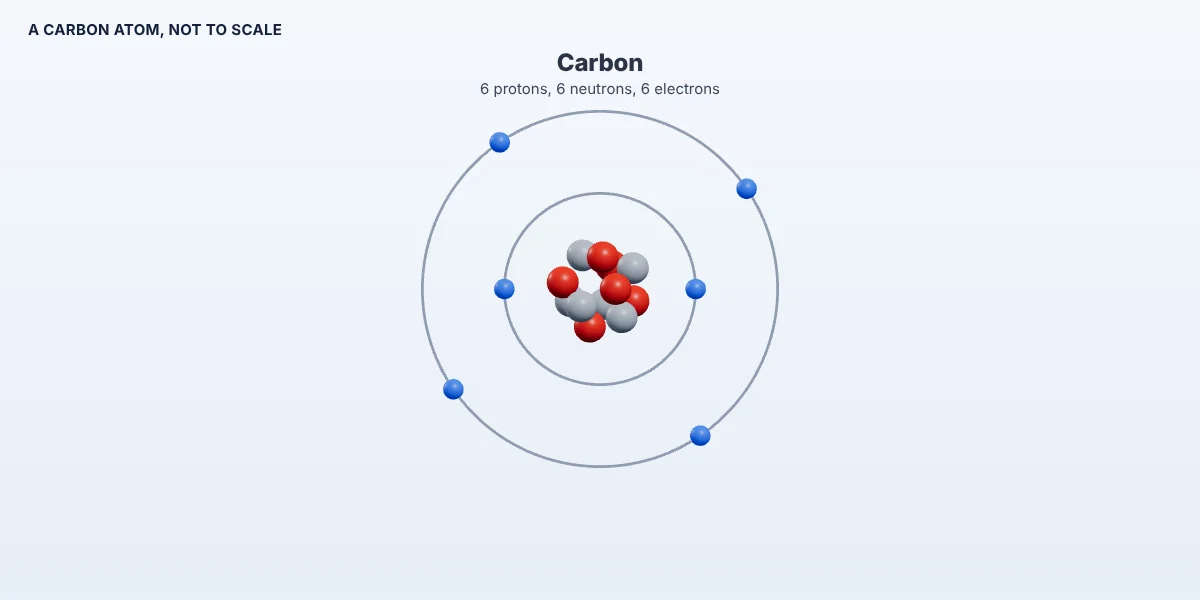
Proton vs neutron vs electron at a glance
| Proton | Neutron | Electron | |
|---|---|---|---|
| Charge | +1 | 0 | −1 |
| Mass | About 1 atomic mass unit | About 1, very slightly more than a proton | About 1/1836 of a proton |
| Where | In the nucleus | In the nucleus | Around the nucleus, in shells |
| What it decides | Which element the atom is | Which isotope it is | How the atom bonds and reacts |
| Made of | Three quarks | Three quarks | Nothing smaller, as far as we know |
| Discovered | About 1917 to 1919, by Ernest Rutherford | 1932, by James Chadwick | 1897, by J. J. Thomson |
Protons give each element its identity
The number of protons is the atomic number. Every atom with 6 protons is carbon; every atom with 8 is oxygen. In a neutral atom, the number of electrons equals the number of protons, so the charges cancel out. Add or remove electrons and you get an ion.
Neutrons and isotopes
Atoms of the same element can have different numbers of neutrons. These versions are called isotopes. Most carbon has 6 neutrons, carbon-12, but a small amount has 8, carbon-14, which is radioactive and is used to date old bones and wood.
Quick facts
- Hydrogen is the only common atom with no neutron: just one proton and one electron.
- Almost all the mass of an atom is in the nucleus.
- If an atom were a football stadium, the nucleus would be about the size of a pea in the middle.
- Electricity in wires is a flow of electrons.
- A free neutron, outside a nucleus, breaks down in about 15 minutes on average.
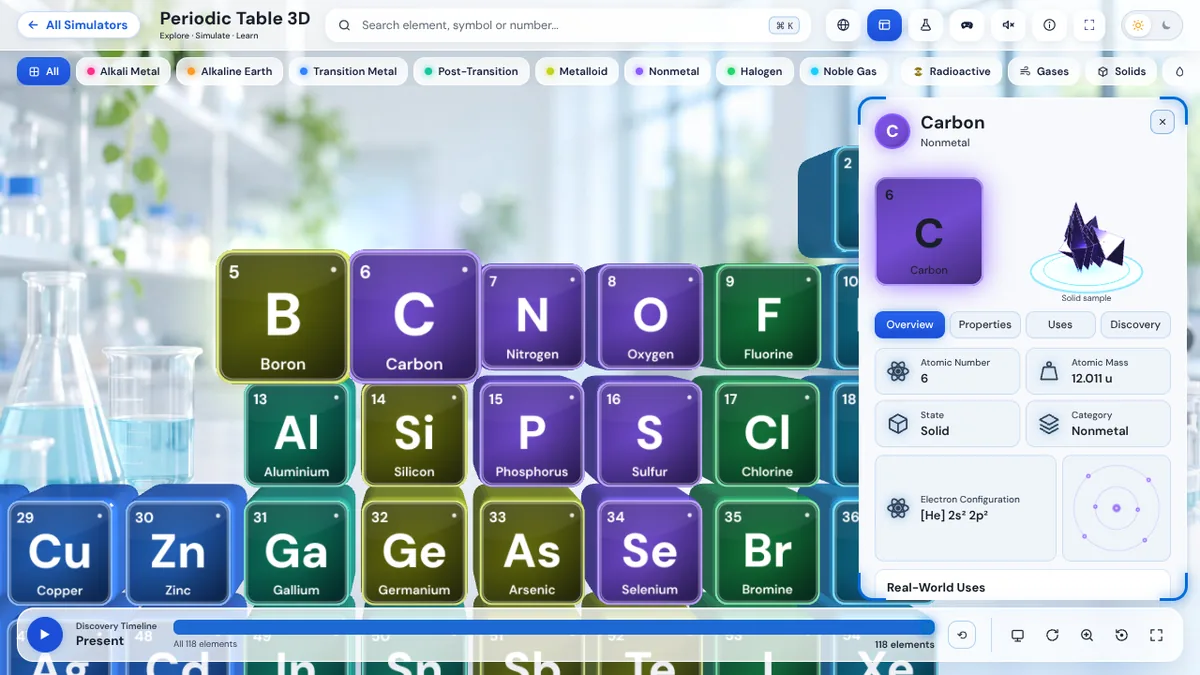
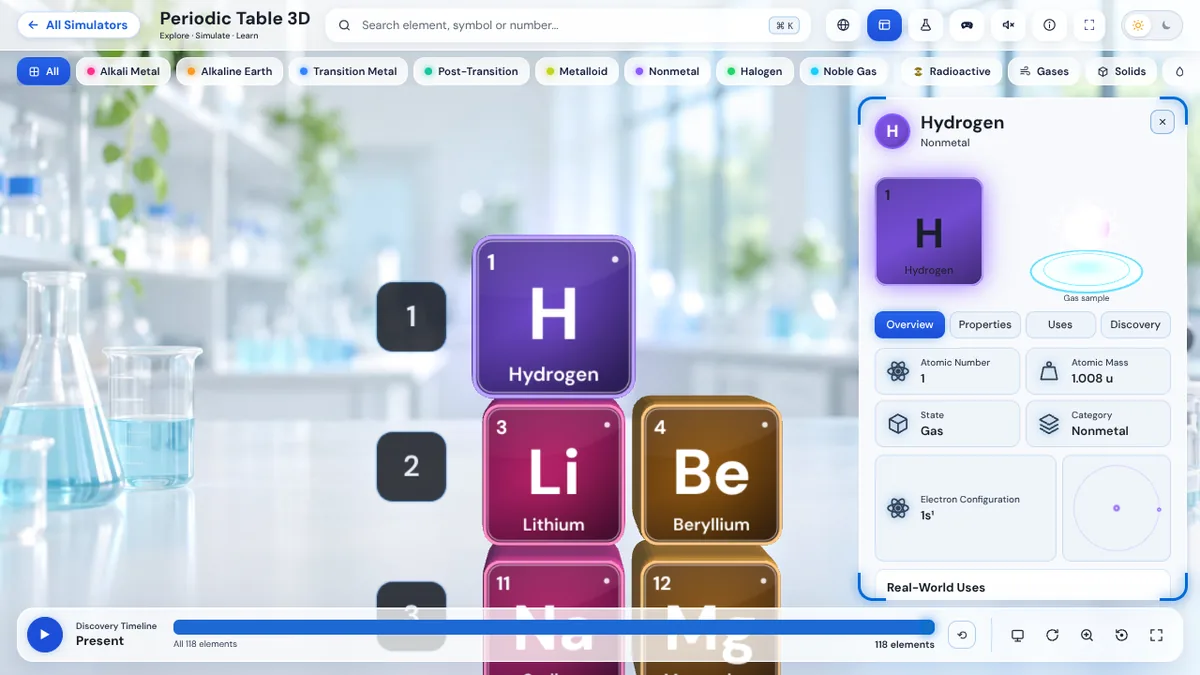
Explore atoms in 3D
Proton vs neutron vs electron questions
What is the difference between a proton, neutron and electron?
A proton has a positive charge and sits in the nucleus. A neutron has no charge and also sits in the nucleus. An electron has a negative charge, is far lighter, and moves around the nucleus.
Which is the heaviest?
The neutron, just slightly heavier than the proton. An electron is about 1,836 times lighter than a proton.
What decides which element an atom is?
The number of protons, called the atomic number.
What are isotopes?
Atoms of the same element with different numbers of neutrons.
Which particle is involved in chemical reactions?
Electrons. Bonds form when atoms share or transfer electrons.
More face-offs: see all 3D comparisons.
The 3D Periodic Table is made by Julian Neagu, a solo founder in London, as part of VisionVix Simulators. It is free to use in the browser on desktop and phone, with no sign-up.