Nervous System in 3D: Brain, Spinal Cord and Nerves
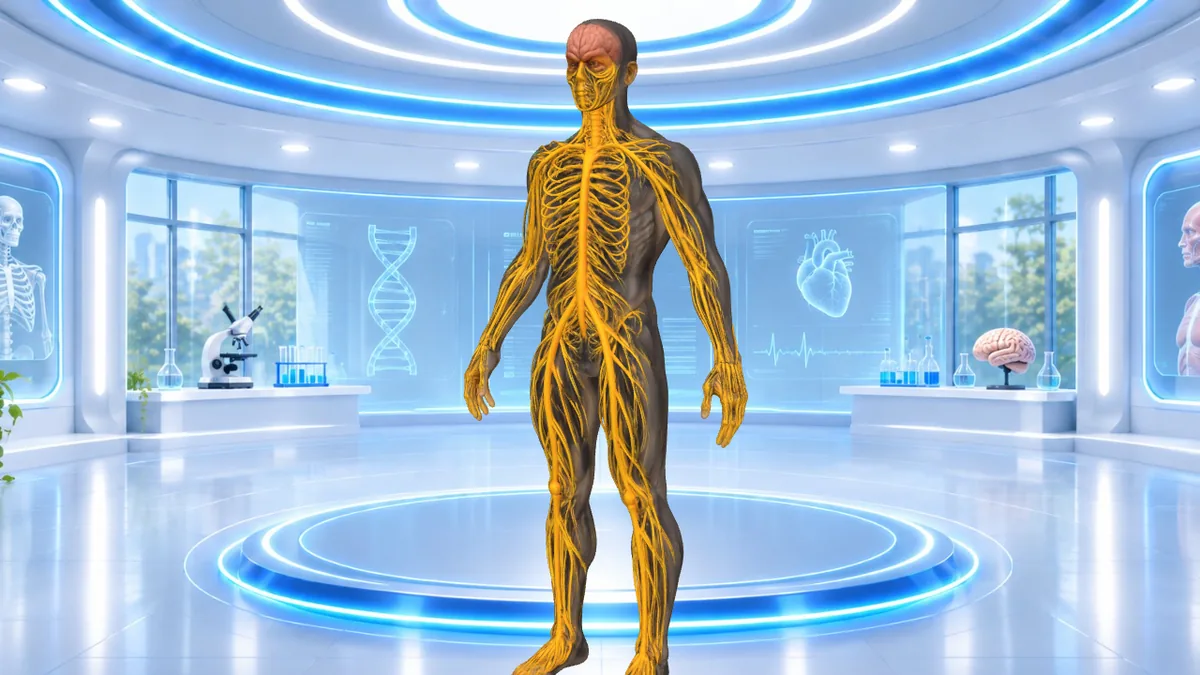
The nervous system is the body's messaging network. The brain and spinal cord send and receive signals along nerves that reach every muscle, organ and patch of skin. In the 3D Anatomy simulator you can show the nervous system on its own and follow the nerves from head to toe.
 Explore in 3D
Nervous System quick facts
| Main parts | Central nervous system (brain and spinal cord) and peripheral nervous system (nerves) |
|---|---|
| Spinal cord length | About 45 cm in adults |
| Spinal nerves | 31 pairs |
| Cranial nerves | 12 pairs |
| Fastest signals | Up to about 120 metres a second |
Interesting facts about the nervous system
- The spinal cord runs down the back inside the bones of the spine, which protect it.
- Sensory nerves carry touch, pain and temperature to the brain.
- Motor nerves carry instructions from the brain to the muscles.
- Reflexes, like pulling your hand from something hot, are handled by the spinal cord before the brain even knows.
- The longest nerve, the sciatic nerve, runs from the lower back down each leg.
What you can do in 3D
Switch to the Nervous System view to see the nerves glowing through the body, then zoom in on the head, spine and arms to follow where they go.
More body systems in 3D
Tap any part to open its page.
Nervous System questions
What are the two parts of the nervous system?
The central nervous system, which is the brain and spinal cord, and the peripheral nervous system, which is all the nerves that branch out to the body.
How fast do nerve signals travel?
The fastest nerve signals travel at up to about 120 metres a second.
What does the spinal cord do?
It carries messages between the brain and the body, and handles quick reflexes on its own.
What is the longest nerve in the body?
The sciatic nerve, which runs from the lower back down the back of each leg.
How many nerves come from the spinal cord?
31 pairs of spinal nerves branch out from the spinal cord.
The 3D Anatomy simulator is made by Julian Neagu, a solo founder in London, as part of VisionVix Simulators. It is free to use in the browser on desktop and phone, with no sign-up. This page is for learning and is not medical advice.