How DNA Copies Itself: DNA Replication in 3D
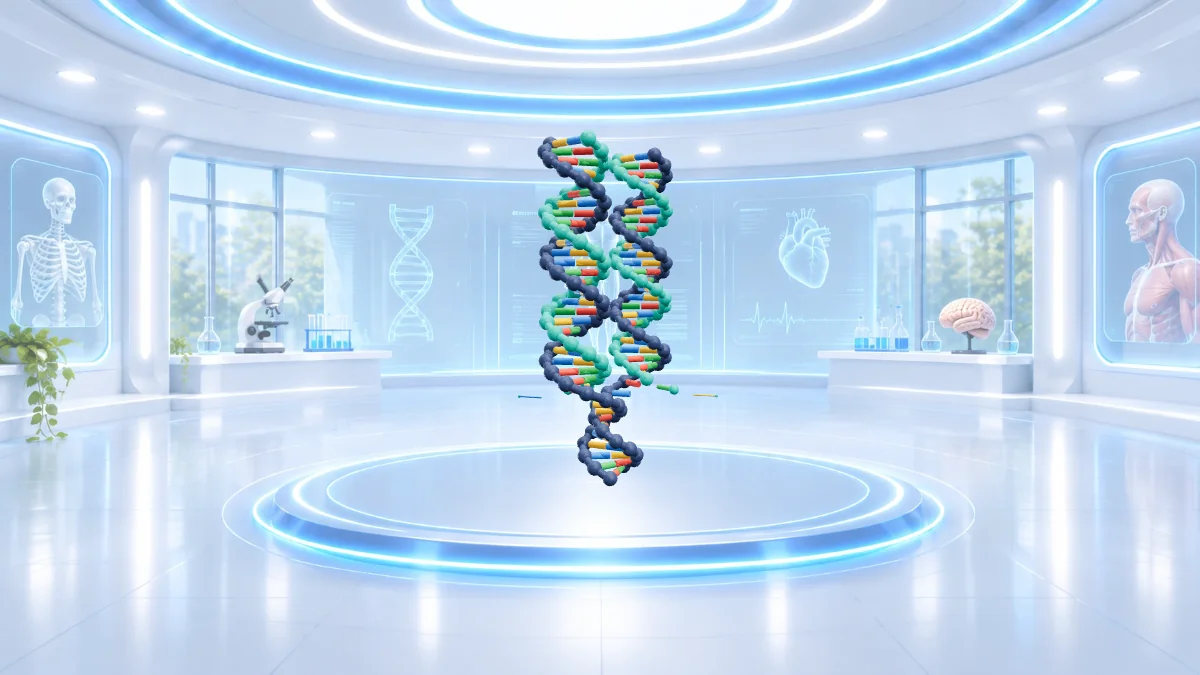
Every time a cell divides, it first copies all of its DNA, so that each new cell gets a full set of instructions. The double helix unzips down the middle, and each old strand becomes the pattern for a new one. In the 3D DNA simulator you can twist the ladder, unzip it and watch the copy being built.
 Explore in 3D
How it works, step by step
- Unzip. An enzyme called helicase breaks the weak bonds between the base pairs, so the two strands come apart like a zip.
- Match. DNA polymerase reads each old strand and adds the matching base every time: A with T, and C with G.
- Two copies. Each new double helix has one old strand and one new strand, so both copies carry exactly the same code.
- Check. The enzyme proofreads as it goes and fixes almost every mistake, so very few errors slip through.
DNA quick facts
| Shape | Double helix, like a twisted ladder |
|---|---|
| Pairing rule | A with T, C with G |
| Copy type | Semi-conservative: each copy keeps one old strand |
| Main enzymes | Helicase unzips, DNA polymerase builds |
| Mistakes after checking | About 1 in a billion bases |
Interesting facts
- Copying starts at thousands of places along each chromosome at once. Otherwise it would take far too long.
- One strand is built smoothly, but the other is built backwards in short pieces that are joined up afterwards.
- The idea that each copy keeps one old strand was proved by Matthew Meselson and Franklin Stahl in 1958.
- A human cell has about 6 billion base pairs to copy before it divides.
- Because the bases always pair the same way, one strand is enough to rebuild the other.
What you can do in 3D
Start with a flat ladder and slide it into the real twisted double helix. Then press Copy the DNA and watch the helix unzip while each strand builds a new partner. Labels point out the backbone and the base pairs, and the colour key shows which bases pair up.
Keep exploring
DNA questions
What is DNA replication?
It is how a cell copies its DNA before it divides. The double helix unzips and each strand is used as a pattern to build a new matching strand.
When does DNA copy itself?
Before a cell divides, so that each of the two new cells gets a complete copy of the DNA.
Why does A pair with T and C with G?
Their shapes fit together and form the right number of weak bonds. A and T form two bonds, and C and G form three.
What does semi-conservative mean?
Each new double helix keeps one strand from the original and has one newly built strand.
How accurate is DNA copying?
Very accurate. After proofreading and repair, only about one mistake slips through for every billion bases copied.
The VisionVix World 3D Cell Lab is made by Julian Neagu, a solo founder in London, as part of VisionVix Simulators. It is free to use in the browser on desktop and phone, with no sign-up. This page and the simulator are simplified for learning, not medical advice.