Carbon Dioxide Molecule in 3D: CO₂ Structure and Facts
Carbon dioxide is one carbon atom with an oxygen atom double bonded on each side. It is the gas we breathe out, the gas plants use to make food, and an important greenhouse gas. In Molecule Studio you can spin the carbon dioxide molecule, zoom in on each atom and measure its bonds.
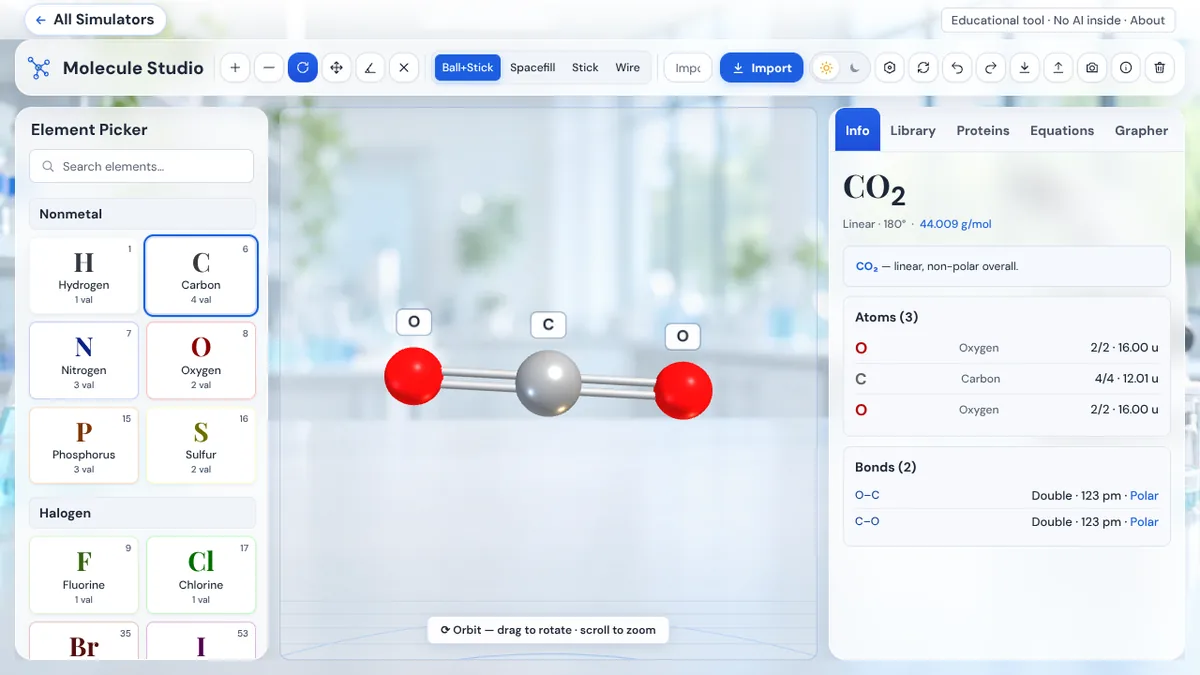 Explore in 3D
Carbon Dioxide quick facts
| Chemical formula | CO₂ |
|---|---|
| Molar mass | 44.01 g/mol |
| Atoms in one molecule | 3 |
| Shape | Linear, with an angle of 180 degrees |
| Group | Essentials |
What is carbon dioxide used for?
- Plants use it in photosynthesis
- Fizzy drinks and fire extinguishers
- Dry ice for cooling
Interesting facts about carbon dioxide
- Its straight shape means the two bonds cancel out, so the molecule is non-polar.
- Solid carbon dioxide, dry ice, turns straight into a gas without melting.
- It traps heat in the atmosphere, which makes it a greenhouse gas.
- Every breath you breathe out carries carbon dioxide made in your cells.
What you can do in 3D
Turn the molecule to see it from every side, switch between ball and stick, space filling and wire views, and tap atoms to measure bond lengths and angles.
More essentials molecules
Carbon Dioxide questions
What is the formula of carbon dioxide?
CO2: one carbon atom double bonded to two oxygen atoms.
What shape is a carbon dioxide molecule?
Linear. The two oxygen atoms sit on opposite sides of the carbon at 180 degrees.
Is carbon dioxide polar?
The bonds are polar, but they point in opposite directions and cancel out, so the molecule as a whole is non-polar.
What is dry ice?
Frozen carbon dioxide. At normal pressure it turns straight from a solid into a gas.
Molecule Studio is made by Julian Neagu, a solo founder in London, as part of VisionVix Simulators. It is free to use in the browser on desktop and phone, with no sign-up. In the tool, molecules load from the built-in library or from PubChem.