Water Molecule in 3D: H₂O Structure and Facts
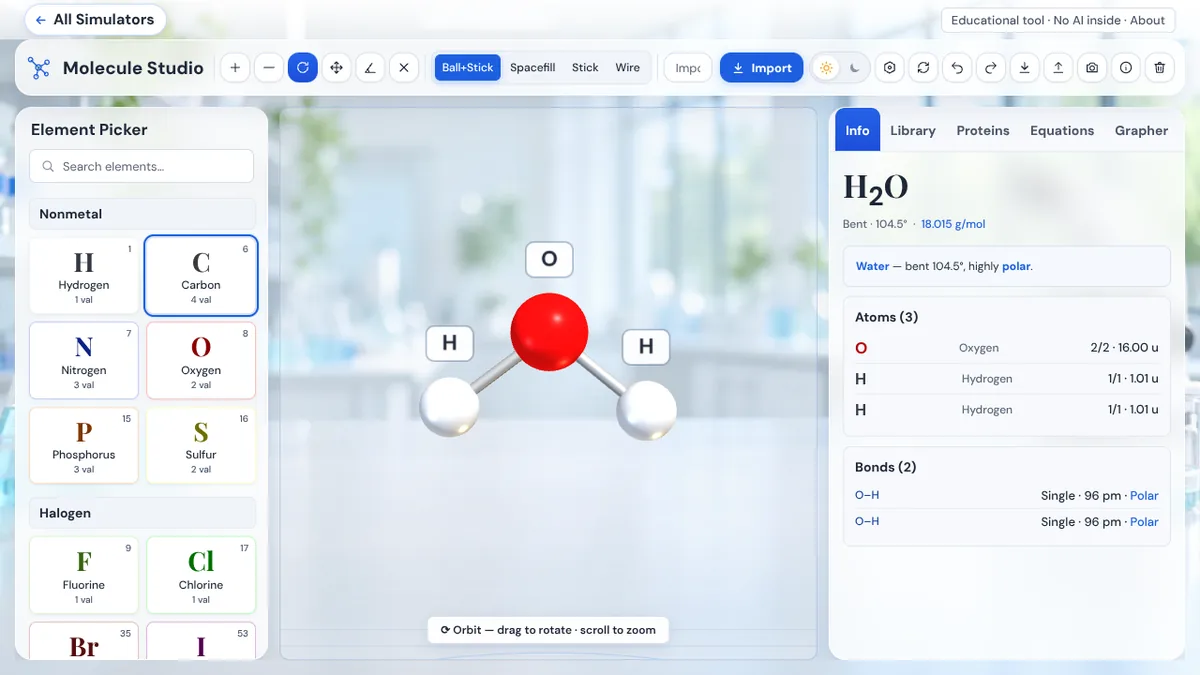
Water is two hydrogen atoms joined to one oxygen atom, and it covers most of our planet. Its bent shape makes one end slightly negative and the other slightly positive, which explains many of its unusual properties. In Molecule Studio you can spin the water molecule, zoom in on each atom and measure its bonds.
 Explore in 3D
Water quick facts
| Chemical formula | H₂O |
|---|---|
| Molar mass | 18.02 g/mol |
| Atoms in one molecule | 3 |
| Shape | Bent, with an angle of about 104.5 degrees |
| Group | Essentials |
What is water used for?
- Drinking and all living things
- Dissolving salts, sugars and many other substances
- Cooling, cleaning and farming
Interesting facts about water
- Ice floats because water expands as it freezes.
- Its bent shape makes water a polar molecule.
- Hydrogen bonds between water molecules give it a high boiling point for its size.
- Pure water has a pH of 7, neutral.
What you can do in 3D
Turn the molecule to see it from every side, switch between ball and stick, space filling and wire views, and tap atoms to measure bond lengths and angles.
More essentials molecules
Water questions
What is the chemical formula of water?
H2O: two hydrogen atoms bonded to one oxygen atom.
Why is water a bent molecule?
Oxygen has two lone pairs of electrons that push the two hydrogen atoms closer together, giving a bond angle of about 104.5 degrees.
Why does ice float?
Water molecules lock into an open, hexagonal pattern when they freeze, so ice is less dense than liquid water.
Is water polar?
Yes. Oxygen pulls electrons more strongly than hydrogen, so the oxygen end is slightly negative and the hydrogen ends are slightly positive.
Molecule Studio is made by Julian Neagu, a solo founder in London, as part of VisionVix Simulators. It is free to use in the browser on desktop and phone, with no sign-up. In the tool, molecules load from the built-in library or from PubChem.