Penicillin G Molecule in 3D: C₁₆H₁₈N₂O₄S Structure and Facts
Penicillin G is one of the original penicillin antibiotics. Its key part is a strained four-membered ring that attacks the walls of bacteria. In Molecule Studio you can spin the penicillin g molecule, zoom in on each atom and measure its bonds.
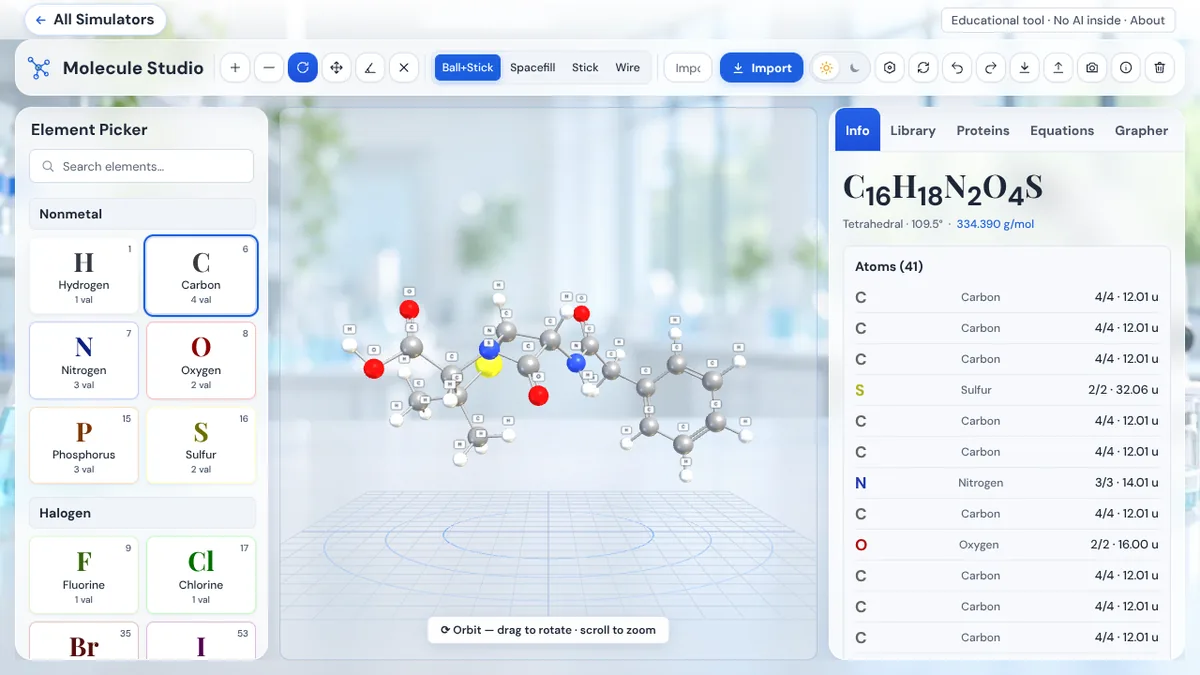 Explore in 3D
Penicillin G quick facts
| Chemical formula | C₁₆H₁₈N₂O₄S |
|---|---|
| Molar mass | 334.4 g/mol |
| Atoms in one molecule | 41 |
| Shape | Fused four- and five-membered rings |
| Group | Medicines |
What is penicillin g used for?
- Treating bacterial infections
- The starting point for many antibiotics
- Medicine for strep throat and syphilis
Interesting facts about penicillin g
- Alexander Fleming discovered penicillin in 1928.
- It stops bacteria building their cell walls.
- Its four-membered beta-lactam ring is the active part.
- Mass production in the 1940s saved huge numbers of lives.
What you can do in 3D
Turn the molecule to see it from every side, switch between ball and stick, space filling and wire views, and tap atoms to measure bond lengths and angles.
More medicines molecules
Penicillin G questions
What is the formula of penicillin G?
C16H18N2O4S.
Who discovered penicillin?
Alexander Fleming, in 1928, after noticing mould killing bacteria.
How does penicillin work?
It blocks the enzymes bacteria use to build their cell walls, so they burst.
What is the beta-lactam ring?
A strained four-membered ring at the heart of penicillin that reacts with bacterial enzymes.
Molecule Studio is made by Julian Neagu, a solo founder in London, as part of VisionVix Simulators. It is free to use in the browser on desktop and phone, with no sign-up. In the tool, molecules load from the built-in library or from PubChem.