Dog vs Cat: Skeletons, Senses and Bodies Compared in 3D
Both are meat-eating mammals that walk on their toes, and both have shared our homes for thousands of years. But a dog is built to track and run for a long time, while a cat is built to sneak up and pounce. Here they are side by side, inside and out.


Dog vs cat: true size
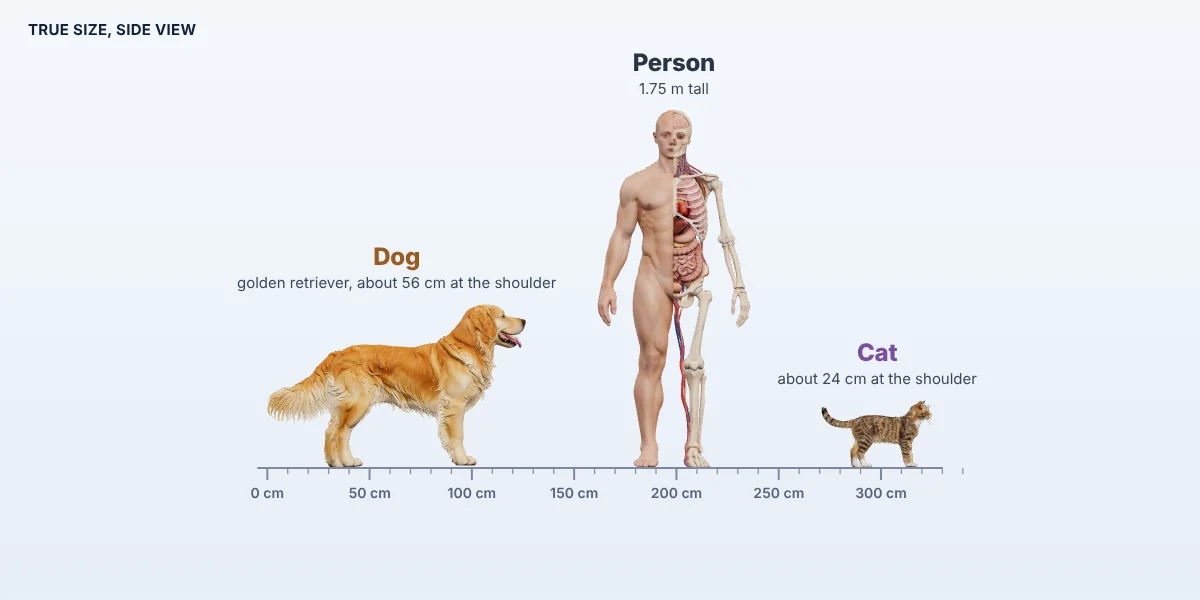
Dog vs cat at a glance
| Dog | Cat | |
|---|---|---|
| Size | A golden retriever is about 51 to 61 cm at the shoulder and 25 to 34 kg | About 23 to 25 cm at the shoulder and 4 to 5 kg |
| Hunting style | Chases and tracks prey over long distances | Creeps up, then pounces in a short burst |
| Adult teeth | 42 | 30 |
| Claws | Always out, blunt, used for grip when running | Pulled back in when walking, sharp, used for catching and climbing |
| Best sense | Smell, far stronger than ours | Hearing and seeing in dim light |
| Hearing | Up to about 45,000 Hz | Up to about 64,000 Hz, one of the widest ranges of any mammal |
| Collarbone | Tiny or missing | Small and floating, so the shoulders squeeze through gaps |
| Spine | Strong and steady for running | Very bendy, lets a cat twist and land on its feet |
| Diet | Meat-eater that can also digest some plant food | Must eat meat to stay healthy |
| Living with people | At least 15,000 years | About 10,000 years |
Built for different hunts
A dog is a chaser. Its long legs, deep chest and big lungs let it keep running, and its nose can follow a trail that is hours old. A cat is an ambusher. It saves its energy, creeps close without a sound, then explodes into a short, fast pounce. Almost every difference in their bodies comes back to those two ways of hunting.
Which has the better senses?
It depends on the sense. A dog wins on smell by a long way, which is why dogs are used to find people, drugs and even some illnesses. A cat wins on hearing high sounds, like the squeak of a mouse, and on seeing in near darkness. Both have a shiny layer at the back of the eye that makes their eyes glow in torchlight.
Inside the body
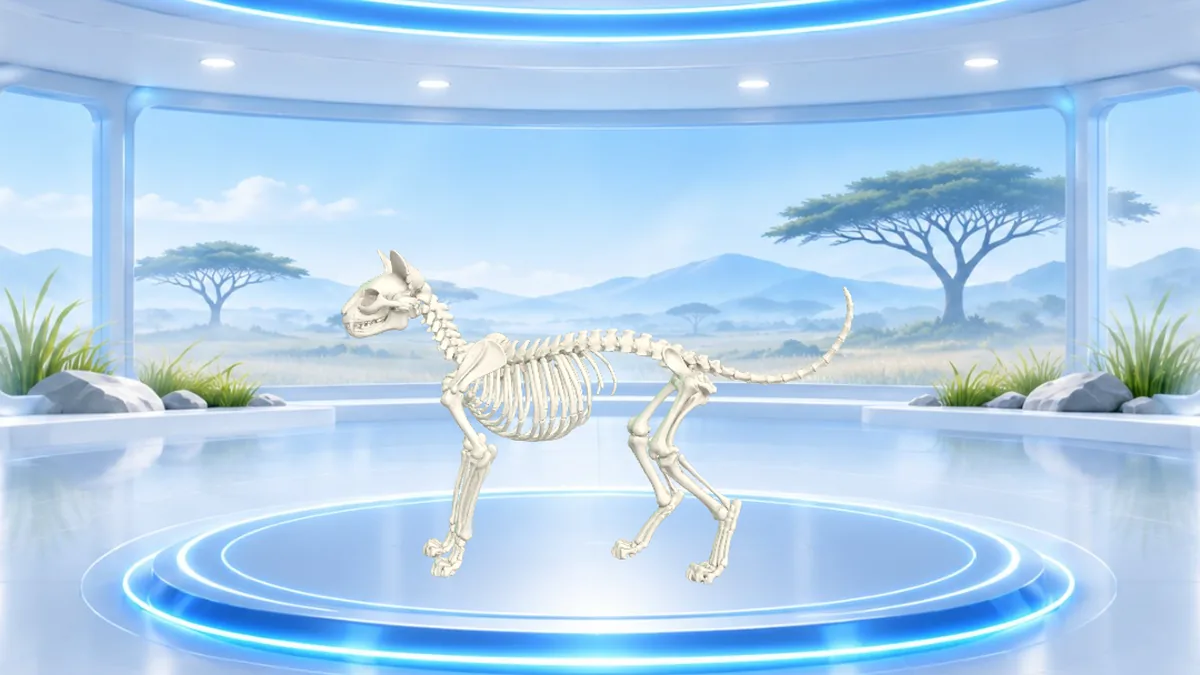
- A cat’s claws sit in sheaths and stay sharp because they are pulled back when it walks. A dog’s claws touch the ground all the time.
- Cats have a tiny floating collarbone, so if the head fits through a gap, the body usually can too.
- A dog has 42 adult teeth, including flat molars for crushing. A cat has 30, almost all of them sharp for slicing meat.
- Cats have a bendier spine than dogs, which helps them turn in mid-air and land on their feet.
- Both walk on their toes, not on the flat of the foot like we do.
Look inside both
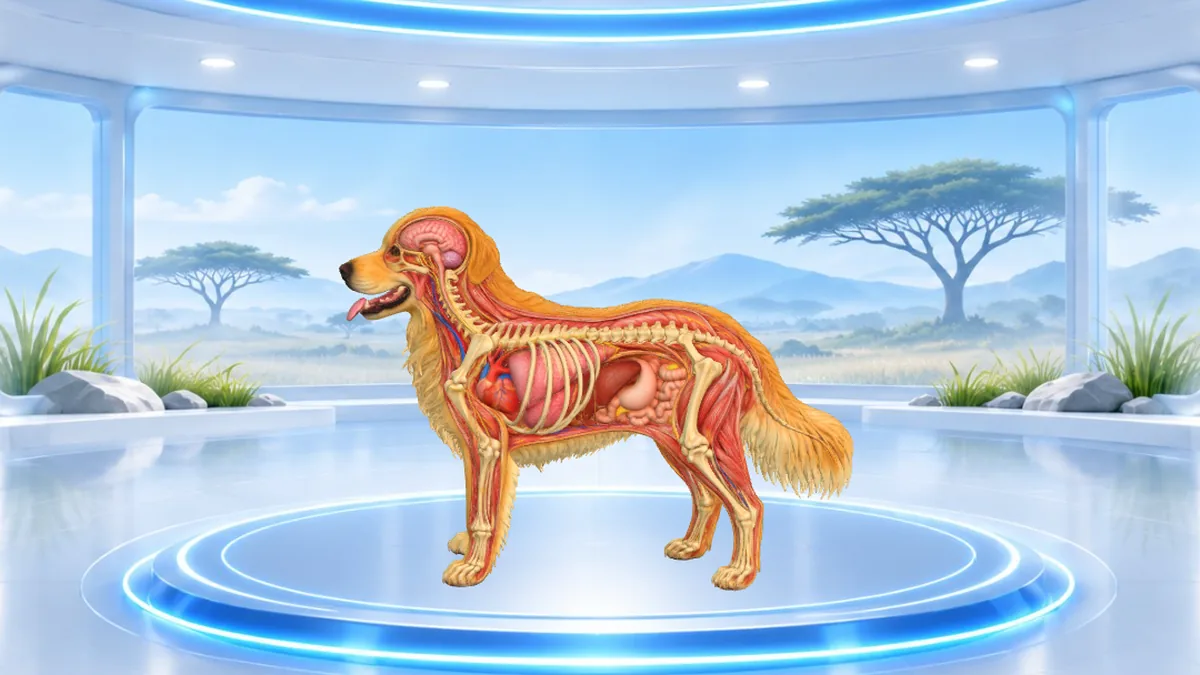
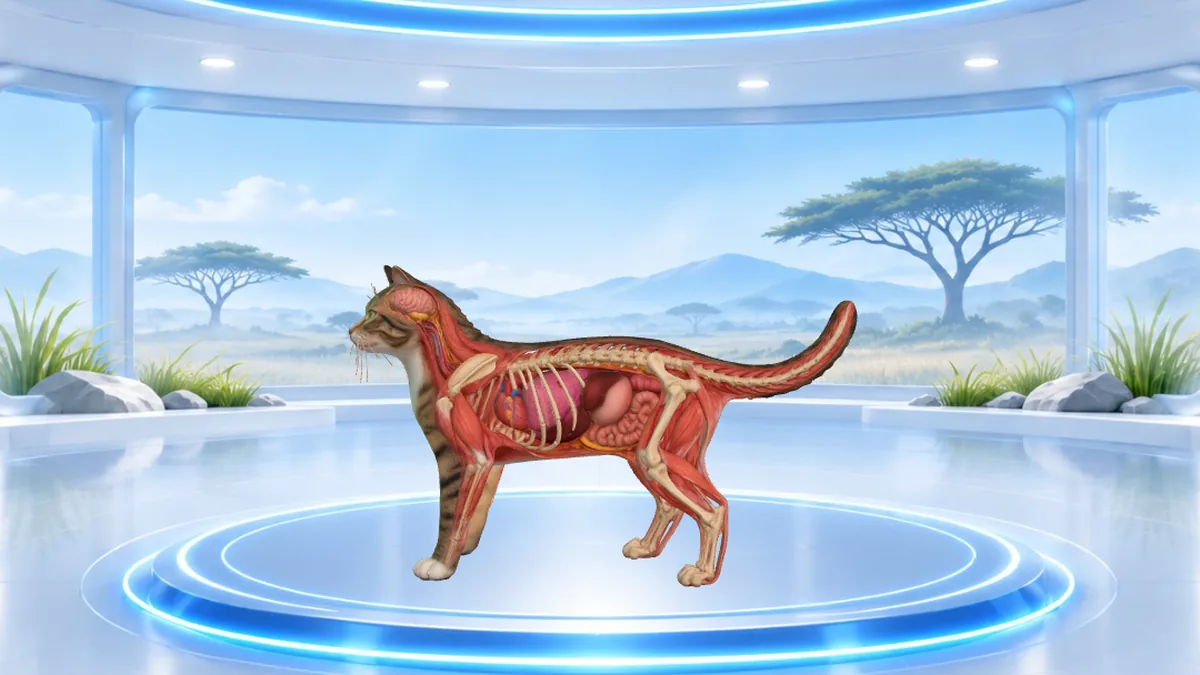
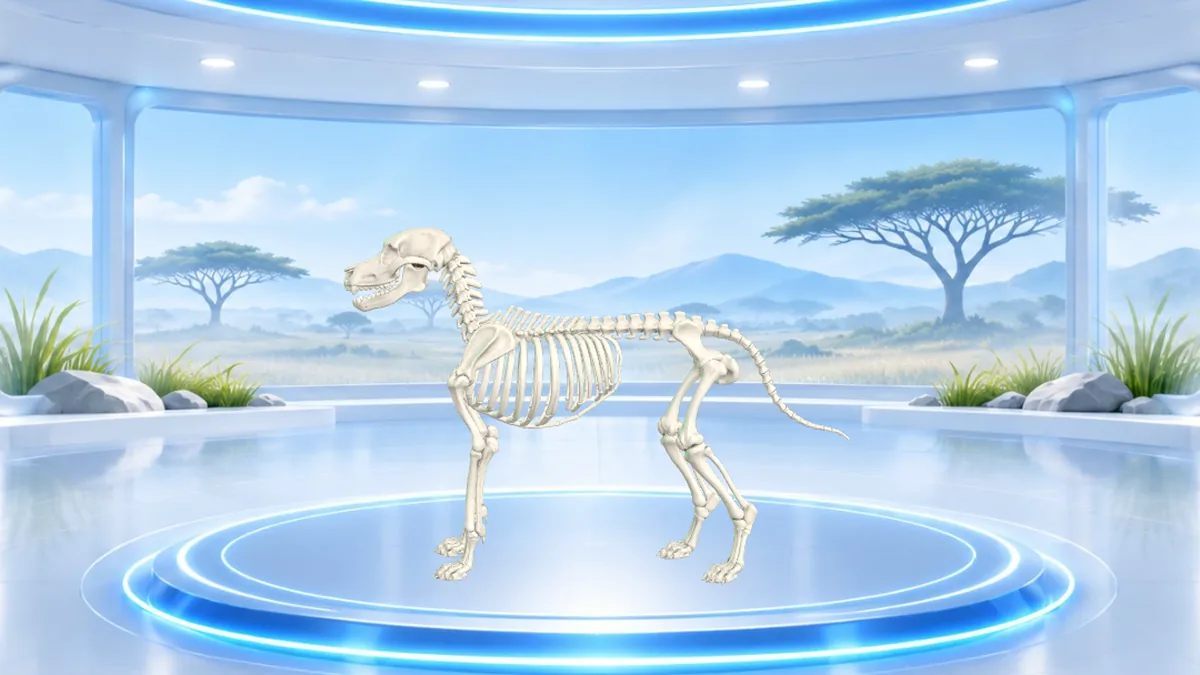
Dog vs cat questions
Is a dog or a cat smarter?
They are smart in different ways, so there is no simple winner. Dogs have more nerve cells in the outer layer of the brain and are very good at reading people. Cats are skilled solo hunters and problem solvers. Each is clever at the things its body was built to do.
Do cats and dogs have the same number of bones?
No. A dog has around 320 bones and a cat around 230 to 250. The numbers vary with the length of the tail and from animal to animal.
Why do cats land on their feet?
A cat has a very bendy spine and a floating collarbone. When it falls, it turns its head first, then twists the front and back of its body in turn so its feet point down before it lands.
Who can hear better, a dog or a cat?
Both hear far more than we do. Cats hear higher sounds, up to about 64,000 Hz, against about 45,000 Hz for dogs, which helps them hear the squeaks of mice.
Who has the better sense of smell?
Dogs. A dog’s nose has hundreds of millions of smell sensors, many times more than a human nose, and a big part of its brain works on smells.
More face-offs: see all 3D comparisons.
The 3D Animal Anatomy simulator is made by Julian Neagu, a solo founder in London, as part of VisionVix Simulators. It is free to use in the browser on desktop and phone, with no sign-up.