Ionic vs Covalent Bonds: Salt vs Water in 3D
Atoms bond in two main ways. In an ionic bond, one atom hands electrons to another, and the charged ions that form pull on each other, like in table salt. In a covalent bond, atoms share pairs of electrons, like the hydrogen and oxygen atoms in water.
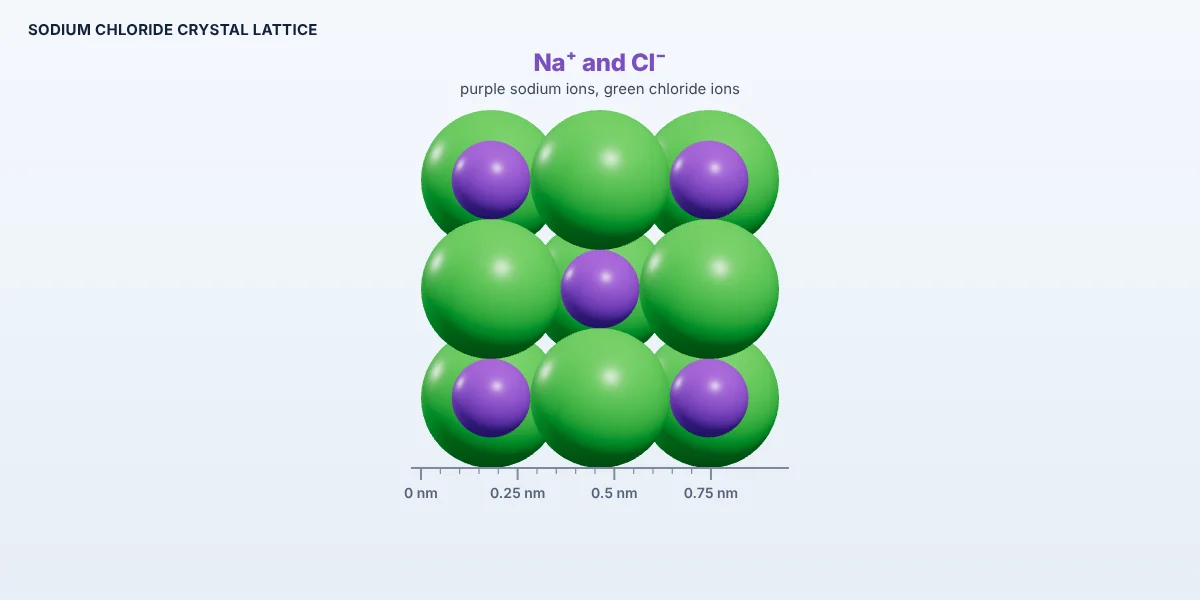
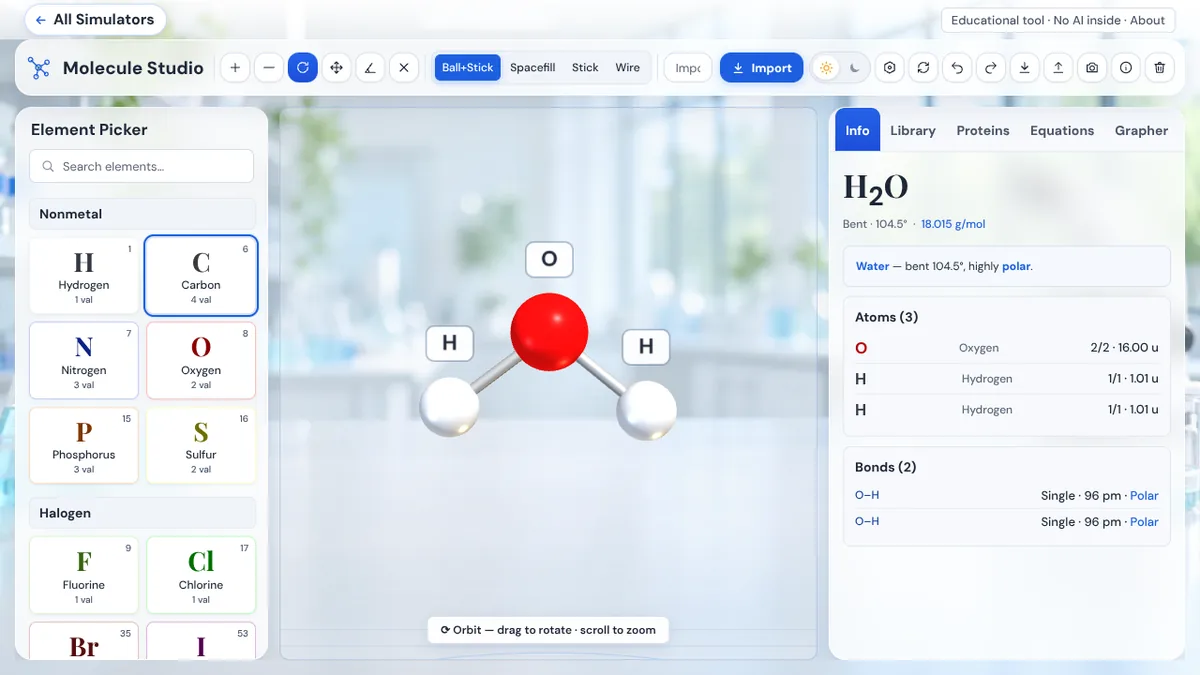
Ionic vs covalent bond: true size
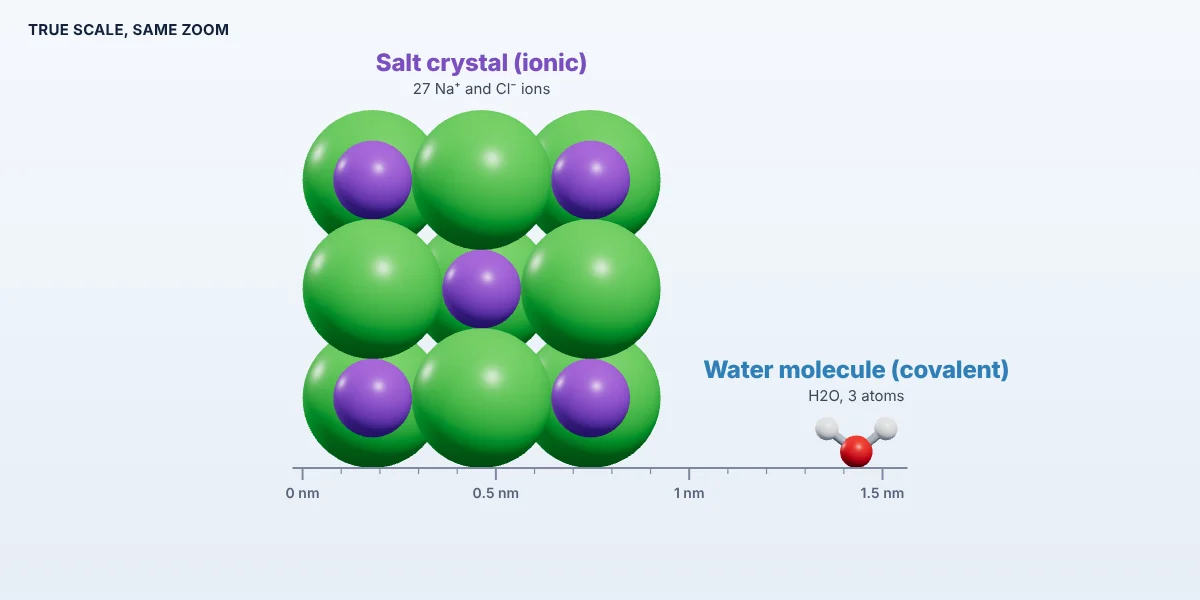
Ionic vs covalent bond at a glance
| Ionic | Covalent | |
|---|---|---|
| Electrons | Transferred from one atom to another | Shared in pairs between atoms |
| Usually between | A metal and a nonmetal | Nonmetals |
| Held together by | Attraction between positive and negative ions | Shared electron pairs |
| Structure | A giant repeating lattice | Usually separate molecules |
| Melting point | High: salt melts at 801 °C | Usually low: ice melts at 0 °C |
| Conducts electricity | When melted or dissolved in water | Usually not |
| Example | Sodium chloride, NaCl | Water, H2O; methane, CH4 |
How an ionic bond forms
Sodium has one electron in its outer shell and chlorine is one short of a full shell. When they react, sodium hands its electron to chlorine. Sodium becomes a positive ion, Na+, and chlorine becomes a negative ion, Cl−. Opposite charges attract, and billions of ions stack into a cube-shaped crystal.
How a covalent bond forms
Oxygen needs two more electrons and each hydrogen needs one. Instead of handing electrons over, they share: oxygen shares one pair with each hydrogen. Oxygen pulls the shared electrons a little closer, so water is slightly negative at one end and positive at the other. That is called a polar covalent bond.
Quick facts
- Salt crystals are cubes because the ions stack in a cube-shaped pattern.
- Diamond is covalent but has a very high melting point, because every carbon is bonded into one giant network.
- Salt water conducts electricity because the ions are free to move.
- Many bonds are somewhere between pure ionic and pure covalent.
- A single shared pair is a single bond; oxygen gas, O2, has a double bond.
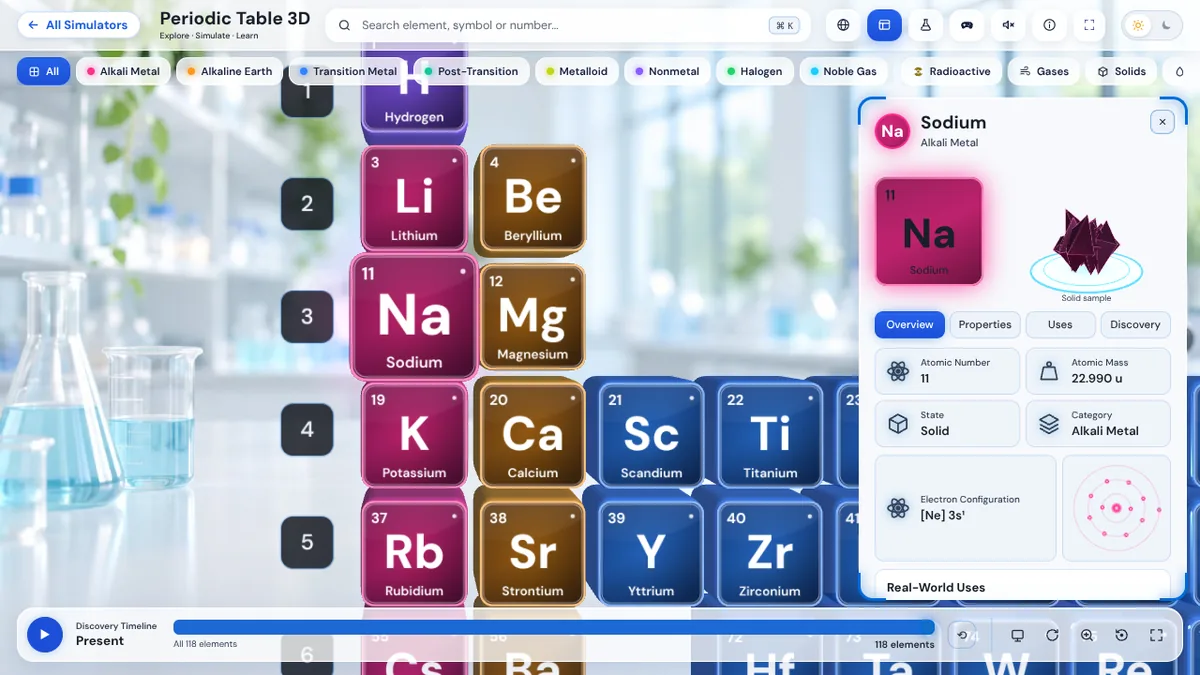
Spin the atoms in 3D
Ionic vs covalent bond questions
What is the difference between ionic and covalent bonds?
In an ionic bond, electrons are transferred and the ions attract each other. In a covalent bond, electrons are shared between atoms.
Is NaCl ionic or covalent?
Ionic. Sodium gives an electron to chlorine, forming Na+ and Cl− ions.
Is water ionic or covalent?
Covalent. The oxygen atom shares a pair of electrons with each hydrogen atom.
Which has a higher melting point, ionic or covalent compounds?
Ionic compounds usually do, because the attraction between ions runs through the whole crystal. Giant covalent structures like diamond are an exception.
Do ionic compounds conduct electricity?
Not as solids, but they do when melted or dissolved in water, because the ions can then move.
More face-offs: see all 3D comparisons.
The 3D Molecule Studio is made by Julian Neagu, a solo founder in London, as part of VisionVix Simulators. It is free to use in the browser on desktop and phone, with no sign-up.