Metals vs Nonmetals: Properties and the Periodic Table in 3D
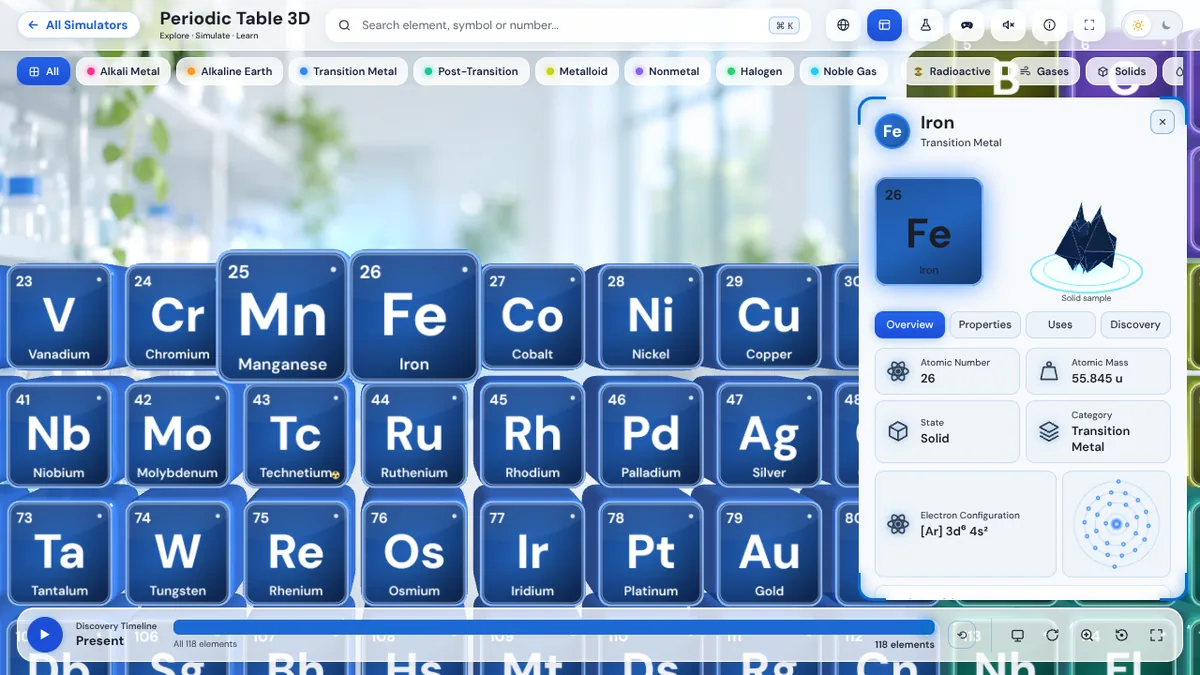
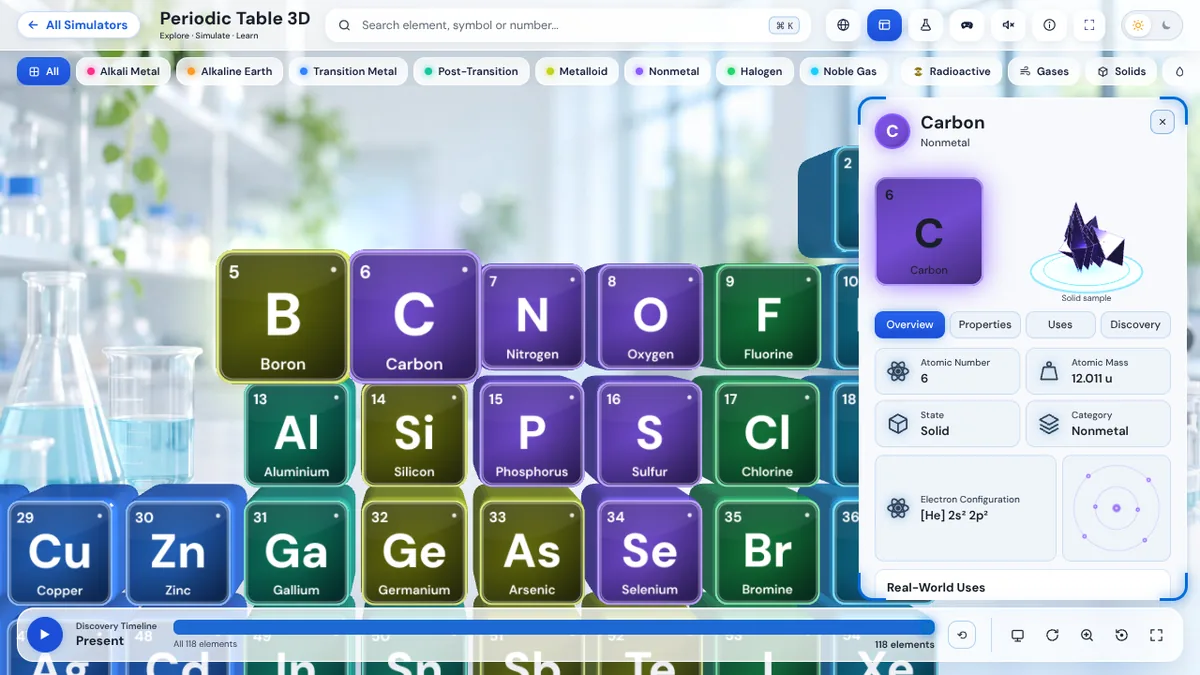
Most elements are metals: shiny, good at carrying heat and electricity, and easy to bend or stretch. Nonmetals are the opposite: usually dull, poor conductors and brittle when solid, and many are gases. On the periodic table, metals fill the left and middle, nonmetals the top right.
Metals vs nonmetals at a glance
| Metals | Nonmetals | |
|---|---|---|
| Shine | Shiny when freshly cut or polished | Usually dull |
| Heat and electricity | Good conductors | Poor conductors, except graphite |
| When hit or bent | Bend, flatten and stretch into wire | Brittle solids that shatter |
| State at room temperature | Solid, except mercury | Solids, gases and one liquid, bromine |
| In reactions | Lose electrons to form positive ions | Gain or share electrons |
| Oxides | Usually basic | Usually acidic |
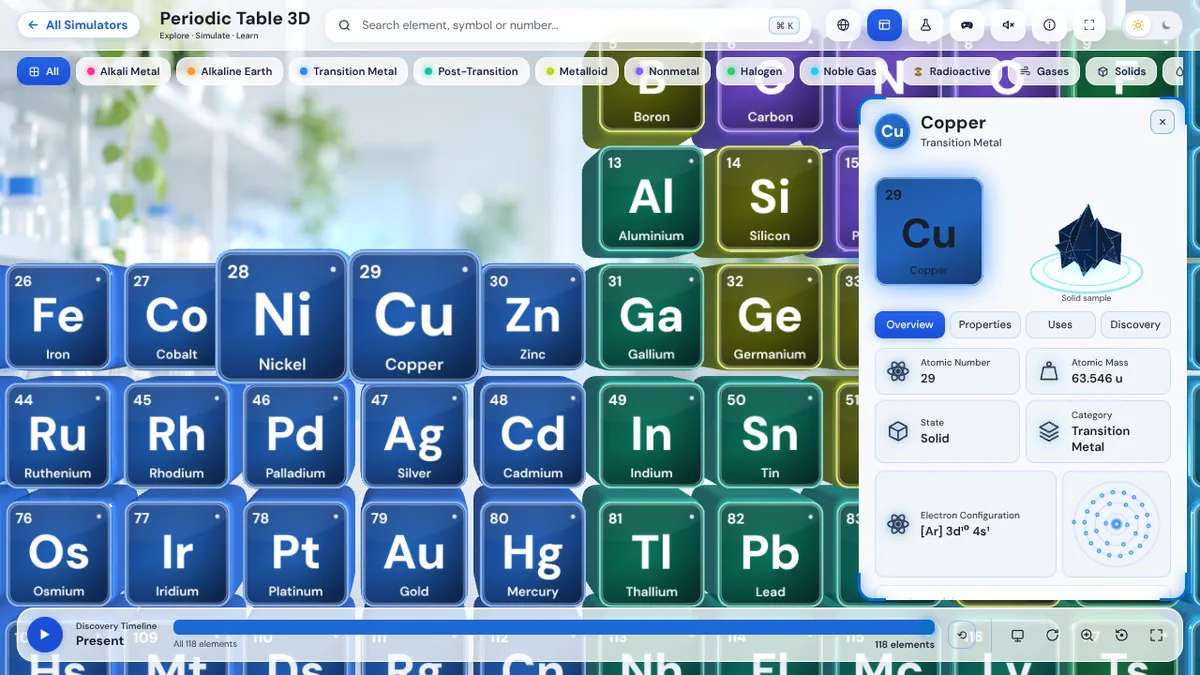
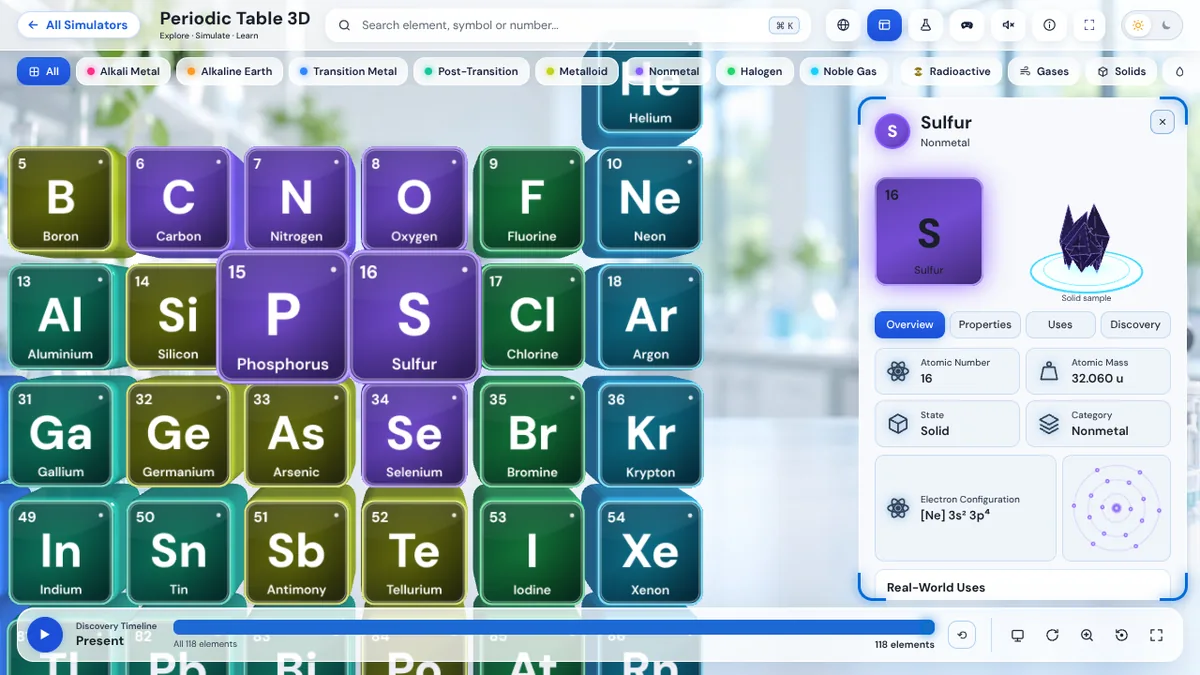
| Where on the table | Left and middle | Top right, plus hydrogen |
| Examples | Iron, copper, gold, sodium, aluminium | Carbon, oxygen, nitrogen, sulfur, chlorine |
Why metals behave like metals
In a metal, the outer electrons are not tied to one atom. They drift freely through the whole piece, like a sea of electrons around the metal ions. That sea carries electricity and heat easily, reflects light so metals shine, and lets layers of atoms slide over each other, so metals bend instead of snapping.
The in-between elements
Along the staircase line between metals and nonmetals sit the metalloids, such as silicon, germanium and arsenic. They have some properties of each. Silicon conducts electricity a little, which makes it perfect for computer chips.
Quick facts
- Around three quarters of all elements are metals.
- Mercury is the only metal that is liquid at room temperature.
- Graphite, a form of carbon, is a nonmetal that conducts electricity.
- Hydrogen sits above the metals on the table but is a nonmetal.
- Diamond, also carbon, is the hardest natural material.
See them in the 3D Periodic Table
Metals vs nonmetals questions
What is the difference between metals and nonmetals?
Metals are usually shiny, conduct heat and electricity, and bend without breaking. Nonmetals are usually dull, poor conductors and brittle, and many are gases.
Where are metals on the periodic table?
On the left and in the middle. Nonmetals are at the top right, with hydrogen at the top left.
Is carbon a metal?
No. Carbon is a nonmetal, though its graphite form conducts electricity.
Are there more metals or nonmetals?
Metals, by far: around three quarters of the elements are metals.
What is a metalloid?
An element with some properties of metals and some of nonmetals, such as silicon.
More face-offs: see all 3D comparisons.
The 3D Periodic Table is made by Julian Neagu, a solo founder in London, as part of VisionVix Simulators. It is free to use in the browser on desktop and phone, with no sign-up.