Iron (Fe): Properties, Uses and Facts in 3D
Iron is element 26 on the periodic table, a transition metal. At room temperature it is a solid. Open it in the 3D Periodic Table to spin its tile, see its electron shells and read its story.
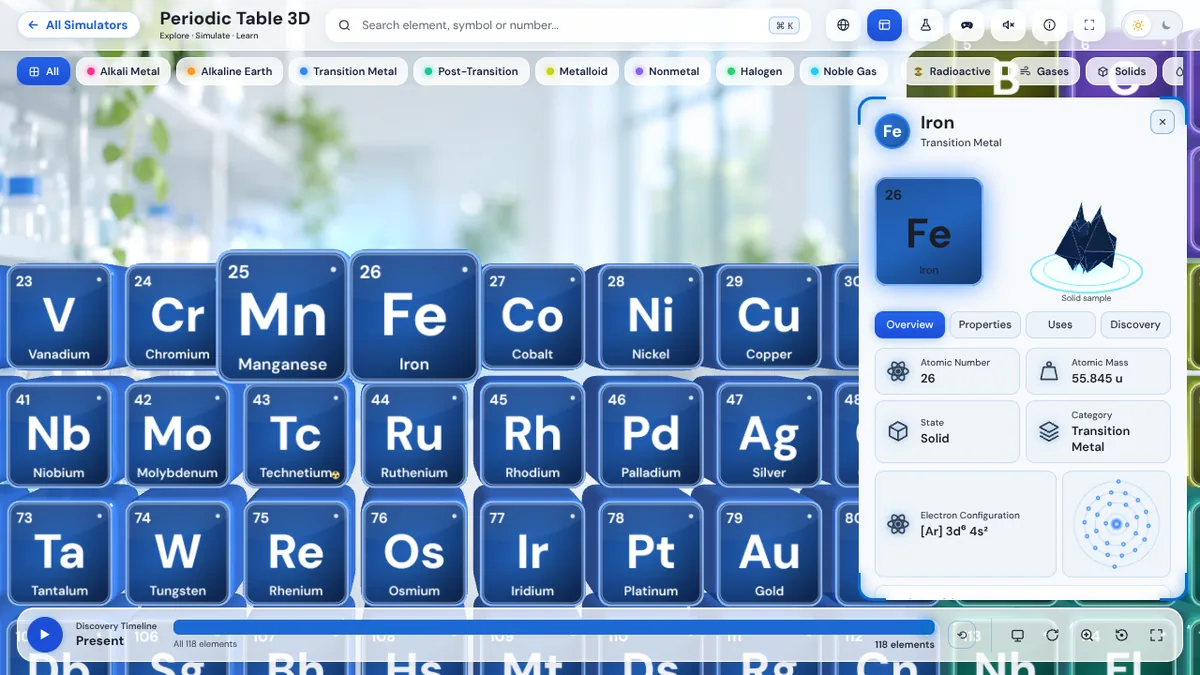 Explore in 3D
Iron quick facts
| Atomic number | 26 |
|---|---|
| Symbol | Fe |
| Atomic mass | 55.845 |
| Category | Transition Metal |
| Group and period | Group 8, period 4 |
| Block | d-block |
| State at room temperature | Solid |
| Electron configuration | [Ar] 3d⁶ 4s² |
| Electrons per shell | 2, 8, 14, 2 |
| Discovered | Ancient times |
What is iron used for?
- Steel construction & manufacturing
- Haemoglobin blood oxygen transport
- Cast iron cookware
Interesting facts about iron
- Iron is the most abundant element on Earth by mass (32%)
- The Earth's core is a solid inner iron ball and liquid outer iron ocean
- Iron is where normal stellar fusion stops. Heavier elements form by neutron capture in giant stars, supernovae and neutron-star mergers
Iron has been known since ancient times, long before anyone could call it an element.
Where iron sits on the periodic table
Iron is in group 8, period 4. Tap any element to open its page.
Other transition metals
Iron questions
What is the atomic number of iron?
Iron has atomic number 26, so every iron atom has 26 protons in its nucleus. Its symbol is Fe and its atomic mass is 55.845.
Is iron a metal?
Iron is a metal. On the periodic table it is grouped as a transition metal, found in group 8, period 4.
What is the electron configuration of iron?
The electron configuration of iron is [Ar] 3d⁶ 4s². Its electrons sit in 4 shells: 2, 8, 14, 2.
What is iron used for?
Iron is used for steel construction & manufacturing, haemoglobin blood oxygen transport and cast iron cookware.
Who discovered iron?
Iron has been known since ancient times, long before anyone could call it an element.
The 3D Periodic Table is made by Julian Neagu, a solo founder in London, as part of VisionVix Simulators. It is free to use in the browser on desktop and phone, with no sign-up.