Titanium (Ti): Properties, Uses and Facts in 3D
Titanium is element 22 on the periodic table, a transition metal. At room temperature it is a solid. Open it in the 3D Periodic Table to spin its tile, see its electron shells and read its story.
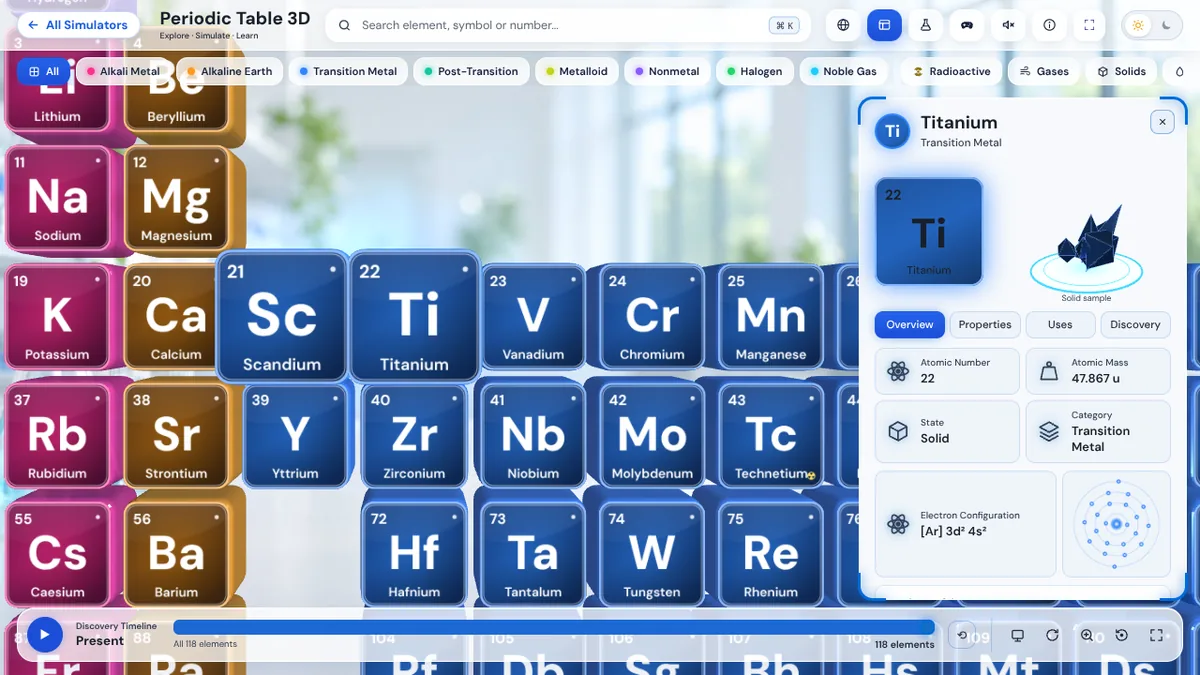 Explore in 3D
Titanium quick facts
| Atomic number | 22 |
|---|---|
| Symbol | Ti |
| Atomic mass | 47.867 |
| Category | Transition Metal |
| Group and period | Group 4, period 4 |
| Block | d-block |
| State at room temperature | Solid |
| Electron configuration | [Ar] 3d² 4s² |
| Electrons per shell | 2, 8, 10, 2 |
| Discovered | 1791, Gregor |
What is titanium used for?
- Aircraft & spacecraft frames
- Medical implants & joint replacements
- Titanium white paint (TiO₂)
Interesting facts about titanium
- Titanium is about 40% lighter than steel of similar strength
- The body tolerates titanium very well. It bonds with bone in a process called osseointegration
- Lockheed's SR-71 Blackbird was largely built from titanium to withstand friction heating at Mach 3+
Titanium was discovered in 1791 by Gregor in Britain.
Where titanium sits on the periodic table
Titanium is in group 4, period 4. Tap any element to open its page.
Other transition metals
Titanium questions
What is the atomic number of titanium?
Titanium has atomic number 22, so every titanium atom has 22 protons in its nucleus. Its symbol is Ti and its atomic mass is 47.867.
Is titanium a metal?
Titanium is a metal. On the periodic table it is grouped as a transition metal, found in group 4, period 4.
What is the electron configuration of titanium?
The electron configuration of titanium is [Ar] 3d² 4s². Its electrons sit in 4 shells: 2, 8, 10, 2.
What is titanium used for?
Titanium is used for aircraft & spacecraft frames, medical implants & joint replacements and titanium white paint (tio₂).
Who discovered titanium?
Titanium was discovered in 1791 by Gregor in Britain.
The 3D Periodic Table is made by Julian Neagu, a solo founder in London, as part of VisionVix Simulators. It is free to use in the browser on desktop and phone, with no sign-up.