Plutonium (Pu): Properties, Uses and Facts in 3D
Plutonium is element 94 on the periodic table, an actinide, so it is a metal. At room temperature it is a solid. Open it in the 3D Periodic Table to spin its tile, see its electron shells and read its story.
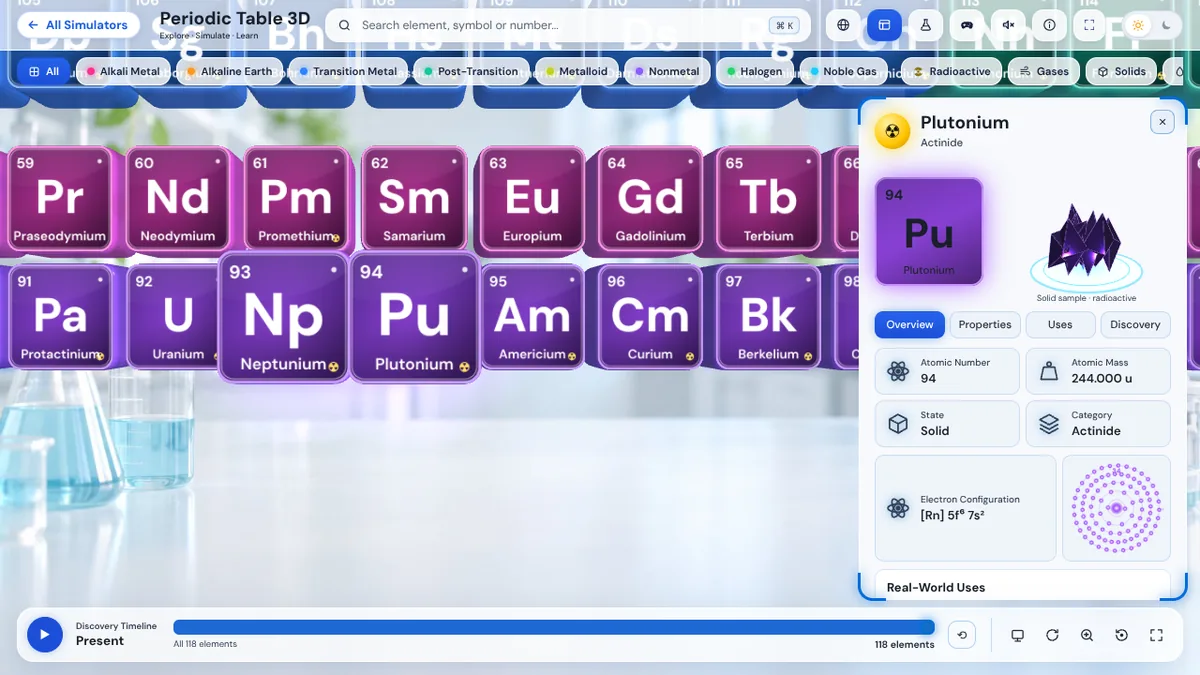 Explore in 3D
Plutonium quick facts
| Atomic number | 94 |
|---|---|
| Symbol | Pu |
| Atomic mass | 244 |
| Category | Actinide |
| Series and period | Actinides, period 7 |
| Block | f-block |
| State at room temperature | Solid |
| Electron configuration | [Rn] 5f⁶ 7s² |
| Electrons per shell | 2, 8, 18, 32, 24, 8, 2 |
| Discovered | 1940, Seaborg |
What is plutonium used for?
- Nuclear weapons (Fat Man bomb used Pu)
- Nuclear power plant fuel
- Radioisotope thermoelectric generators (spacecraft)
Interesting facts about plutonium
- A quantity of plutonium the size of a grapefruit can produce a nuclear explosion
- Voyager spacecraft launched in 1977 still operate today on plutonium-powered RTGs
- Plutonium-238 emits steady heat with very little gamma radiation. Ideal for spacecraft power
Plutonium was discovered in 1940 by Seaborg in the United States.
Where plutonium sits on the periodic table
Plutonium is in the actinide series (period 7). Tap any element to open its page.
Other actinides
Plutonium questions
What is the atomic number of plutonium?
Plutonium has atomic number 94, so every plutonium atom has 94 protons in its nucleus. Its symbol is Pu and its atomic mass is 244.
Is plutonium a metal?
Plutonium is a metal. On the periodic table it is grouped as an actinide, found in the actinide series (period 7).
What is the electron configuration of plutonium?
The electron configuration of plutonium is [Rn] 5f⁶ 7s². Its electrons sit in 7 shells: 2, 8, 18, 32, 24, 8, 2.
What is plutonium used for?
Plutonium is used for nuclear weapons (fat man bomb used pu), nuclear power plant fuel and radioisotope thermoelectric generators (spacecraft).
Who discovered plutonium?
Plutonium was discovered in 1940 by Seaborg in the United States.
The 3D Periodic Table is made by Julian Neagu, a solo founder in London, as part of VisionVix Simulators. It is free to use in the browser on desktop and phone, with no sign-up.