Lutetium (Lu): Properties, Uses and Facts in 3D
Lutetium is element 71 on the periodic table, a lanthanide, so it is a metal. At room temperature it is a solid. Open it in the 3D Periodic Table to spin its tile, see its electron shells and read its story.
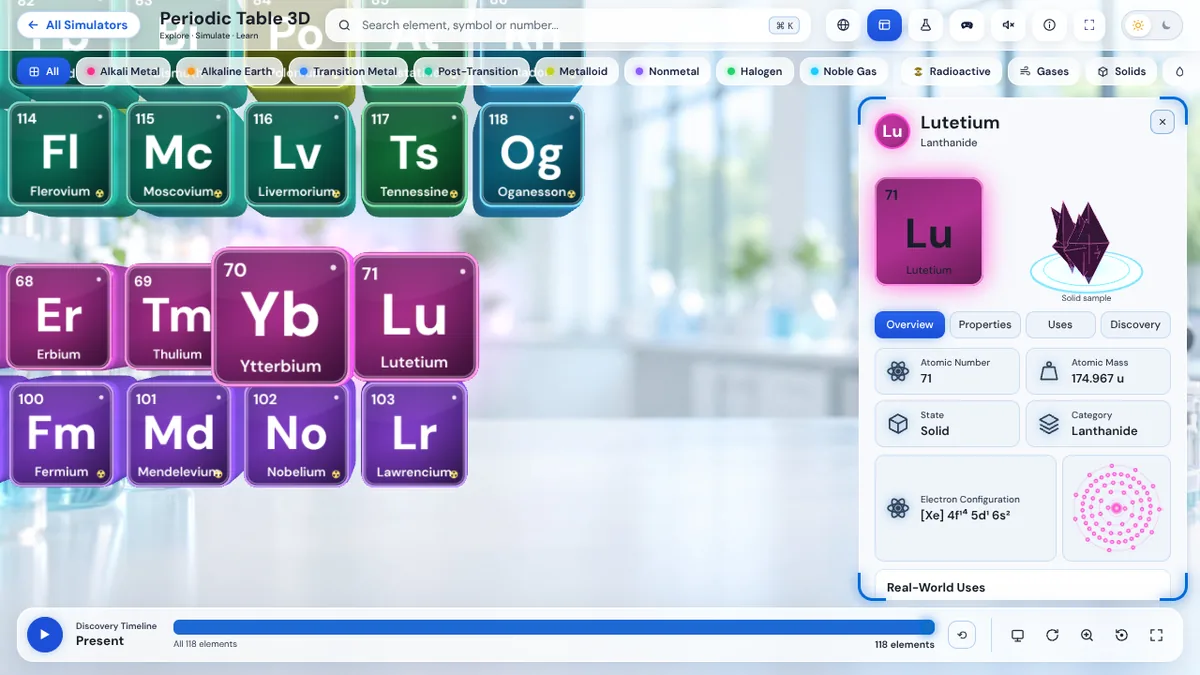 Explore in 3D
Lutetium quick facts
| Atomic number | 71 |
|---|---|
| Symbol | Lu |
| Atomic mass | 174.967 |
| Category | Lanthanide |
| Series and period | Lanthanides, period 6 |
| Block | f-block |
| State at room temperature | Solid |
| Electron configuration | [Xe] 4f¹⁴ 5d¹ 6s² |
| Electrons per shell | 2, 8, 18, 32, 9, 2 |
| Discovered | 1907, Urbain |
What is lutetium used for?
- PET scanner detectors (lutetium oxyorthosilicate)
- Lutetium-177 cancer radiotherapy
- High-refractive-index glass
Interesting facts about lutetium
- Named after Lutetia. The Roman name for Paris
- Lutetium-177 DOTATATE is among the most effective targeted radiotherapy agents for neuroendocrine tumours
- Lutetium is the densest and hardest of all the lanthanides
Lutetium was discovered in 1907 by Urbain in France.
Where lutetium sits on the periodic table
Lutetium is in the lanthanide series (period 6). Tap any element to open its page.
Other lanthanides
Lutetium questions
What is the atomic number of lutetium?
Lutetium has atomic number 71, so every lutetium atom has 71 protons in its nucleus. Its symbol is Lu and its atomic mass is 174.967.
Is lutetium a metal?
Lutetium is a metal. On the periodic table it is grouped as a lanthanide, found in the lanthanide series (period 6).
What is the electron configuration of lutetium?
The electron configuration of lutetium is [Xe] 4f¹⁴ 5d¹ 6s². Its electrons sit in 6 shells: 2, 8, 18, 32, 9, 2.
What is lutetium used for?
Lutetium is used for pet scanner detectors (lutetium oxyorthosilicate), lutetium-177 cancer radiotherapy and high-refractive-index glass.
Who discovered lutetium?
Lutetium was discovered in 1907 by Urbain in France.
The 3D Periodic Table is made by Julian Neagu, a solo founder in London, as part of VisionVix Simulators. It is free to use in the browser on desktop and phone, with no sign-up.