Technetium (Tc): Properties, Uses and Facts in 3D
Technetium is element 43 on the periodic table, a transition metal. At room temperature it is a solid. Open it in the 3D Periodic Table to spin its tile, see its electron shells and read its story.
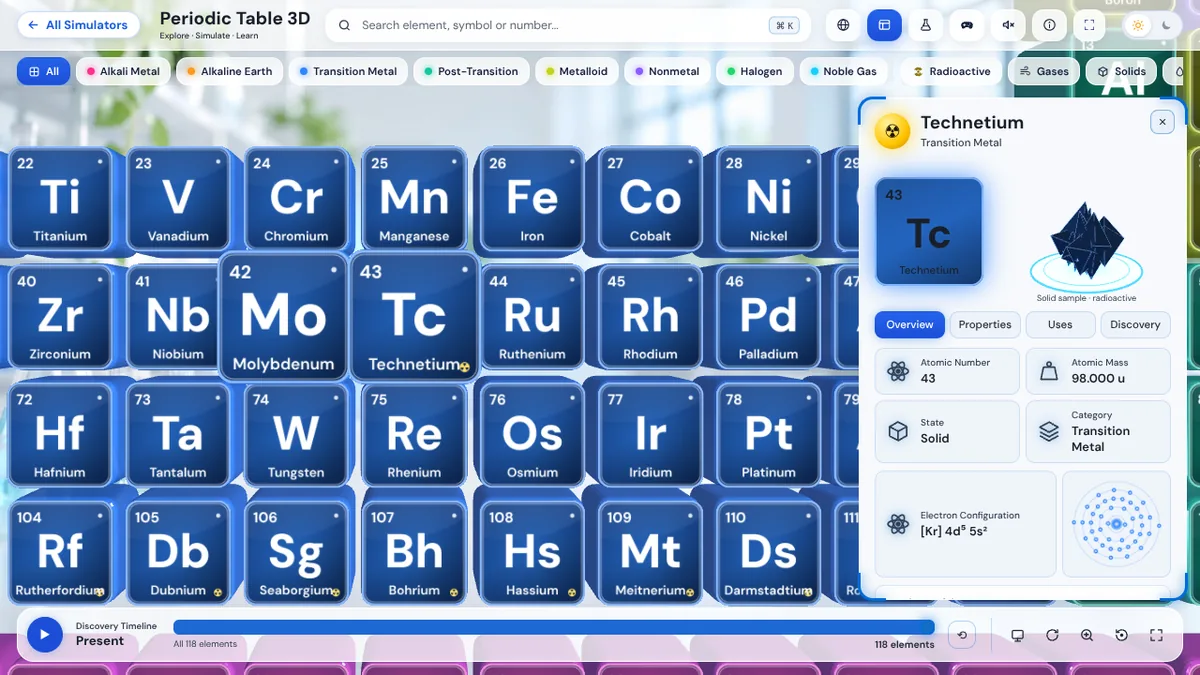 Explore in 3D
Technetium quick facts
| Atomic number | 43 |
|---|---|
| Symbol | Tc |
| Atomic mass | 98 |
| Category | Transition Metal |
| Group and period | Group 7, period 5 |
| Block | d-block |
| State at room temperature | Solid |
| Electron configuration | [Kr] 4d⁵ 5s² |
| Electrons per shell | 2, 8, 18, 13, 2 |
| Discovered | 1937, Perrier |
What is technetium used for?
- Nuclear medicine imaging (Tc-99m tracer)
- Anti-corrosion agent (experimental)
- Scientific research
Interesting facts about technetium
- Technetium was the first artificially produced element. Its name means "artificial"
- Tc-99m is used in 40 million medical imaging procedures per year worldwide
- Almost all technetium on Earth is synthetic. Only traces form naturally in uranium ores
Technetium was discovered in 1937 by Perrier in Italy.
Where technetium sits on the periodic table
Technetium is in group 7, period 5. Tap any element to open its page.
Other transition metals
Technetium questions
What is the atomic number of technetium?
Technetium has atomic number 43, so every technetium atom has 43 protons in its nucleus. Its symbol is Tc and its atomic mass is 98.
Is technetium a metal?
Technetium is a metal. On the periodic table it is grouped as a transition metal, found in group 7, period 5.
What is the electron configuration of technetium?
The electron configuration of technetium is [Kr] 4d⁵ 5s². Its electrons sit in 5 shells: 2, 8, 18, 13, 2.
What is technetium used for?
Technetium is used for nuclear medicine imaging (tc-99m tracer), anti-corrosion agent (experimental) and scientific research.
Who discovered technetium?
Technetium was discovered in 1937 by Perrier in Italy.
The 3D Periodic Table is made by Julian Neagu, a solo founder in London, as part of VisionVix Simulators. It is free to use in the browser on desktop and phone, with no sign-up.