Fermium (Fm): Properties, Uses and Facts in 3D
Fermium is element 100 on the periodic table, an actinide, so it is a metal. At room temperature it is expected to be a solid (too few atoms have ever been made to check). Open it in the 3D Periodic Table to spin its tile, see its electron shells and read its story.
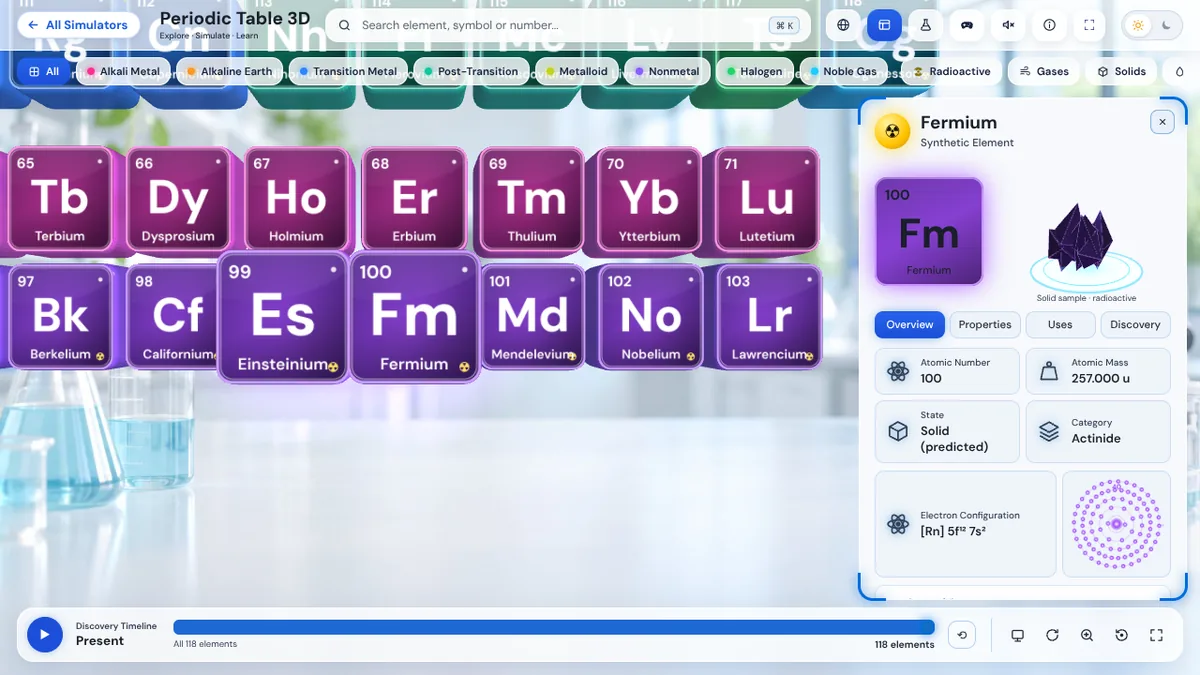 Explore in 3D
Fermium quick facts
| Atomic number | 100 |
|---|---|
| Symbol | Fm |
| Atomic mass | 257 |
| Category | Actinide |
| Series and period | Actinides, period 7 |
| Block | f-block |
| State at room temperature | Solid (expected) |
| Electron configuration | [Rn] 5f¹² 7s² |
| Electrons per shell | 2, 8, 18, 32, 30, 8, 2 |
| Discovered | 1952, Ghiorso |
What is fermium used for?
- Scientific research only
- Studying how heavy nuclei split
- Nuclear physics studies
Interesting facts about fermium
- Named after Enrico Fermi. Architect of the first nuclear reactor
- Also discovered in Ivy Mike hydrogen bomb fallout. Detected in the highly classified analysis
- No visible sample of fermium has ever been produced. Quantities measured in atoms
Fermium was discovered in 1952 by Ghiorso in the United States.
Where fermium sits on the periodic table
Fermium is in the actinide series (period 7). Tap any element to open its page.
Other actinides
Fermium questions
What is the atomic number of fermium?
Fermium has atomic number 100, so every fermium atom has 100 protons in its nucleus. Its symbol is Fm and its atomic mass is 257.
Is fermium a metal?
Fermium is a metal. On the periodic table it is grouped as an actinide, found in the actinide series (period 7).
What is the electron configuration of fermium?
The electron configuration of fermium is [Rn] 5f¹² 7s². Its electrons sit in 7 shells: 2, 8, 18, 32, 30, 8, 2.
What is fermium used for?
Fermium is used for scientific research only, studying how heavy nuclei split and nuclear physics studies.
Who discovered fermium?
Fermium was discovered in 1952 by Ghiorso in the United States.
The 3D Periodic Table is made by Julian Neagu, a solo founder in London, as part of VisionVix Simulators. It is free to use in the browser on desktop and phone, with no sign-up.