Manganese (Mn): Properties, Uses and Facts in 3D
Manganese is element 25 on the periodic table, a transition metal. At room temperature it is a solid. Open it in the 3D Periodic Table to spin its tile, see its electron shells and read its story.
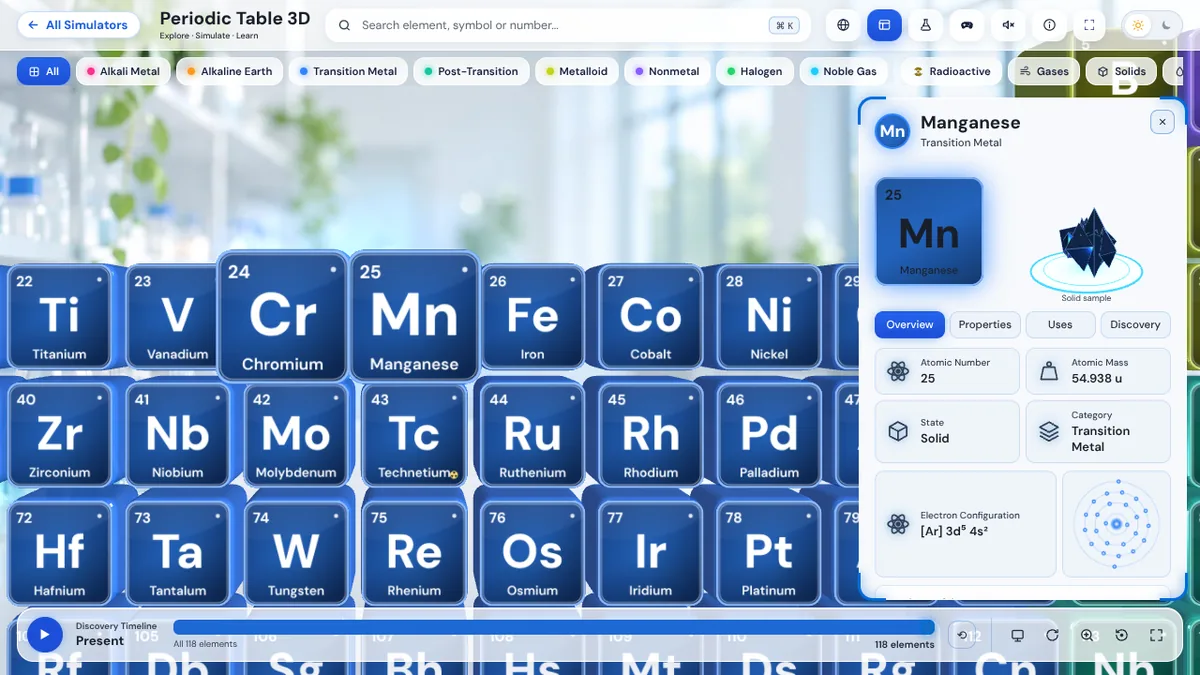 Explore in 3D
Manganese quick facts
| Atomic number | 25 |
|---|---|
| Symbol | Mn |
| Atomic mass | 54.938 |
| Category | Transition Metal |
| Group and period | Group 7, period 4 |
| Block | d-block |
| State at room temperature | Solid |
| Electron configuration | [Ar] 3d⁵ 4s² |
| Electrons per shell | 2, 8, 13, 2 |
| Discovered | 1774, Gahn |
What is manganese used for?
- Steel alloying agent (strength & hardness)
- Dry cell batteries (MnO₂)
- Pigment for glass & ceramics
Interesting facts about manganese
- Manganese nodules on the ocean floor contain vast untapped reserves
- Pure manganese is hard and very brittle
- The brain needs a little manganese, but too much (manganism) causes Parkinson-like tremors
Manganese was discovered in 1774 by Gahn in Sweden.
Where manganese sits on the periodic table
Manganese is in group 7, period 4. Tap any element to open its page.
Other transition metals
Manganese questions
What is the atomic number of manganese?
Manganese has atomic number 25, so every manganese atom has 25 protons in its nucleus. Its symbol is Mn and its atomic mass is 54.938.
Is manganese a metal?
Manganese is a metal. On the periodic table it is grouped as a transition metal, found in group 7, period 4.
What is the electron configuration of manganese?
The electron configuration of manganese is [Ar] 3d⁵ 4s². Its electrons sit in 4 shells: 2, 8, 13, 2.
What is manganese used for?
Manganese is used for steel alloying agent (strength & hardness), dry cell batteries (mno₂) and pigment for glass & ceramics.
Who discovered manganese?
Manganese was discovered in 1774 by Gahn in Sweden.
The 3D Periodic Table is made by Julian Neagu, a solo founder in London, as part of VisionVix Simulators. It is free to use in the browser on desktop and phone, with no sign-up.