Rubidium (Rb): Properties, Uses and Facts in 3D
Rubidium is element 37 on the periodic table, an alkali metal. At room temperature it is a solid. Open it in the 3D Periodic Table to spin its tile, see its electron shells and read its story.
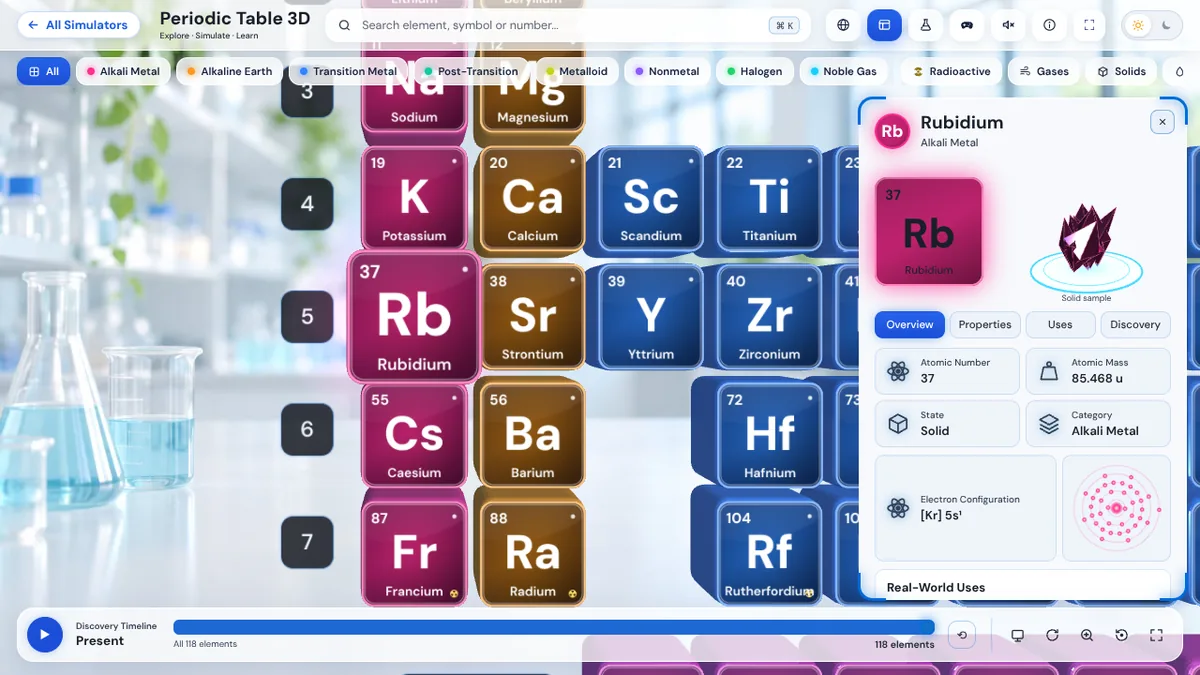 Explore in 3D
Rubidium quick facts
| Atomic number | 37 |
|---|---|
| Symbol | Rb |
| Atomic mass | 85.468 |
| Category | Alkali Metal |
| Group and period | Group 1, period 5 |
| Block | s-block |
| State at room temperature | Solid |
| Electron configuration | [Kr] 5s¹ |
| Electrons per shell | 2, 8, 18, 8, 1 |
| Discovered | 1861, Bunsen |
What is rubidium used for?
- Atomic clocks (GPS accuracy)
- Research on quantum Bose-Einstein condensates
- Rubidium vapour lamps
Interesting facts about rubidium
- Rubidium atomic clocks on GPS satellites lose less than a second in many thousands of years
- At near absolute zero, rubidium atoms form a Bose-Einstein condensate. A fifth state of matter
- Rubidium ignites spontaneously in air and explodes in water
Rubidium was discovered in 1861 by Bunsen in Germany.
Where rubidium sits on the periodic table
Rubidium is in group 1, period 5. Tap any element to open its page.
Other alkali metals
Rubidium questions
What is the atomic number of rubidium?
Rubidium has atomic number 37, so every rubidium atom has 37 protons in its nucleus. Its symbol is Rb and its atomic mass is 85.468.
Is rubidium a metal?
Rubidium is a metal. On the periodic table it is grouped as an alkali metal, found in group 1, period 5.
What is the electron configuration of rubidium?
The electron configuration of rubidium is [Kr] 5s¹. Its electrons sit in 5 shells: 2, 8, 18, 8, 1.
What is rubidium used for?
Rubidium is used for atomic clocks (gps accuracy), research on quantum bose-einstein condensates and rubidium vapour lamps.
Who discovered rubidium?
Rubidium was discovered in 1861 by Bunsen in Germany.
The 3D Periodic Table is made by Julian Neagu, a solo founder in London, as part of VisionVix Simulators. It is free to use in the browser on desktop and phone, with no sign-up.