Neodymium (Nd): Properties, Uses and Facts in 3D
Neodymium is element 60 on the periodic table, a lanthanide, so it is a metal. At room temperature it is a solid. Open it in the 3D Periodic Table to spin its tile, see its electron shells and read its story.
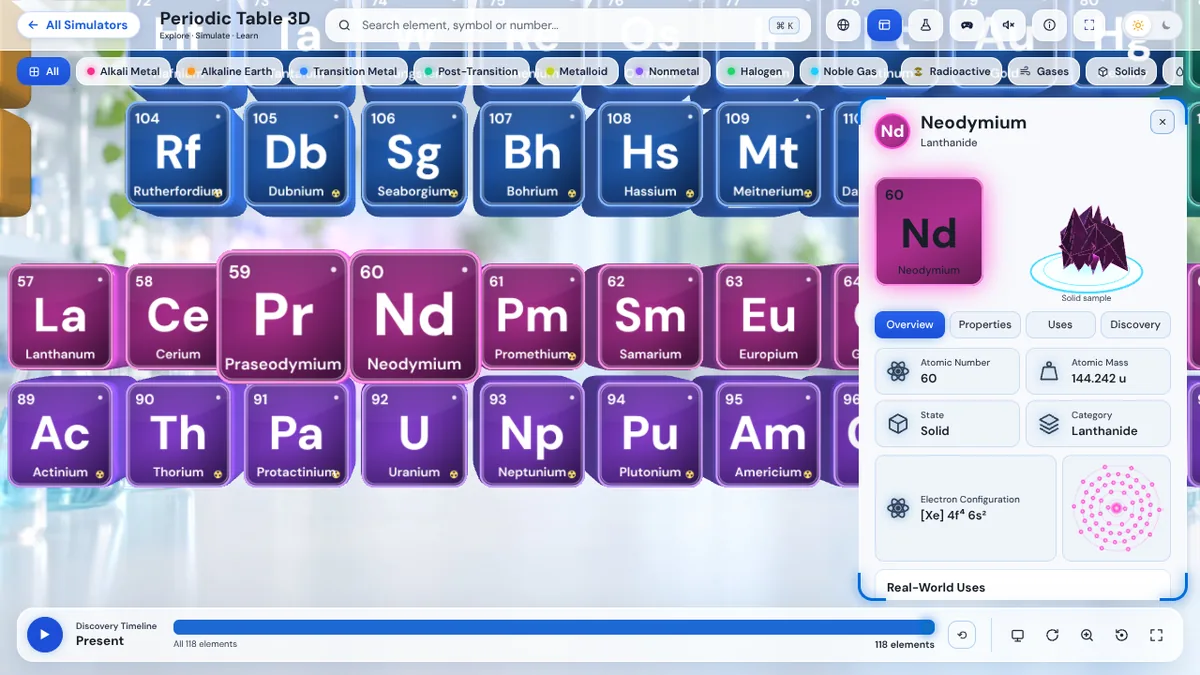 Explore in 3D
Neodymium quick facts
| Atomic number | 60 |
|---|---|
| Symbol | Nd |
| Atomic mass | 144.242 |
| Category | Lanthanide |
| Series and period | Lanthanides, period 6 |
| Block | f-block |
| State at room temperature | Solid |
| Electron configuration | [Xe] 4f⁴ 6s² |
| Electrons per shell | 2, 8, 18, 22, 8, 2 |
| Discovered | 1885, von Welsbach |
What is neodymium used for?
- Strongest permanent magnets (Nd-Fe-B)
- EV motors & wind turbine generators
- Neodymium-YAG lasers
Interesting facts about neodymium
- A neodymium magnet the size of your thumb can hold tens of kilograms
- Most electric car motors and many direct-drive wind turbines use neodymium magnets
- Neodymium magnets are so powerful they can cause bone fractures if two large ones snap together on a finger
Neodymium was discovered in 1885 by von Welsbach in Austria.
Where neodymium sits on the periodic table
Neodymium is in the lanthanide series (period 6). Tap any element to open its page.
Other lanthanides
Neodymium questions
What is the atomic number of neodymium?
Neodymium has atomic number 60, so every neodymium atom has 60 protons in its nucleus. Its symbol is Nd and its atomic mass is 144.242.
Is neodymium a metal?
Neodymium is a metal. On the periodic table it is grouped as a lanthanide, found in the lanthanide series (period 6).
What is the electron configuration of neodymium?
The electron configuration of neodymium is [Xe] 4f⁴ 6s². Its electrons sit in 6 shells: 2, 8, 18, 22, 8, 2.
What is neodymium used for?
Neodymium is used for strongest permanent magnets (nd-fe-b), ev motors & wind turbine generators and neodymium-yag lasers.
Who discovered neodymium?
Neodymium was discovered in 1885 by von Welsbach in Austria.
The 3D Periodic Table is made by Julian Neagu, a solo founder in London, as part of VisionVix Simulators. It is free to use in the browser on desktop and phone, with no sign-up.