Radon (Rn): Properties, Uses and Facts in 3D
Radon is element 86 on the periodic table, a noble gas, so it is a nonmetal. At room temperature it is a gas. Open it in the 3D Periodic Table to spin its tile, see its electron shells and read its story.
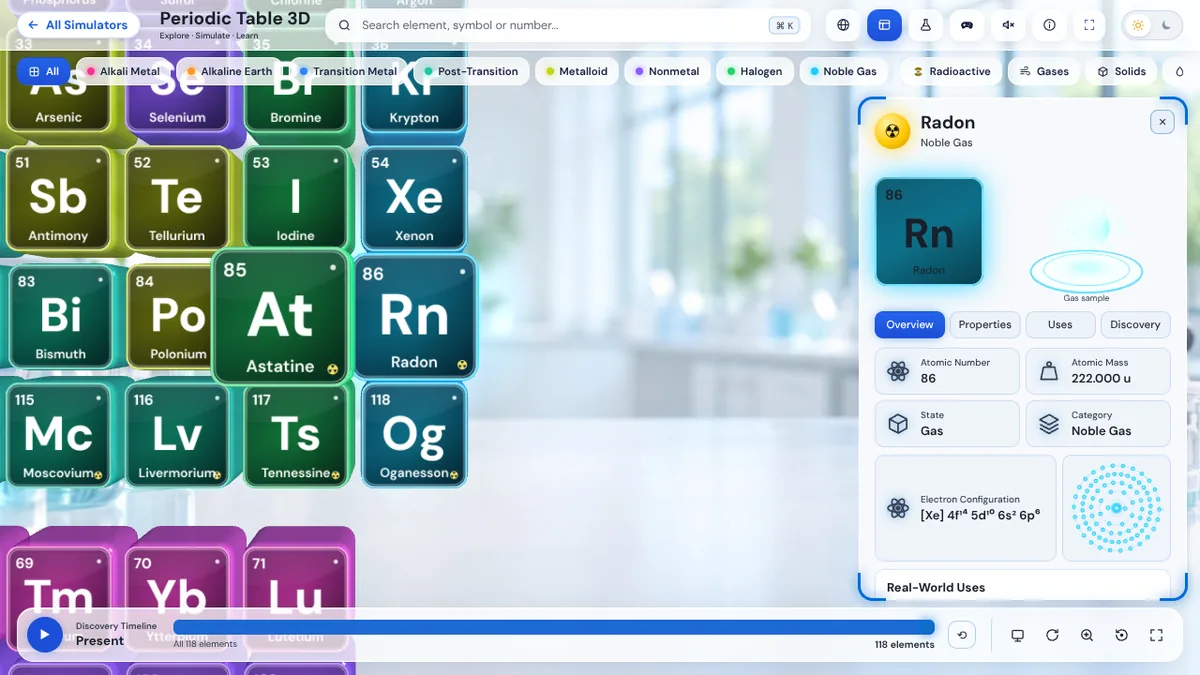 Explore in 3D
Radon quick facts
| Atomic number | 86 |
|---|---|
| Symbol | Rn |
| Atomic mass | 222 |
| Category | Noble Gas |
| Group and period | Group 18, period 6 |
| Block | p-block |
| State at room temperature | Gas |
| Electron configuration | [Xe] 4f¹⁴ 5d¹⁰ 6s² 6p⁶ |
| Electrons per shell | 2, 8, 18, 32, 18, 8 |
| Discovered | 1900, Dorn |
What is radon used for?
- Earthquake & groundwater tracer studies
- Cancer radiotherapy (historical radon seeds)
- Home radon testing for health safety
Interesting facts about radon
- Radon is the second leading cause of lung cancer after smoking. Responsible for 21,000 US deaths annually
- Radon seeps from uranium-bearing rock. Homes built over granite can build up dangerous levels
- Radon-222 has a half-life of just 3.8 days. It's constantly replenished from uranium decay in soil
Radon was discovered in 1900 by Dorn in Germany.
Where radon sits on the periodic table
Radon is in group 18, period 6. Tap any element to open its page.
Other noble gass
Radon questions
What is the atomic number of radon?
Radon has atomic number 86, so every radon atom has 86 protons in its nucleus. Its symbol is Rn and its atomic mass is 222.
Is radon a metal?
Radon is a nonmetal. On the periodic table it is grouped as a noble gas, found in group 18, period 6.
What is the electron configuration of radon?
The electron configuration of radon is [Xe] 4f¹⁴ 5d¹⁰ 6s² 6p⁶. Its electrons sit in 6 shells: 2, 8, 18, 32, 18, 8.
What is radon used for?
Radon is used for earthquake & groundwater tracer studies, cancer radiotherapy (historical radon seeds) and home radon testing for health safety.
Who discovered radon?
Radon was discovered in 1900 by Dorn in Germany.
The 3D Periodic Table is made by Julian Neagu, a solo founder in London, as part of VisionVix Simulators. It is free to use in the browser on desktop and phone, with no sign-up.