Arsenic (As): Properties, Uses and Facts in 3D
Arsenic is element 33 on the periodic table, a metalloid, with properties between metals and nonmetals. At room temperature it is a solid. Open it in the 3D Periodic Table to spin its tile, see its electron shells and read its story.
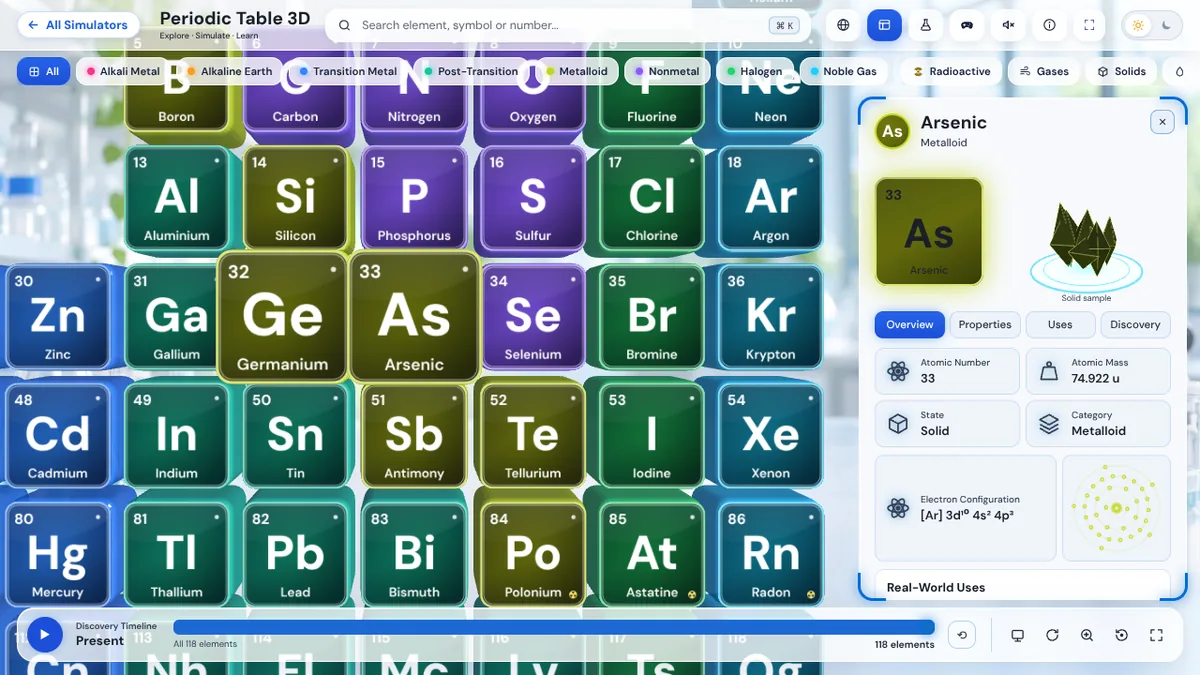 Explore in 3D
Arsenic quick facts
| Atomic number | 33 |
|---|---|
| Symbol | As |
| Atomic mass | 74.922 |
| Category | Metalloid |
| Group and period | Group 15, period 4 |
| Block | p-block |
| State at room temperature | Solid |
| Electron configuration | [Ar] 3d¹⁰ 4s² 4p³ |
| Electrons per shell | 2, 8, 18, 5 |
| Discovered | 1250, Albertus Magnus |
What is arsenic used for?
- Gallium arsenide semiconductors
- Wood preservative (historical)
- Herbicides & pesticides (largely historical)
Interesting facts about arsenic
- Arsenic was once called "inheritance powder". Undetectable in autopsies before modern toxicology
- A popular theory says Napoleon was poisoned by arsenic wallpaper. Hair tests later showed similar levels all his life
- Arsenic-based compounds were the first modern chemotherapy drugs. Used against syphilis in 1910
Arsenic was discovered in 1250 by Albertus Magnus in Germany.
Where arsenic sits on the periodic table
Arsenic is in group 15, period 4. Tap any element to open its page.
Other metalloids
Arsenic questions
What is the atomic number of arsenic?
Arsenic has atomic number 33, so every arsenic atom has 33 protons in its nucleus. Its symbol is As and its atomic mass is 74.922.
Is arsenic a metal?
Arsenic is a metalloid, with properties between metals and nonmetals. On the periodic table it is grouped as a metalloid, found in group 15, period 4.
What is the electron configuration of arsenic?
The electron configuration of arsenic is [Ar] 3d¹⁰ 4s² 4p³. Its electrons sit in 4 shells: 2, 8, 18, 5.
What is arsenic used for?
Arsenic is used for gallium arsenide semiconductors, wood preservative (historical) and herbicides & pesticides (largely historical).
Who discovered arsenic?
Arsenic was discovered in 1250 by Albertus Magnus in Germany.
The 3D Periodic Table is made by Julian Neagu, a solo founder in London, as part of VisionVix Simulators. It is free to use in the browser on desktop and phone, with no sign-up.