Germanium (Ge): Properties, Uses and Facts in 3D
Germanium is element 32 on the periodic table, a metalloid, with properties between metals and nonmetals. At room temperature it is a solid. Open it in the 3D Periodic Table to spin its tile, see its electron shells and read its story.
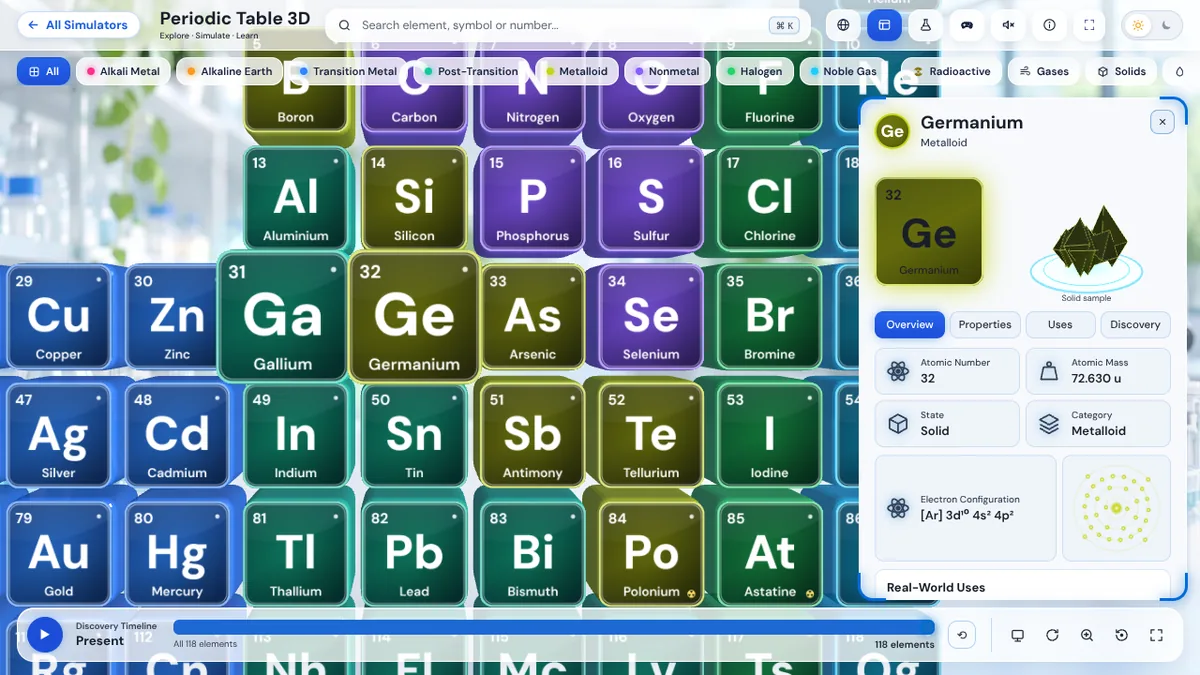 Explore in 3D
Germanium quick facts
| Atomic number | 32 |
|---|---|
| Symbol | Ge |
| Atomic mass | 72.63 |
| Category | Metalloid |
| Group and period | Group 14, period 4 |
| Block | p-block |
| State at room temperature | Solid |
| Electron configuration | [Ar] 3d¹⁰ 4s² 4p² |
| Electrons per shell | 2, 8, 18, 4 |
| Discovered | 1886, Winkler |
What is germanium used for?
- Fibre optic cables (refractive index control)
- Infrared optics
- Early transistors & semiconductors
Interesting facts about germanium
- Mendeleyev predicted germanium 15 years before its discovery (he called it eka-silicon)
- Germanium is transparent to infrared light. Used in thermal imaging cameras
- The first functional transistor was made from germanium in 1947 at Bell Labs
Germanium was discovered in 1886 by Winkler in Germany.
Where germanium sits on the periodic table
Germanium is in group 14, period 4. Tap any element to open its page.
Other metalloids
Germanium questions
What is the atomic number of germanium?
Germanium has atomic number 32, so every germanium atom has 32 protons in its nucleus. Its symbol is Ge and its atomic mass is 72.63.
Is germanium a metal?
Germanium is a metalloid, with properties between metals and nonmetals. On the periodic table it is grouped as a metalloid, found in group 14, period 4.
What is the electron configuration of germanium?
The electron configuration of germanium is [Ar] 3d¹⁰ 4s² 4p². Its electrons sit in 4 shells: 2, 8, 18, 4.
What is germanium used for?
Germanium is used for fibre optic cables (refractive index control), infrared optics and early transistors & semiconductors.
Who discovered germanium?
Germanium was discovered in 1886 by Winkler in Germany.
The 3D Periodic Table is made by Julian Neagu, a solo founder in London, as part of VisionVix Simulators. It is free to use in the browser on desktop and phone, with no sign-up.