Radium (Ra): Properties, Uses and Facts in 3D
Radium is element 88 on the periodic table, an alkaline earth metal. At room temperature it is a solid. Open it in the 3D Periodic Table to spin its tile, see its electron shells and read its story.
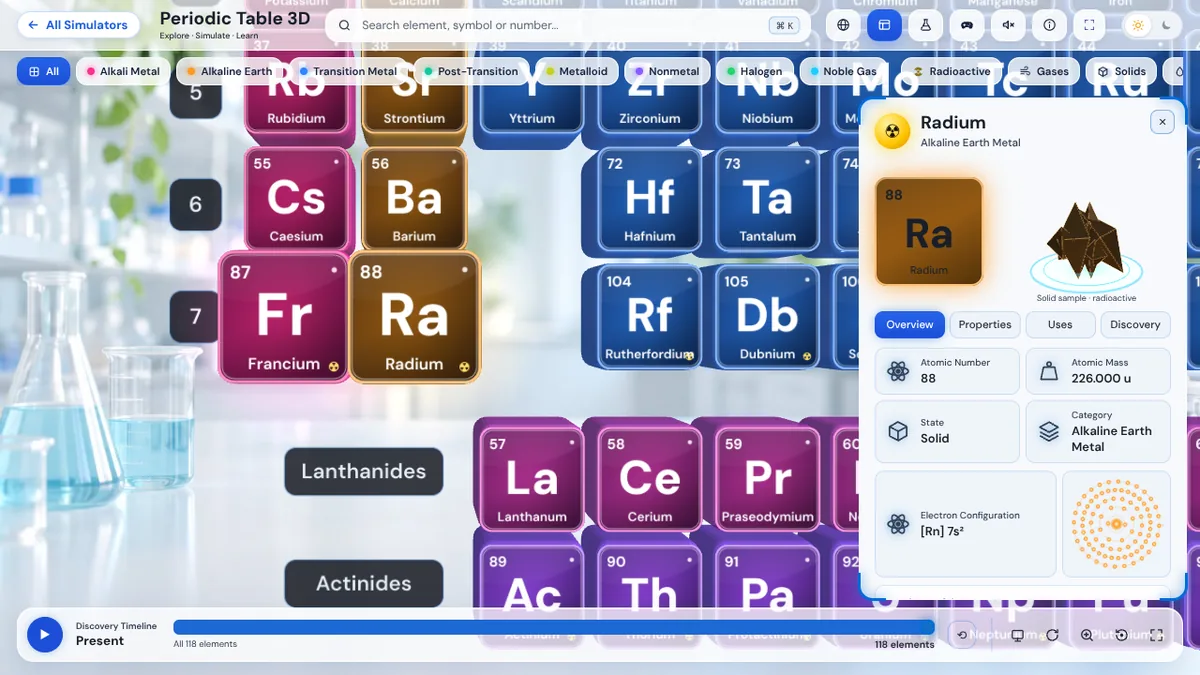 Explore in 3D
Radium quick facts
| Atomic number | 88 |
|---|---|
| Symbol | Ra |
| Atomic mass | 226 |
| Category | Alkaline Earth Metal |
| Group and period | Group 2, period 7 |
| Block | s-block |
| State at room temperature | Solid |
| Electron configuration | [Rn] 7s² |
| Electrons per shell | 2, 8, 18, 32, 18, 8, 2 |
| Discovered | 1898, Marie & Pierre Curie |
What is radium used for?
- Historical cancer radiotherapy
- Radon gas production (decay product)
- Historical luminous paint (watch dials)
Interesting facts about radium
- Marie Curie won two Nobel prizes. Physics (1903, radioactivity) and Chemistry (1911, discovering radium and polonium)
- Radium dial painters (Radium Girls) painted watch dials with luminous paint and suffered radiation poisoning
- Radium salts glow faintly in the dark. Marie Curie described her samples glowing like faint fairy lights
Radium was discovered in 1898 by Marie & Pierre Curie in France.
Where radium sits on the periodic table
Radium is in group 2, period 7. Tap any element to open its page.
Other alkaline earth metals
Radium questions
What is the atomic number of radium?
Radium has atomic number 88, so every radium atom has 88 protons in its nucleus. Its symbol is Ra and its atomic mass is 226.
Is radium a metal?
Radium is a metal. On the periodic table it is grouped as an alkaline earth metal, found in group 2, period 7.
What is the electron configuration of radium?
The electron configuration of radium is [Rn] 7s². Its electrons sit in 7 shells: 2, 8, 18, 32, 18, 8, 2.
What is radium used for?
Radium is used for historical cancer radiotherapy, radon gas production (decay product) and historical luminous paint (watch dials).
Who discovered radium?
Radium was discovered in 1898 by Marie & Pierre Curie in France.
The 3D Periodic Table is made by Julian Neagu, a solo founder in London, as part of VisionVix Simulators. It is free to use in the browser on desktop and phone, with no sign-up.