Xenon (Xe): Properties, Uses and Facts in 3D
Xenon is element 54 on the periodic table, a noble gas, so it is a nonmetal. At room temperature it is a gas. Open it in the 3D Periodic Table to spin its tile, see its electron shells and read its story.
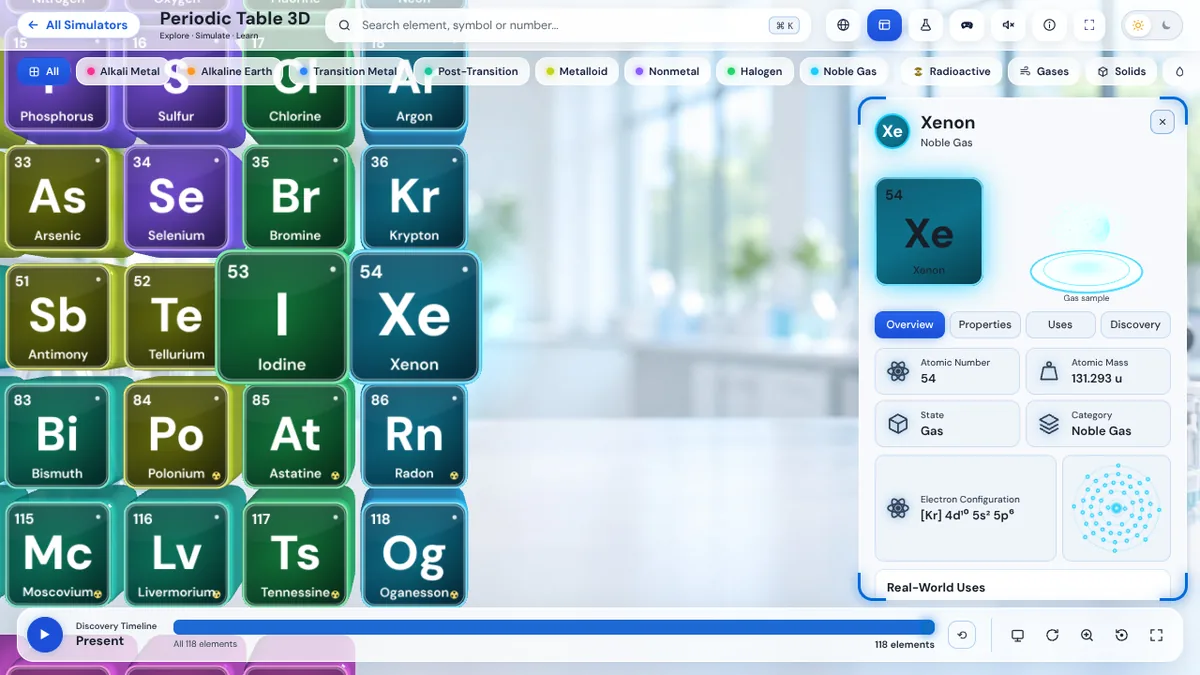 Explore in 3D
Xenon quick facts
| Atomic number | 54 |
|---|---|
| Symbol | Xe |
| Atomic mass | 131.293 |
| Category | Noble Gas |
| Group and period | Group 18, period 5 |
| Block | p-block |
| State at room temperature | Gas |
| Electron configuration | [Kr] 4d¹⁰ 5s² 5p⁶ |
| Electrons per shell | 2, 8, 18, 18, 8 |
| Discovered | 1898, Ramsay |
What is xenon used for?
- Xenon flash lamps in photography
- Ion propulsion engines for spacecraft
- General anaesthetic
Interesting facts about xenon
- Xenon ion thrusters power NASA's Dawn, JAXA's Hayabusa2 and many other spacecraft
- Xenon was the first noble gas to form a stable compound (XePtF₆). Considered impossible before 1962
- Xenon can act as a general anaesthetic and is being studied for possible brain-protective effects
Xenon was discovered in 1898 by Ramsay in Britain.
Where xenon sits on the periodic table
Xenon is in group 18, period 5. Tap any element to open its page.
Other noble gass
Xenon questions
What is the atomic number of xenon?
Xenon has atomic number 54, so every xenon atom has 54 protons in its nucleus. Its symbol is Xe and its atomic mass is 131.293.
Is xenon a metal?
Xenon is a nonmetal. On the periodic table it is grouped as a noble gas, found in group 18, period 5.
What is the electron configuration of xenon?
The electron configuration of xenon is [Kr] 4d¹⁰ 5s² 5p⁶. Its electrons sit in 5 shells: 2, 8, 18, 18, 8.
What is xenon used for?
Xenon is used for xenon flash lamps in photography, ion propulsion engines for spacecraft and general anaesthetic.
Who discovered xenon?
Xenon was discovered in 1898 by Ramsay in Britain.
The 3D Periodic Table is made by Julian Neagu, a solo founder in London, as part of VisionVix Simulators. It is free to use in the browser on desktop and phone, with no sign-up.