Gadolinium (Gd): Properties, Uses and Facts in 3D
Gadolinium is element 64 on the periodic table, a lanthanide, so it is a metal. At room temperature it is a solid. Open it in the 3D Periodic Table to spin its tile, see its electron shells and read its story.
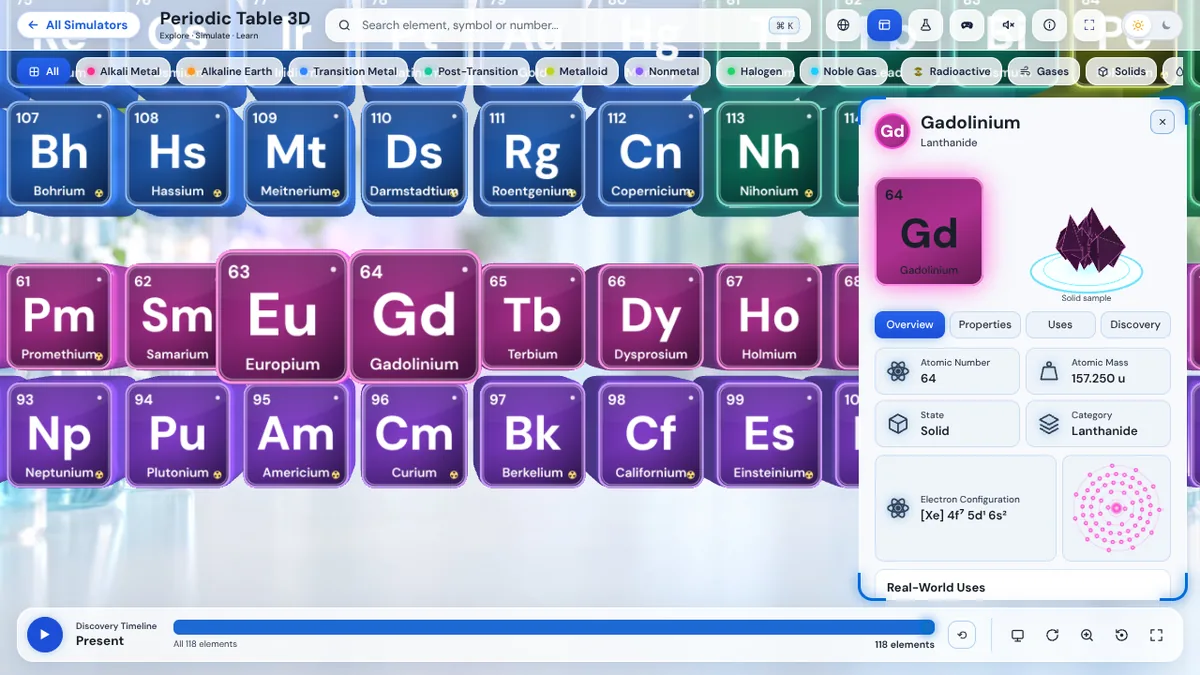 Explore in 3D
Gadolinium quick facts
| Atomic number | 64 |
|---|---|
| Symbol | Gd |
| Atomic mass | 157.25 |
| Category | Lanthanide |
| Series and period | Lanthanides, period 6 |
| Block | f-block |
| State at room temperature | Solid |
| Electron configuration | [Xe] 4f⁷ 5d¹ 6s² |
| Electrons per shell | 2, 8, 18, 25, 9, 2 |
| Discovered | 1880, de Marignac |
What is gadolinium used for?
- MRI contrast agent (Gd chelates)
- Neutron capture in nuclear reactors
- Magnetic refrigeration research
Interesting facts about gadolinium
- Gadolinium MRI contrast agents have been injected into hundreds of millions of patients worldwide
- Gadolinium has the highest neutron absorption cross-section of any stable element
- Named after Johan Gadolin. A Finnish chemist who discovered the first rare earth element
Gadolinium was discovered in 1880 by de Marignac in Switzerland.
Where gadolinium sits on the periodic table
Gadolinium is in the lanthanide series (period 6). Tap any element to open its page.
Other lanthanides
Gadolinium questions
What is the atomic number of gadolinium?
Gadolinium has atomic number 64, so every gadolinium atom has 64 protons in its nucleus. Its symbol is Gd and its atomic mass is 157.25.
Is gadolinium a metal?
Gadolinium is a metal. On the periodic table it is grouped as a lanthanide, found in the lanthanide series (period 6).
What is the electron configuration of gadolinium?
The electron configuration of gadolinium is [Xe] 4f⁷ 5d¹ 6s². Its electrons sit in 6 shells: 2, 8, 18, 25, 9, 2.
What is gadolinium used for?
Gadolinium is used for mri contrast agent (gd chelates), neutron capture in nuclear reactors and magnetic refrigeration research.
Who discovered gadolinium?
Gadolinium was discovered in 1880 by de Marignac in Switzerland.
The 3D Periodic Table is made by Julian Neagu, a solo founder in London, as part of VisionVix Simulators. It is free to use in the browser on desktop and phone, with no sign-up.