Gold (Au): Properties, Uses and Facts in 3D
Gold is element 79 on the periodic table, a transition metal. At room temperature it is a solid. Open it in the 3D Periodic Table to spin its tile, see its electron shells and read its story.
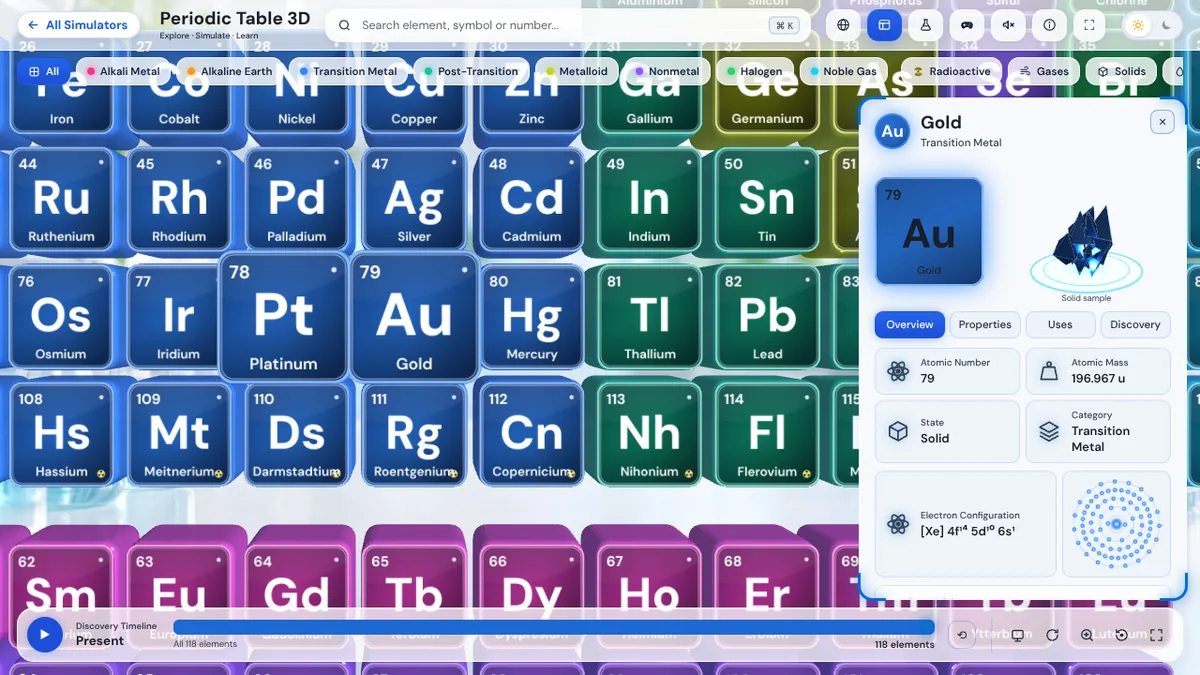 Explore in 3D
Gold quick facts
| Atomic number | 79 |
|---|---|
| Symbol | Au |
| Atomic mass | 196.967 |
| Category | Transition Metal |
| Group and period | Group 11, period 6 |
| Block | d-block |
| State at room temperature | Solid |
| Electron configuration | [Xe] 4f¹⁴ 5d¹⁰ 6s¹ |
| Electrons per shell | 2, 8, 18, 32, 18, 1 |
| Discovered | Ancient times |
What is gold used for?
- Financial reserves & investment
- Electronic contacts (corrosion-free)
- Dentistry & medical devices
Interesting facts about gold
- All the gold ever mined would form a cube about 22 metres on each side
- Gold's colour comes from relativity. Inner electrons move so fast (about 58% of light speed) that it absorbs blue light; only caesium shares the golden tint
- Astronaut visors are coated with a thin layer of gold that reflects infrared radiation
Gold has been known since ancient times, long before anyone could call it an element.
Where gold sits on the periodic table
Gold is in group 11, period 6. Tap any element to open its page.
Other transition metals
Gold questions
What is the atomic number of gold?
Gold has atomic number 79, so every gold atom has 79 protons in its nucleus. Its symbol is Au and its atomic mass is 196.967.
Is gold a metal?
Gold is a metal. On the periodic table it is grouped as a transition metal, found in group 11, period 6.
What is the electron configuration of gold?
The electron configuration of gold is [Xe] 4f¹⁴ 5d¹⁰ 6s¹. Its electrons sit in 6 shells: 2, 8, 18, 32, 18, 1.
What is gold used for?
Gold is used for financial reserves & investment, electronic contacts (corrosion-free) and dentistry & medical devices.
Who discovered gold?
Gold has been known since ancient times, long before anyone could call it an element.
The 3D Periodic Table is made by Julian Neagu, a solo founder in London, as part of VisionVix Simulators. It is free to use in the browser on desktop and phone, with no sign-up.