Dysprosium (Dy): Properties, Uses and Facts in 3D
Dysprosium is element 66 on the periodic table, a lanthanide, so it is a metal. At room temperature it is a solid. Open it in the 3D Periodic Table to spin its tile, see its electron shells and read its story.
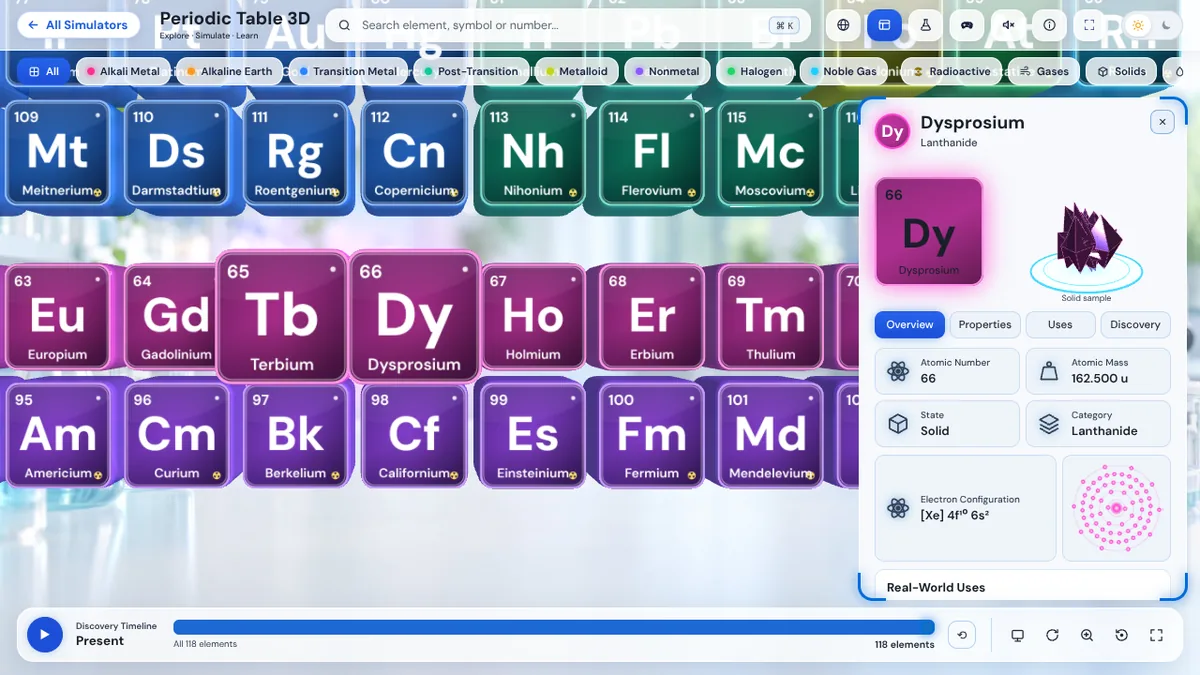 Explore in 3D
Dysprosium quick facts
| Atomic number | 66 |
|---|---|
| Symbol | Dy |
| Atomic mass | 162.5 |
| Category | Lanthanide |
| Series and period | Lanthanides, period 6 |
| Block | f-block |
| State at room temperature | Solid |
| Electron configuration | [Xe] 4f¹⁰ 6s² |
| Electrons per shell | 2, 8, 18, 28, 8, 2 |
| Discovered | 1886, Lecoq de Boisbaudran |
What is dysprosium used for?
- Neodymium magnet additive for high-temperature stability
- Nuclear reactor control rods
- Data storage (hard disk recording layer)
Interesting facts about dysprosium
- Dysprosium additions allow neodymium magnets to function in EV motors above 150°C
- Named from Greek "dysprositos". Hard to get. After more than 30 attempts to separate its oxide
- Dysprosium and holmium share the highest magnetic moment of any element
Dysprosium was discovered in 1886 by Lecoq de Boisbaudran in France.
Where dysprosium sits on the periodic table
Dysprosium is in the lanthanide series (period 6). Tap any element to open its page.
Other lanthanides
Dysprosium questions
What is the atomic number of dysprosium?
Dysprosium has atomic number 66, so every dysprosium atom has 66 protons in its nucleus. Its symbol is Dy and its atomic mass is 162.5.
Is dysprosium a metal?
Dysprosium is a metal. On the periodic table it is grouped as a lanthanide, found in the lanthanide series (period 6).
What is the electron configuration of dysprosium?
The electron configuration of dysprosium is [Xe] 4f¹⁰ 6s². Its electrons sit in 6 shells: 2, 8, 18, 28, 8, 2.
What is dysprosium used for?
Dysprosium is used for neodymium magnet additive for high-temperature stability, nuclear reactor control rods and data storage (hard disk recording layer).
Who discovered dysprosium?
Dysprosium was discovered in 1886 by Lecoq de Boisbaudran in France.
The 3D Periodic Table is made by Julian Neagu, a solo founder in London, as part of VisionVix Simulators. It is free to use in the browser on desktop and phone, with no sign-up.