Roentgenium (Rg): Properties, Uses and Facts in 3D
Roentgenium is element 111 on the periodic table, a transition metal. At room temperature it is expected to be a solid (too few atoms have ever been made to check). Open it in the 3D Periodic Table to spin its tile, see its electron shells and read its story.
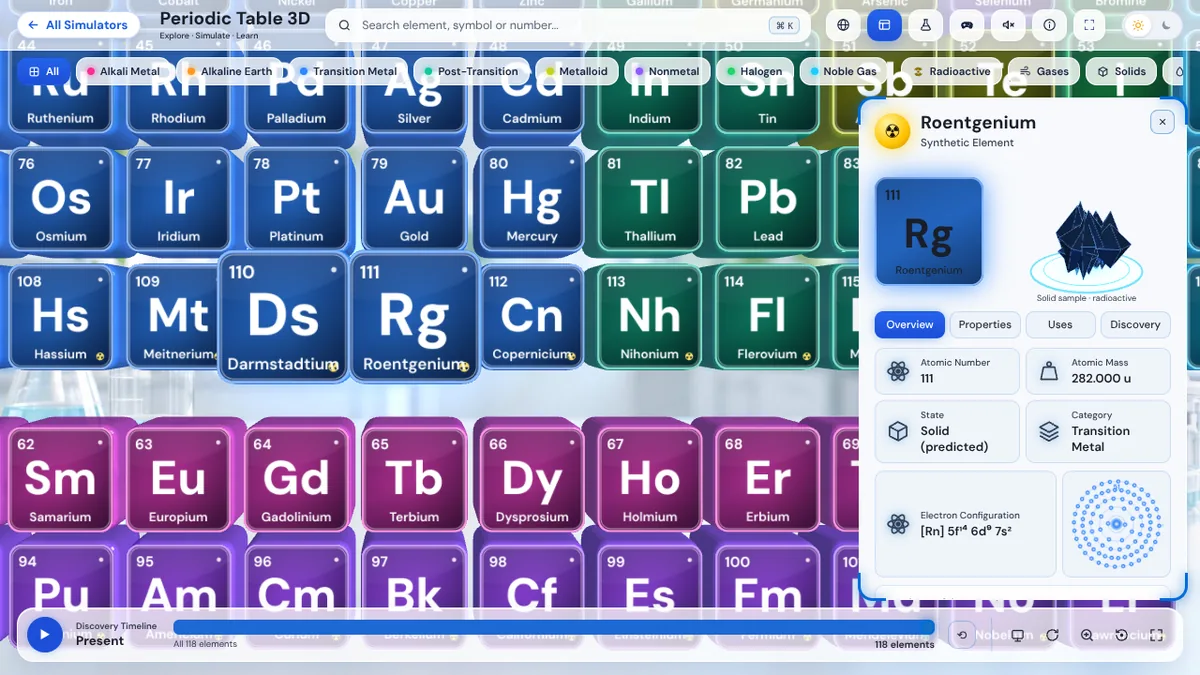 Explore in 3D
Roentgenium quick facts
| Atomic number | 111 |
|---|---|
| Symbol | Rg |
| Atomic mass | 282 |
| Category | Transition Metal |
| Group and period | Group 11, period 7 |
| Block | d-block |
| State at room temperature | Solid (expected) |
| Electron configuration | [Rn] 5f¹⁴ 6d⁹ 7s² |
| Electrons per shell | 2, 8, 18, 32, 32, 17, 2 |
| Discovered | 1994, Hofmann |
What is roentgenium used for?
- Scientific research only
- No practical applications
- Nuclear physics
Interesting facts about roentgenium
- Named after Wilhelm Röntgen. Discoverer of X-rays (and first Nobel Prize in Physics, 1901)
- Half-life: about 100 seconds for the most stable isotope (Rg-282)
- Predicted to be a noble metal. Possibly even more unreactive than gold
Roentgenium was discovered in 1994 by Hofmann in Germany.
Where roentgenium sits on the periodic table
Roentgenium is in group 11, period 7. Tap any element to open its page.
Other transition metals
Roentgenium questions
What is the atomic number of roentgenium?
Roentgenium has atomic number 111, so every roentgenium atom has 111 protons in its nucleus. Its symbol is Rg and its atomic mass is 282.
Is roentgenium a metal?
Roentgenium is a metal. On the periodic table it is grouped as a transition metal, found in group 11, period 7.
What is the electron configuration of roentgenium?
The electron configuration of roentgenium is [Rn] 5f¹⁴ 6d⁹ 7s². Its electrons sit in 7 shells: 2, 8, 18, 32, 32, 17, 2.
What is roentgenium used for?
Roentgenium is used for scientific research only, no practical applications and nuclear physics.
Who discovered roentgenium?
Roentgenium was discovered in 1994 by Hofmann in Germany.
The 3D Periodic Table is made by Julian Neagu, a solo founder in London, as part of VisionVix Simulators. It is free to use in the browser on desktop and phone, with no sign-up.