Europium (Eu): Properties, Uses and Facts in 3D
Europium is element 63 on the periodic table, a lanthanide, so it is a metal. At room temperature it is a solid. Open it in the 3D Periodic Table to spin its tile, see its electron shells and read its story.
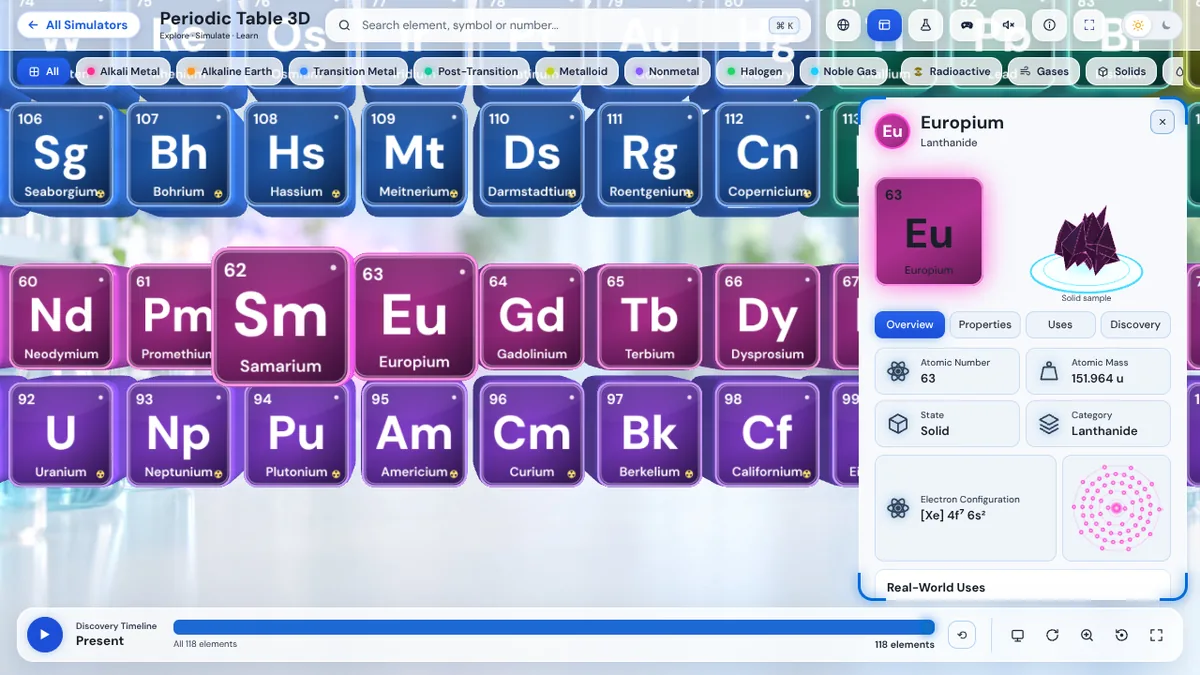 Explore in 3D
Europium quick facts
| Atomic number | 63 |
|---|---|
| Symbol | Eu |
| Atomic mass | 151.964 |
| Category | Lanthanide |
| Series and period | Lanthanides, period 6 |
| Block | f-block |
| State at room temperature | Solid |
| Electron configuration | [Xe] 4f⁷ 6s² |
| Electrons per shell | 2, 8, 18, 25, 8, 2 |
| Discovered | 1901, Demarçay |
What is europium used for?
- Red & blue phosphors in CRT and LED screens
- Euro banknote anti-counterfeiting fluorescence
- Mercury vapour lamp phosphor
Interesting facts about europium
- Europium compounds glow vividly under UV light. They authenticate euro banknotes
- From the 1960s, the bright red in colour CRT televisions came from europium phosphors
- Europium is the most reactive of all lanthanides. Reacts rapidly with water and oxygen
Europium was discovered in 1901 by Demarçay in France.
Where europium sits on the periodic table
Europium is in the lanthanide series (period 6). Tap any element to open its page.
Other lanthanides
Europium questions
What is the atomic number of europium?
Europium has atomic number 63, so every europium atom has 63 protons in its nucleus. Its symbol is Eu and its atomic mass is 151.964.
Is europium a metal?
Europium is a metal. On the periodic table it is grouped as a lanthanide, found in the lanthanide series (period 6).
What is the electron configuration of europium?
The electron configuration of europium is [Xe] 4f⁷ 6s². Its electrons sit in 6 shells: 2, 8, 18, 25, 8, 2.
What is europium used for?
Europium is used for red & blue phosphors in crt and led screens, euro banknote anti-counterfeiting fluorescence and mercury vapour lamp phosphor.
Who discovered europium?
Europium was discovered in 1901 by Demarçay in France.
The 3D Periodic Table is made by Julian Neagu, a solo founder in London, as part of VisionVix Simulators. It is free to use in the browser on desktop and phone, with no sign-up.