Holmium (Ho): Properties, Uses and Facts in 3D
Holmium is element 67 on the periodic table, a lanthanide, so it is a metal. At room temperature it is a solid. Open it in the 3D Periodic Table to spin its tile, see its electron shells and read its story.
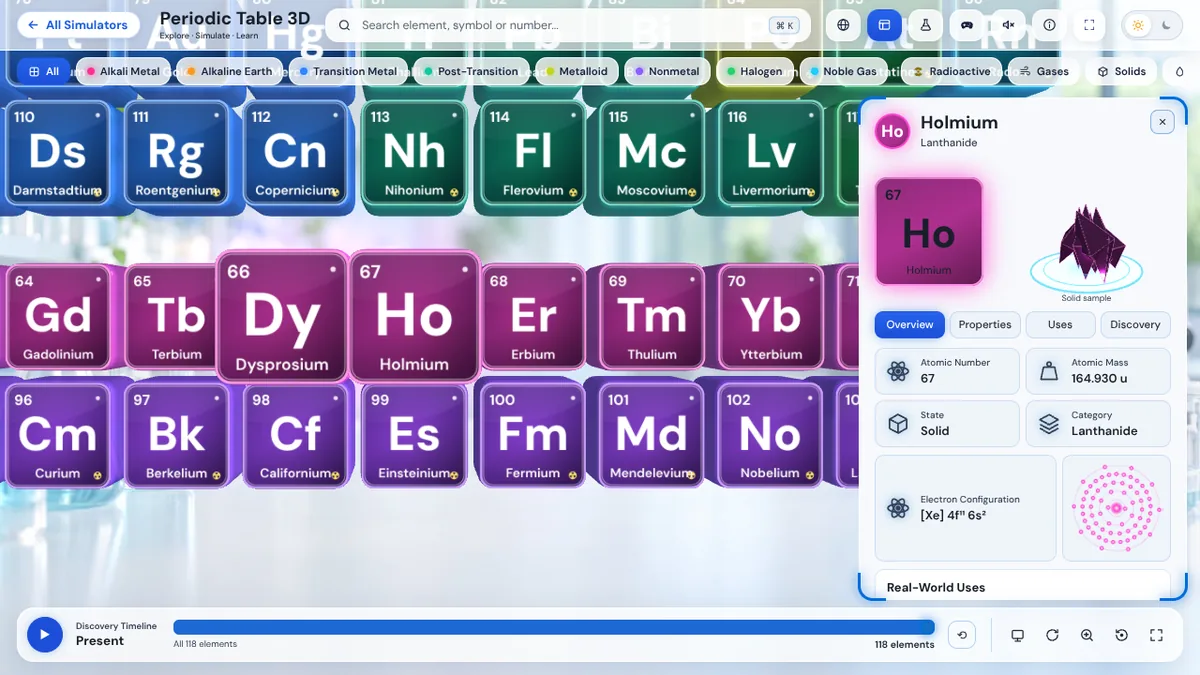 Explore in 3D
Holmium quick facts
| Atomic number | 67 |
|---|---|
| Symbol | Ho |
| Atomic mass | 164.93 |
| Category | Lanthanide |
| Series and period | Lanthanides, period 6 |
| Block | f-block |
| State at room temperature | Solid |
| Electron configuration | [Xe] 4f¹¹ 6s² |
| Electrons per shell | 2, 8, 18, 29, 8, 2 |
| Discovered | 1878, Delafontaine & Soret |
What is holmium used for?
- Holmium YAG lasers in medicine (kidney stones, prostate)
- Magnetic field pole pieces (highest saturation magnetisation)
- Nuclear reactor control rods
Interesting facts about holmium
- Named after Holmia, the Latin name for Stockholm
- Holmium and dysprosium share the highest magnetic moment of any element
- Ho:YAG lasers are used to break up kidney stones without incisions
Holmium was discovered in 1878 by Delafontaine & Soret in Switzerland.
Where holmium sits on the periodic table
Holmium is in the lanthanide series (period 6). Tap any element to open its page.
Other lanthanides
Holmium questions
What is the atomic number of holmium?
Holmium has atomic number 67, so every holmium atom has 67 protons in its nucleus. Its symbol is Ho and its atomic mass is 164.93.
Is holmium a metal?
Holmium is a metal. On the periodic table it is grouped as a lanthanide, found in the lanthanide series (period 6).
What is the electron configuration of holmium?
The electron configuration of holmium is [Xe] 4f¹¹ 6s². Its electrons sit in 6 shells: 2, 8, 18, 29, 8, 2.
What is holmium used for?
Holmium is used for holmium yag lasers in medicine (kidney stones, prostate), magnetic field pole pieces (highest saturation magnetisation) and nuclear reactor control rods.
Who discovered holmium?
Holmium was discovered in 1878 by Delafontaine & Soret in Switzerland.
The 3D Periodic Table is made by Julian Neagu, a solo founder in London, as part of VisionVix Simulators. It is free to use in the browser on desktop and phone, with no sign-up.