Krypton (Kr): Properties, Uses and Facts in 3D
Krypton is element 36 on the periodic table, a noble gas, so it is a nonmetal. At room temperature it is a gas. Open it in the 3D Periodic Table to spin its tile, see its electron shells and read its story.
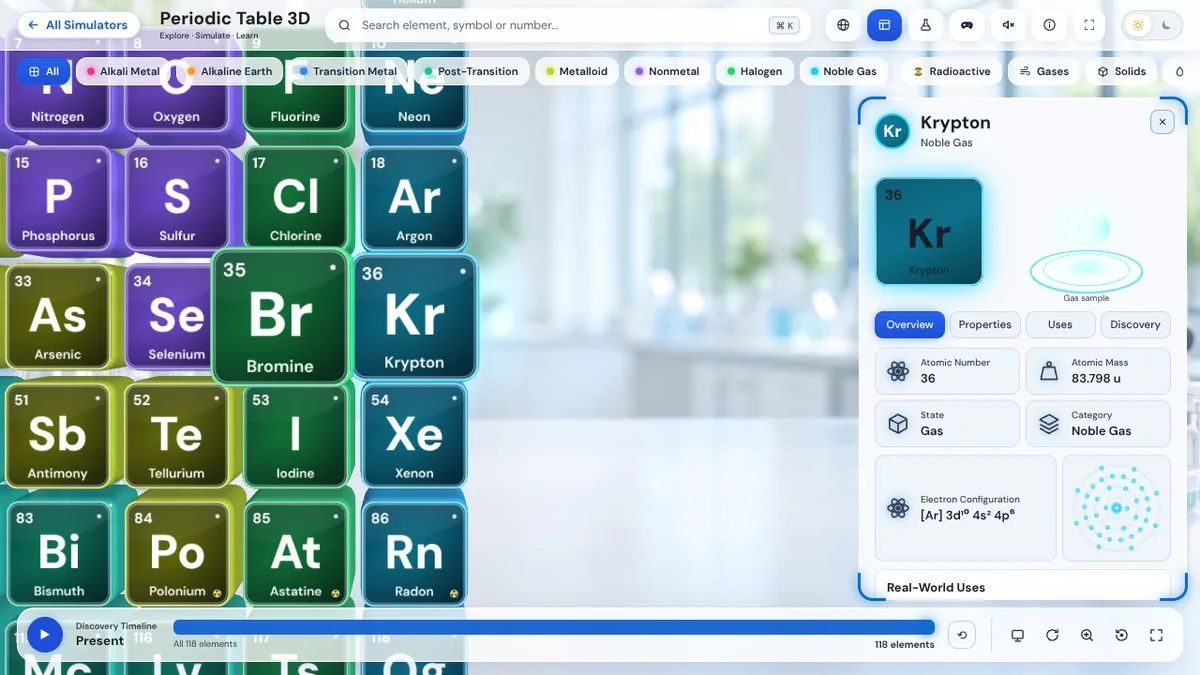 Explore in 3D
Krypton quick facts
| Atomic number | 36 |
|---|---|
| Symbol | Kr |
| Atomic mass | 83.798 |
| Category | Noble Gas |
| Group and period | Group 18, period 4 |
| Block | p-block |
| State at room temperature | Gas |
| Electron configuration | [Ar] 3d¹⁰ 4s² 4p⁶ |
| Electrons per shell | 2, 8, 18, 8 |
| Discovered | 1898, Ramsay |
What is krypton used for?
- High-powered lasers
- Insulating gas in double-glazed windows
- Defining the metre (1960 to 1983 standard)
Interesting facts about krypton
- The metre was officially defined by krypton-86 wavelength from 1960 to 1983
- Krypton has no connection to Superman's planet. The name predates the comic character by decades
- Unlike most noble gases, krypton difluoride (KrF₂) can be formed under extreme conditions
Krypton was discovered in 1898 by Ramsay in Britain.
Where krypton sits on the periodic table
Krypton is in group 18, period 4. Tap any element to open its page.
Other noble gass
Krypton questions
What is the atomic number of krypton?
Krypton has atomic number 36, so every krypton atom has 36 protons in its nucleus. Its symbol is Kr and its atomic mass is 83.798.
Is krypton a metal?
Krypton is a nonmetal. On the periodic table it is grouped as a noble gas, found in group 18, period 4.
What is the electron configuration of krypton?
The electron configuration of krypton is [Ar] 3d¹⁰ 4s² 4p⁶. Its electrons sit in 4 shells: 2, 8, 18, 8.
What is krypton used for?
Krypton is used for high-powered lasers, insulating gas in double-glazed windows and defining the metre (1960 to 1983 standard).
Who discovered krypton?
Krypton was discovered in 1898 by Ramsay in Britain.
The 3D Periodic Table is made by Julian Neagu, a solo founder in London, as part of VisionVix Simulators. It is free to use in the browser on desktop and phone, with no sign-up.