Curium (Cm): Properties, Uses and Facts in 3D
Curium is element 96 on the periodic table, an actinide, so it is a metal. At room temperature it is a solid. Open it in the 3D Periodic Table to spin its tile, see its electron shells and read its story.
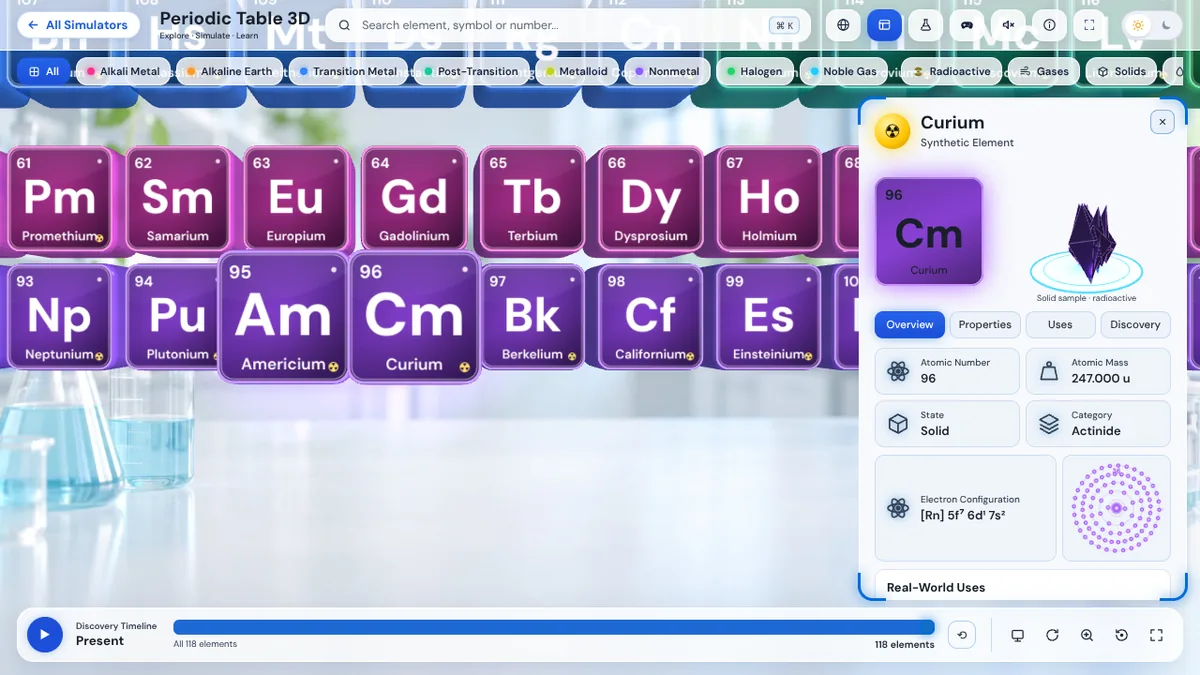 Explore in 3D
Curium quick facts
| Atomic number | 96 |
|---|---|
| Symbol | Cm |
| Atomic mass | 247 |
| Category | Actinide |
| Series and period | Actinides, period 7 |
| Block | f-block |
| State at room temperature | Solid |
| Electron configuration | [Rn] 5f⁷ 6d¹ 7s² |
| Electrons per shell | 2, 8, 18, 32, 25, 9, 2 |
| Discovered | 1944, Seaborg |
What is curium used for?
- Alpha particle X-ray spectrometers (Mars rovers)
- Scientific research
- Radiation sources
Interesting facts about curium
- Mars rovers (Sojourner, Spirit, Opportunity, Curiosity) carried curium-244 as an alpha source for rock analysis
- Named in honour of Pierre and Marie Curie
- Curium was created secretly during the Manhattan Project and only announced after WWII
Curium was discovered in 1944 by Seaborg in the United States.
Where curium sits on the periodic table
Curium is in the actinide series (period 7). Tap any element to open its page.
Other actinides
Curium questions
What is the atomic number of curium?
Curium has atomic number 96, so every curium atom has 96 protons in its nucleus. Its symbol is Cm and its atomic mass is 247.
Is curium a metal?
Curium is a metal. On the periodic table it is grouped as an actinide, found in the actinide series (period 7).
What is the electron configuration of curium?
The electron configuration of curium is [Rn] 5f⁷ 6d¹ 7s². Its electrons sit in 7 shells: 2, 8, 18, 32, 25, 9, 2.
What is curium used for?
Curium is used for alpha particle x-ray spectrometers (mars rovers), scientific research and radiation sources.
Who discovered curium?
Curium was discovered in 1944 by Seaborg in the United States.
The 3D Periodic Table is made by Julian Neagu, a solo founder in London, as part of VisionVix Simulators. It is free to use in the browser on desktop and phone, with no sign-up.