Barium (Ba): Properties, Uses and Facts in 3D
Barium is element 56 on the periodic table, an alkaline earth metal. At room temperature it is a solid. Open it in the 3D Periodic Table to spin its tile, see its electron shells and read its story.
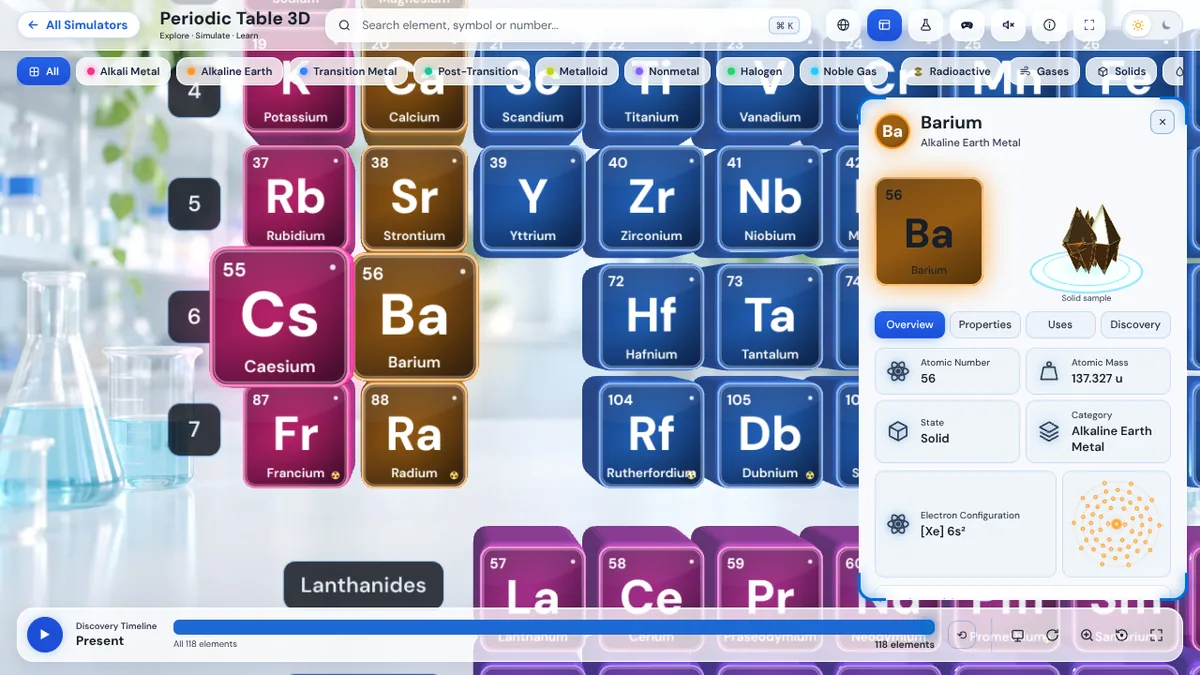 Explore in 3D
Barium quick facts
| Atomic number | 56 |
|---|---|
| Symbol | Ba |
| Atomic mass | 137.327 |
| Category | Alkaline Earth Metal |
| Group and period | Group 2, period 6 |
| Block | s-block |
| State at room temperature | Solid |
| Electron configuration | [Xe] 6s² |
| Electrons per shell | 2, 8, 18, 18, 8, 2 |
| Discovered | 1808, Davy |
What is barium used for?
- Barium sulfate for GI X-ray contrast
- Rat poison (barium carbonate)
- Green firework colour
Interesting facts about barium
- A "barium meal" coats the digestive tract to make it visible under X-rays
- Barium sulfate is so insoluble it's safe to swallow. Barium carbonate dissolves in stomach acid and is toxic
- Barite (barium sulfate) is so dense it's used as drilling mud in oil and gas wells
Barium was discovered in 1808 by Davy in Britain.
Where barium sits on the periodic table
Barium is in group 2, period 6. Tap any element to open its page.
Other alkaline earth metals
Barium questions
What is the atomic number of barium?
Barium has atomic number 56, so every barium atom has 56 protons in its nucleus. Its symbol is Ba and its atomic mass is 137.327.
Is barium a metal?
Barium is a metal. On the periodic table it is grouped as an alkaline earth metal, found in group 2, period 6.
What is the electron configuration of barium?
The electron configuration of barium is [Xe] 6s². Its electrons sit in 6 shells: 2, 8, 18, 18, 8, 2.
What is barium used for?
Barium is used for barium sulfate for gi x-ray contrast, rat poison (barium carbonate) and green firework colour.
Who discovered barium?
Barium was discovered in 1808 by Davy in Britain.
The 3D Periodic Table is made by Julian Neagu, a solo founder in London, as part of VisionVix Simulators. It is free to use in the browser on desktop and phone, with no sign-up.