Uranus vs Neptune: The Ice Giants Compared in 3D
Uranus and Neptune are near twins in size, the two ice giants at the edge of the solar system. Uranus rolls around the Sun on its side. Neptune has the fastest winds of any planet. Both have been visited by only one spacecraft, Voyager 2.
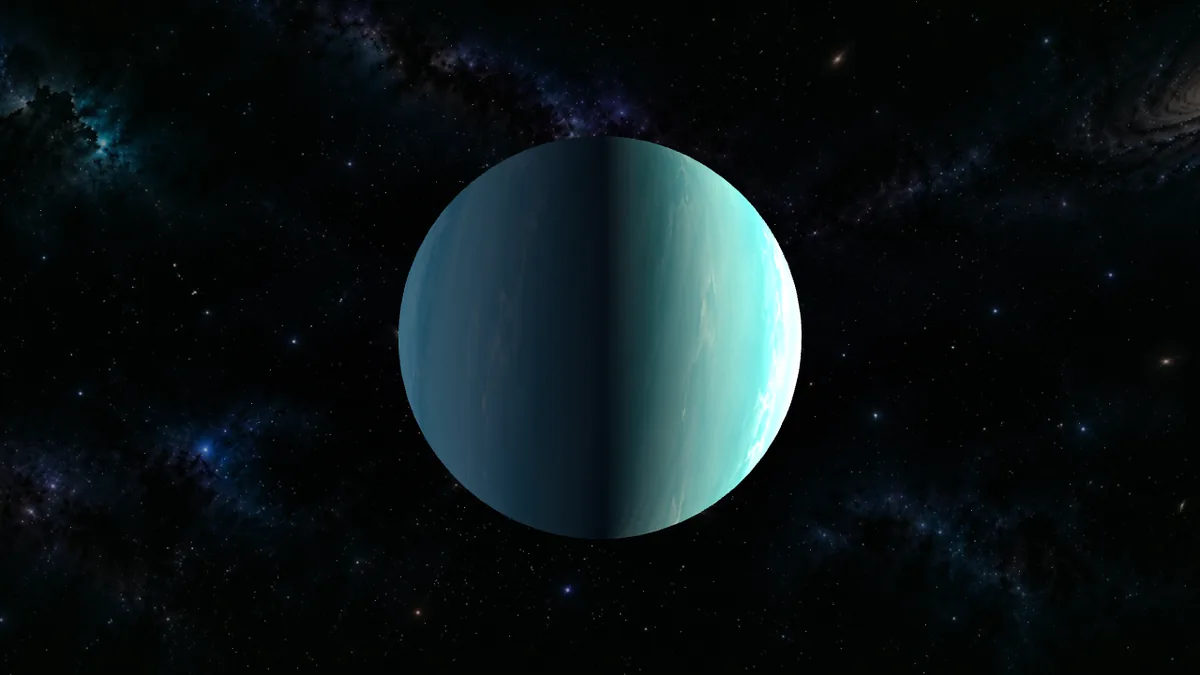
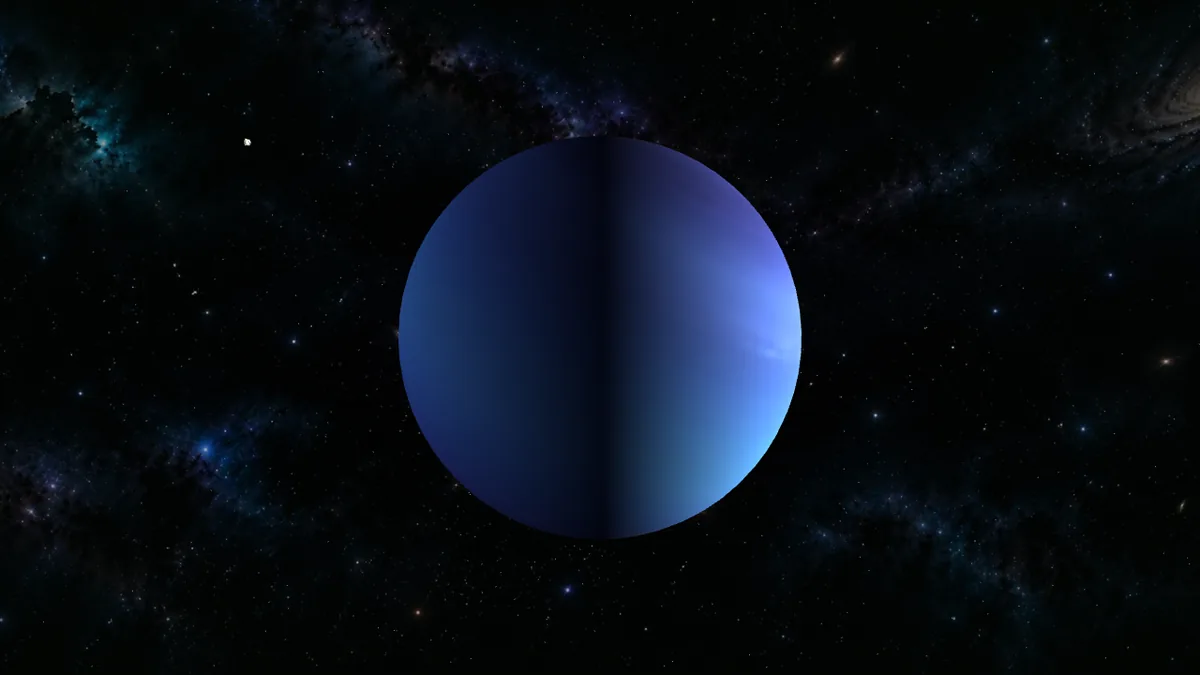
Uranus vs Neptune: true size
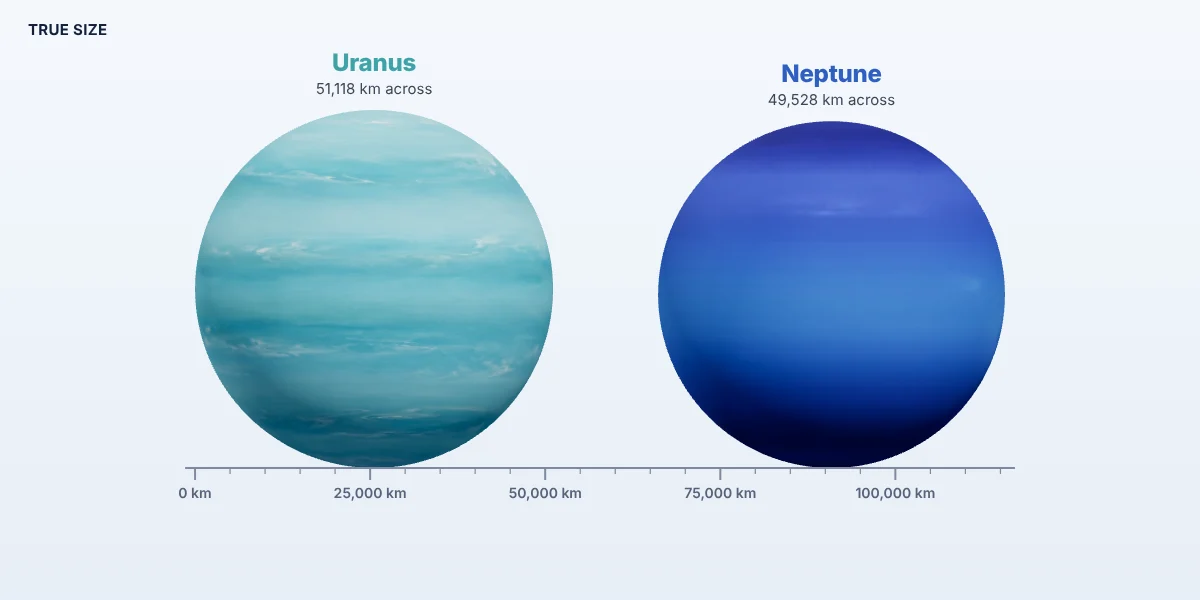
Uranus vs Neptune at a glance
| Uranus | Neptune | |
|---|---|---|
| Diameter | 51,118 km, about 4 Earths | 49,528 km, about 4 Earths |
| Mass | About 14.5 Earths | About 17 Earths, the heavier of the two |
| Axis tilt | About 98 degrees, on its side | About 28 degrees |
| Day | About 17.2 hours | About 16.1 hours |
| Year | About 84 Earth years | About 165 Earth years |
| Distance from the Sun | About 2.9 billion km | About 4.5 billion km |
| Winds | Up to about 900 km/h | Up to about 2,100 km/h, the fastest in the solar system |
| Coldest air | About −224 °C, the coldest of any planet | About −218 °C |
| Discovered | 1781, by William Herschel with a telescope | 1846, predicted by maths, then spotted by telescope |
Twins with different moods
Size for size, they are almost identical, and both are made mostly of water, ammonia and methane ices around a rocky core, under hydrogen and helium air. Yet Uranus looks calm and Neptune is stormy. Neptune gives off more than twice as much heat as it gets from the Sun, which may power its storms. Uranus gives off very little, and nobody is sure why.
The planet on its side
Uranus is tilted so far that it rolls around the Sun. Each pole gets about 42 years of sunlight followed by 42 years of darkness. Scientists think a giant collision long ago knocked it over.
Quick facts
- Voyager 2 flew past Uranus in 1986 and Neptune in 1989.
- Neptune’s largest moon, Triton, orbits backwards and may be a captured dwarf planet.
- Both planets have faint rings.
- Studies in 2024 found the two are closer in colour than old photos suggested: both are a pale greenish blue.
- Neptune has completed only about one orbit since it was discovered.
See their neighbours in 3D
Uranus vs Neptune questions
Which is bigger, Uranus or Neptune?
Uranus is slightly wider, 51,118 km against 49,528 km. Neptune is heavier, at about 17 Earth masses against 14.5.
Why is Uranus tilted on its side?
Scientists think one or more giant collisions early in its history knocked it over.
Which planet has the fastest winds?
Neptune, with winds up to about 2,100 km/h.
Which is colder, Uranus or Neptune?
Uranus has the coldest recorded air of any planet, about −224 °C, even though Neptune is farther from the Sun.
Why are Uranus and Neptune blue?
Methane in their air absorbs red light and reflects blue and green light.
More face-offs: see all 3D comparisons.
The 3D Solar System is made by Julian Neagu, a solo founder in London, as part of VisionVix Simulators. It is free to use in the browser on desktop and phone, with no sign-up.