Uranus in 3D: Facts About the Sideways Planet
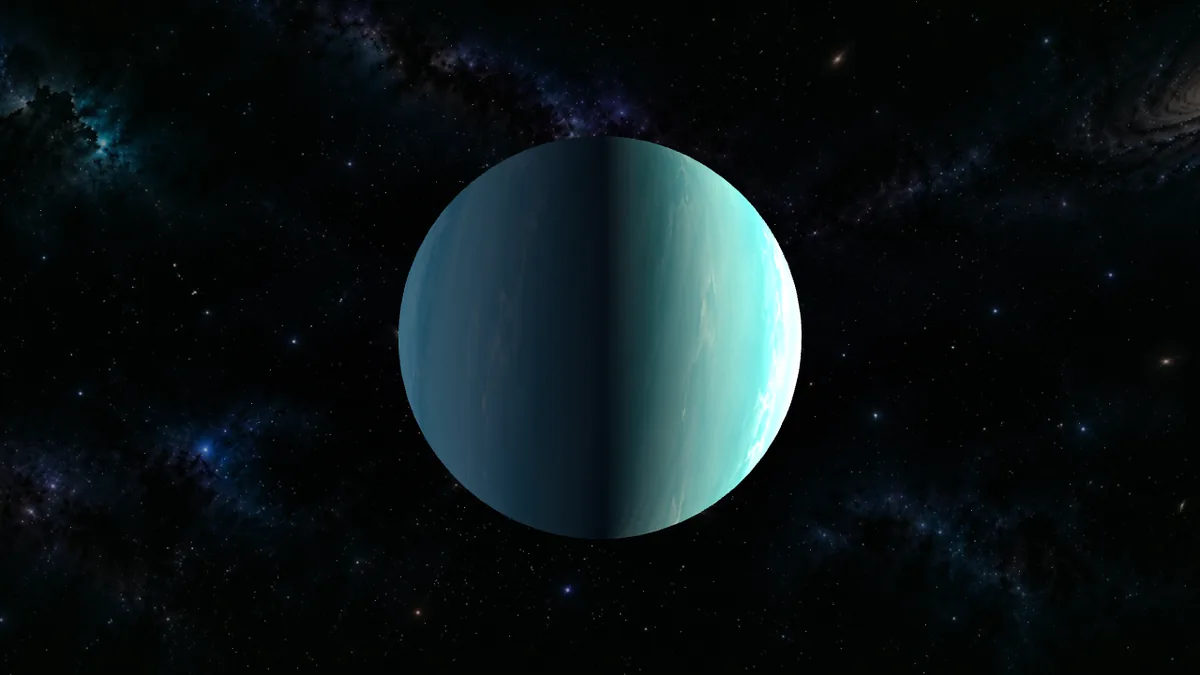
Uranus is the seventh planet from the Sun, an ice giant with a pale blue green colour. Its axis is tipped right over, so it rolls around the Sun on its side. In the 3D Solar System you can fly to Uranus and see its sideways tilt for yourself.
 Explore in 3D
Uranus quick facts
| Type | Ice giant |
|---|---|
| Diameter | 51,118 km, about 4 Earths across |
| Distance from the Sun | About 2.87 billion km |
| Year | About 84 Earth years |
| Day | About 17.2 hours |
| Axis tilt | About 98 degrees |
| Coldest air | About minus 224 °C |
| Position | 7th planet from the Sun |
Interesting facts about Uranus
- Uranus is tilted by about 98 degrees, so it spins on its side.
- Each pole gets about 42 years of sunlight followed by about 42 years of darkness.
- It has the coldest atmosphere of any planet, down to about minus 224 °C.
- Methane gas in its air gives it its blue green colour.
- It was the first planet found with a telescope, by William Herschel in 1781.
What you can do in 3D
Fly to Uranus and look at the angle of its spin, then compare it with the upright planets around it.
From the Sun outwards
7th planet from the Sun. Tap any body to open its page.
Uranus questions
Why does Uranus spin on its side?
Scientists think a huge collision long ago knocked it over, leaving its axis tilted by about 98 degrees.
What colour is Uranus?
Pale blue green. Methane in its atmosphere absorbs red light and reflects blue and green.
How cold is Uranus?
Its atmosphere is the coldest of any planet, reaching about minus 224 °C.
How long is a year on Uranus?
About 84 Earth years. A day lasts about 17.2 hours.
Who discovered Uranus?
William Herschel in 1781. It was the first planet discovered with a telescope.
The 3D Solar System is made by Julian Neagu, a solo founder in London, as part of VisionVix Simulators. It is free to use in the browser on desktop and phone, with no sign-up. Facts are based on NASA data.