The Moon in 3D: Facts About Earth's Moon
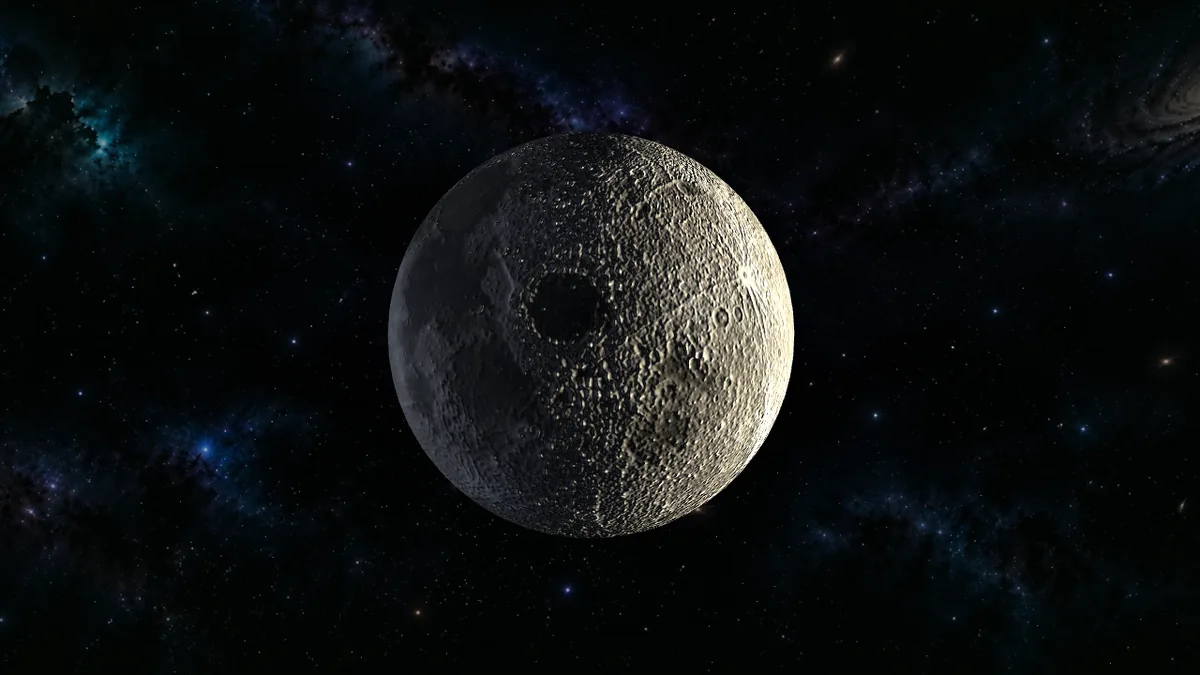
The Moon is Earth's only natural satellite and the only place beyond Earth where people have walked. It always shows us the same face as it circles our planet. In the 3D Solar System you can open the Moon on its own and turn it to see its craters and dark plains.
 Explore in 3D
Moon quick facts
| Type | Moon of Earth |
|---|---|
| Diameter | 3,475 km, about a quarter of Earth's |
| Distance from Earth | About 384,400 km |
| Orbit | About 27.3 days |
| Gravity | 1.6 m/s², about one sixth of Earth's |
| Atmosphere | Almost none |
| Position | Earth's only natural satellite |
Interesting facts about the Moon
- The Moon turns once in the same time it takes to orbit Earth, so we always see the same side.
- Its gravity pulls on Earth's oceans and causes the tides.
- Twelve astronauts walked on the Moon during the Apollo missions between 1969 and 1972.
- The dark patches are old lava plains called maria.
- It is slowly moving away from Earth, by about 3.8 cm each year.
What you can do in 3D
Open the Moon in focus view to see it on its own, then turn it to explore its craters and the dark maria you can see from Earth.
From the Sun outwards
Earth's only natural satellite. Tap any body to open its page.
Moon questions
How far away is the Moon?
About 384,400 km on average. That is roughly 30 Earths lined up side by side.
Why do we always see the same side of the Moon?
The Moon spins once for every trip around Earth, so the same face always points towards us.
How does the Moon cause tides?
The Moon's gravity pulls on Earth's oceans, making them bulge. As Earth turns, coasts pass through these bulges and get high and low tides.
How big is the Moon?
The Moon is 3,475 km across, about a quarter of Earth's width.
Has anyone walked on the Moon?
Yes. Twelve astronauts walked on the Moon during NASA's Apollo missions between 1969 and 1972.
The 3D Solar System is made by Julian Neagu, a solo founder in London, as part of VisionVix Simulators. It is free to use in the browser on desktop and phone, with no sign-up. Facts are based on NASA data.