Mars in 3D: Facts About the Red Planet
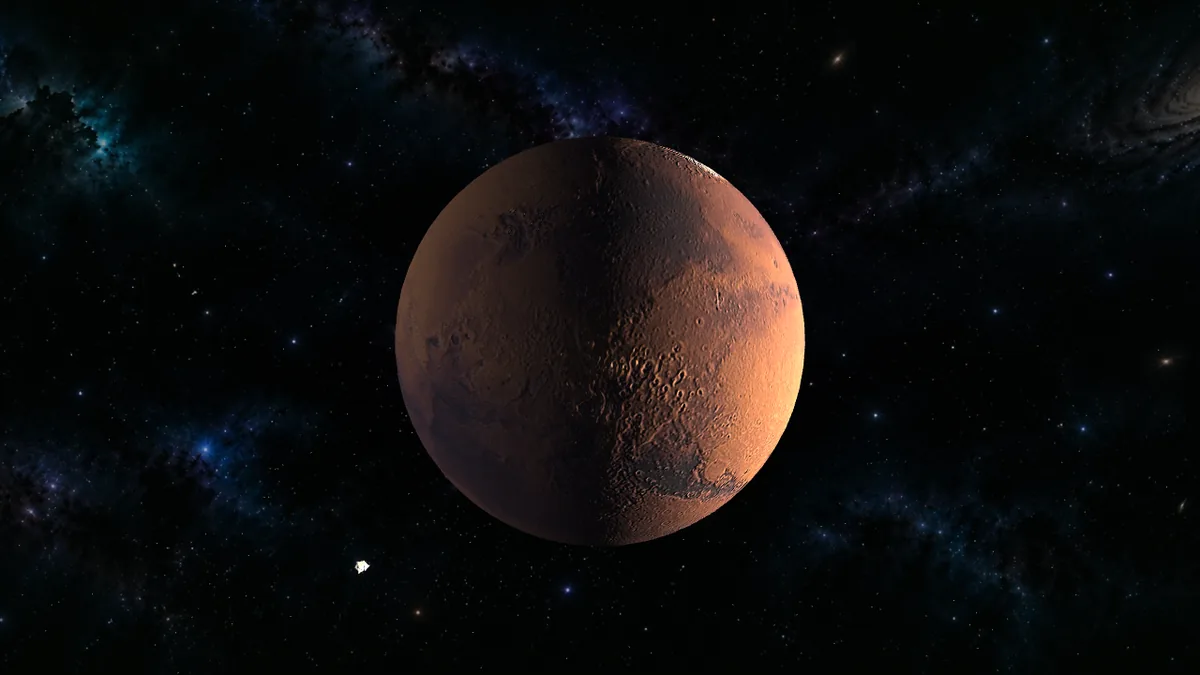
Mars is the fourth planet from the Sun, known as the red planet because of the rusty iron dust on its surface. It has the tallest volcano in the Solar System and signs that water once flowed there. In the 3D Solar System you can fly to Mars and spin its red globe.
 Explore in 3D
Mars quick facts
| Type | Rocky planet |
|---|---|
| Diameter | 6,792 km, about half of Earth's |
| Distance from the Sun | About 227.9 million km |
| Year | 687 Earth days |
| Day | About 24 hours 37 minutes |
| Gravity | 3.7 m/s², about 38% of Earth's |
| Moons | Two, Phobos and Deimos |
| Position | 4th planet from the Sun |
Interesting facts about Mars
- Mars looks red because its dust is full of iron oxide, the same thing as rust.
- Olympus Mons is the tallest volcano in the Solar System, about 22 km high.
- Valles Marineris is a canyon system about 4,000 km long.
- A day on Mars is only about 37 minutes longer than a day on Earth.
- Rovers have found dry riverbeds and lake beds, so water once flowed on its surface.
What you can do in 3D
Fly to Mars from the planet bar, turn it to find its dark patches and polar caps, and compare its size with Earth.
From the Sun outwards
4th planet from the Sun. Tap any body to open its page.
Mars questions
Why is Mars red?
Its surface dust contains a lot of iron oxide, the same compound as rust, which gives the planet its red colour.
How long is a day on Mars?
About 24 hours and 37 minutes, very close to a day on Earth. A year on Mars lasts 687 Earth days.
Does Mars have moons?
Yes, two small moons called Phobos and Deimos. They are lumpy and only about 22 km and 12 km across.
Was there water on Mars?
Yes. Rovers and orbiters have found old riverbeds, lake beds and minerals that form in water, and there is still ice at the poles.
What is the tallest volcano on Mars?
Olympus Mons, about 22 km high, is the tallest volcano in the whole Solar System.
The 3D Solar System is made by Julian Neagu, a solo founder in London, as part of VisionVix Simulators. It is free to use in the browser on desktop and phone, with no sign-up. Facts are based on NASA data.