Venus in 3D: Facts About the Hottest Planet
Venus is the second planet from the Sun and almost the same size as Earth. Under its thick yellow clouds it is the hottest planet in the Solar System. In the 3D Solar System you can fly to Venus and see its cloud-covered globe up close.
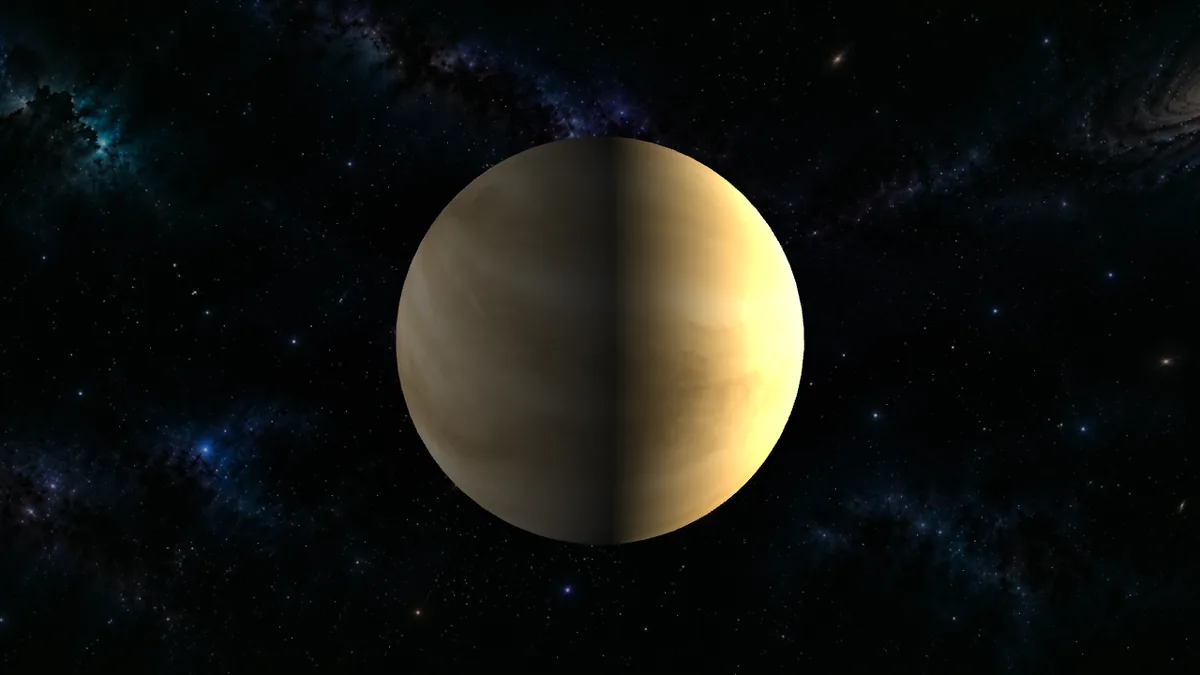 Explore in 3D
Venus quick facts
| Type | Rocky planet |
|---|---|
| Diameter | 12,104 km |
| Distance from the Sun | About 108.2 million km |
| Year | About 225 Earth days |
| Spin | 243 Earth days, backwards |
| Surface temperature | About 464 °C |
| Moons | None |
| Position | 2nd planet from the Sun |
Interesting facts about Venus
- Venus is hotter than Mercury, even though it is farther from the Sun, because its thick air traps heat.
- It spins backwards compared with most planets, so the Sun rises in the west.
- One spin takes 243 Earth days, longer than its year of about 225 days.
- The air pressure on the surface is about 90 times that on Earth.
- After the Moon, it is the brightest natural object in our night sky.
What you can do in 3D
Pick Venus in the planet bar to fly in, then turn the globe to see its swirling cloud tops, and compare its size with Earth next door.
From the Sun outwards
2nd planet from the Sun. Tap any body to open its page.
Venus questions
Why is Venus the hottest planet?
Its thick carbon dioxide atmosphere traps the Sun's heat, a runaway greenhouse effect, keeping the surface at about 464 °C day and night.
Is Venus the same size as Earth?
Nearly. Venus is 12,104 km across, about 95% of Earth's width, which is why it is called Earth's twin.
Does Venus spin backwards?
Yes. Venus turns in the opposite direction to most planets, so on Venus the Sun would rise in the west and set in the east.
How long is a day on Venus?
One full spin takes 243 Earth days, which is longer than its year of about 225 Earth days.
Can you see Venus from Earth?
Yes. Venus is often the bright point seen near sunrise or sunset, which is why it is called the morning or evening star.
The 3D Solar System is made by Julian Neagu, a solo founder in London, as part of VisionVix Simulators. It is free to use in the browser on desktop and phone, with no sign-up. Facts are based on NASA data.