Neptune in 3D: Facts About the Farthest Planet
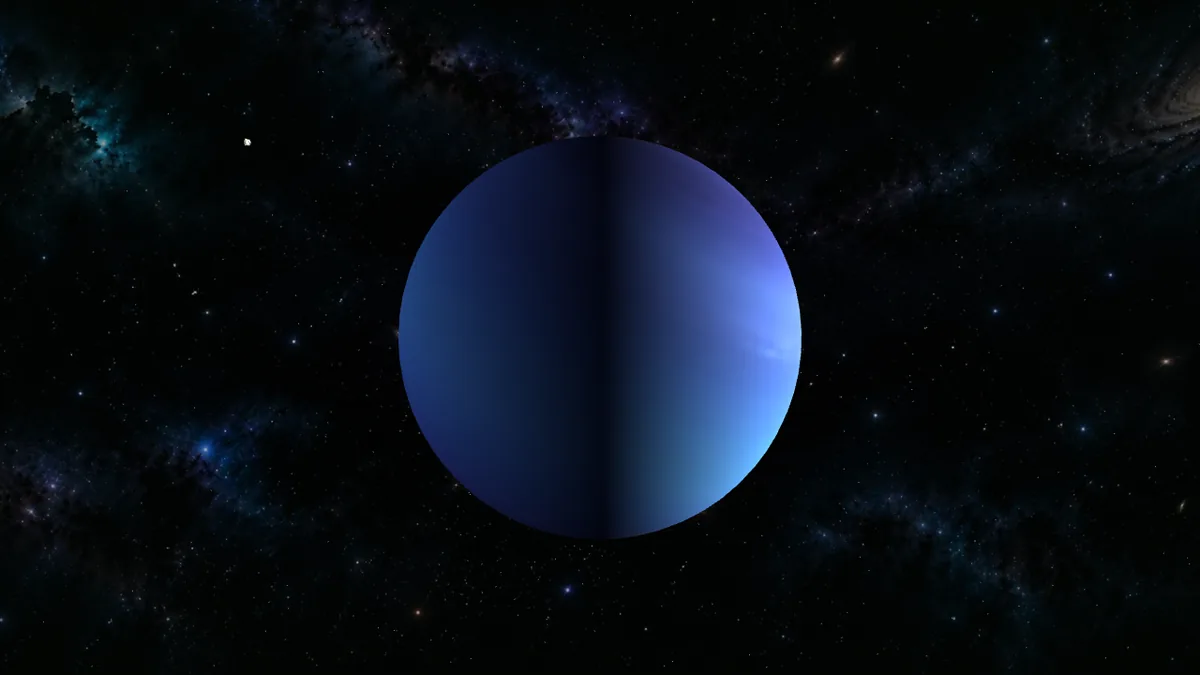
Neptune is the eighth and farthest planet from the Sun. It is a deep blue ice giant with the strongest winds in the Solar System. In the 3D Solar System you can fly all the way out to Neptune and see how far it is from the Sun.
 Explore in 3D
Neptune quick facts
| Type | Ice giant |
|---|---|
| Diameter | 49,528 km, about 4 Earths across |
| Distance from the Sun | About 4.5 billion km |
| Year | About 165 Earth years |
| Day | About 16.1 hours |
| Gravity | 11.0 m/s², a little more than Earth's |
| Largest moon | Triton |
| Position | 8th planet from the Sun |
Interesting facts about Neptune
- Neptune has the fastest winds in the Solar System, over 2,000 km per hour.
- It takes about 165 Earth years to go around the Sun once.
- It was found in 1846 using maths, before anyone saw it through a telescope.
- Its largest moon, Triton, orbits backwards compared with Neptune's spin.
- Sunlight takes about four hours to reach Neptune.
What you can do in 3D
Fly to Neptune at the edge of the planet bar, then zoom out with the orbits on to see the huge gap between it and the Sun.
From the Sun outwards
8th planet from the Sun. Tap any body to open its page.
Neptune questions
How far is Neptune from the Sun?
About 4.5 billion km, around 30 times farther than Earth. Sunlight takes about four hours to get there.
Why is Neptune blue?
Methane in its atmosphere absorbs red light, so the planet looks a deep blue.
How fast are the winds on Neptune?
The fastest in the Solar System, over 2,000 km per hour.
How was Neptune discovered?
In 1846, astronomers used maths to predict where an unseen planet was pulling on Uranus, then found Neptune right there.
How long is a year on Neptune?
About 165 Earth years. Neptune has completed only one orbit since it was discovered in 1846.
The 3D Solar System is made by Julian Neagu, a solo founder in London, as part of VisionVix Simulators. It is free to use in the browser on desktop and phone, with no sign-up. Facts are based on NASA data.