Jupiter in 3D: Facts About the Biggest Planet
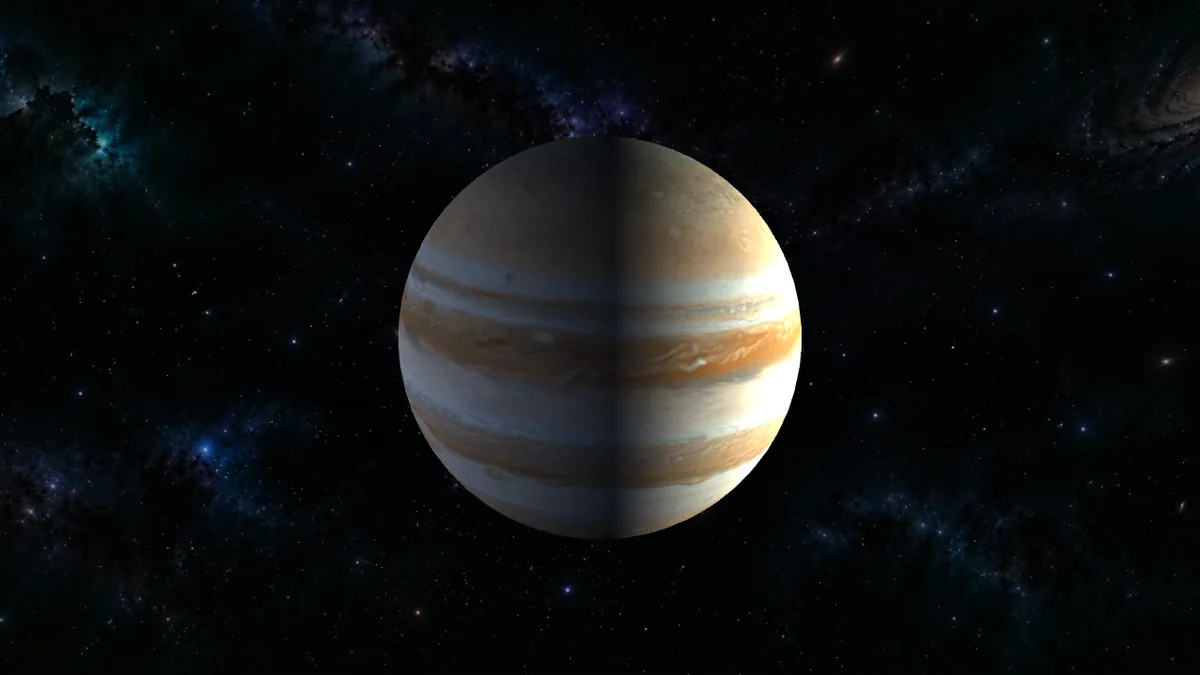
Jupiter is the fifth planet from the Sun and by far the largest. It is a gas giant made mostly of hydrogen and helium, striped with colourful cloud bands and home to the Great Red Spot, a storm wider than Earth. In the 3D Solar System you can fly to Jupiter and watch it turn.
 Explore in 3D
Jupiter quick facts
| Type | Gas giant |
|---|---|
| Diameter | 142,984 km, about 11 Earths across |
| Distance from the Sun | About 778.6 million km |
| Year | About 11.9 Earth years |
| Day | About 9.9 hours |
| Gravity | 23.1 m/s², about 2.4 times Earth's |
| Moons | Dozens, including the four large Galilean moons |
| Position | 5th planet from the Sun |
Interesting facts about Jupiter
- Jupiter is more than twice as massive as all the other planets put together.
- The Great Red Spot is a giant storm wider than Earth that has been watched for over 300 years.
- It spins faster than any other planet, once every 9.9 hours.
- Its moon Ganymede is the largest moon in the Solar System, bigger than the planet Mercury.
- Europa, another moon, has an ocean of liquid water under its icy crust.
What you can do in 3D
Fly to Jupiter to see its cloud bands up close, then pull back and compare its huge size with the rocky planets near the Sun.
From the Sun outwards
5th planet from the Sun. Tap any body to open its page.
Jupiter questions
How big is Jupiter?
Jupiter is 142,984 km across, about 11 times the width of Earth. More than 1,300 Earths could fit inside it.
What is the Great Red Spot?
It is a huge storm in Jupiter's clouds, wider than Earth, that astronomers have watched for more than 300 years.
Can you stand on Jupiter?
No. Jupiter is a gas giant with no solid surface. Its gases just get thicker and hotter the deeper you go.
How long is a day on Jupiter?
About 9.9 hours, the shortest day of any planet. A year on Jupiter lasts about 11.9 Earth years.
What are Jupiter's biggest moons?
The four Galilean moons: Io, Europa, Ganymede and Callisto. Ganymede is the largest moon in the Solar System.
The 3D Solar System is made by Julian Neagu, a solo founder in London, as part of VisionVix Simulators. It is free to use in the browser on desktop and phone, with no sign-up. Facts are based on NASA data.