Saturn in 3D: Facts About the Ringed Planet
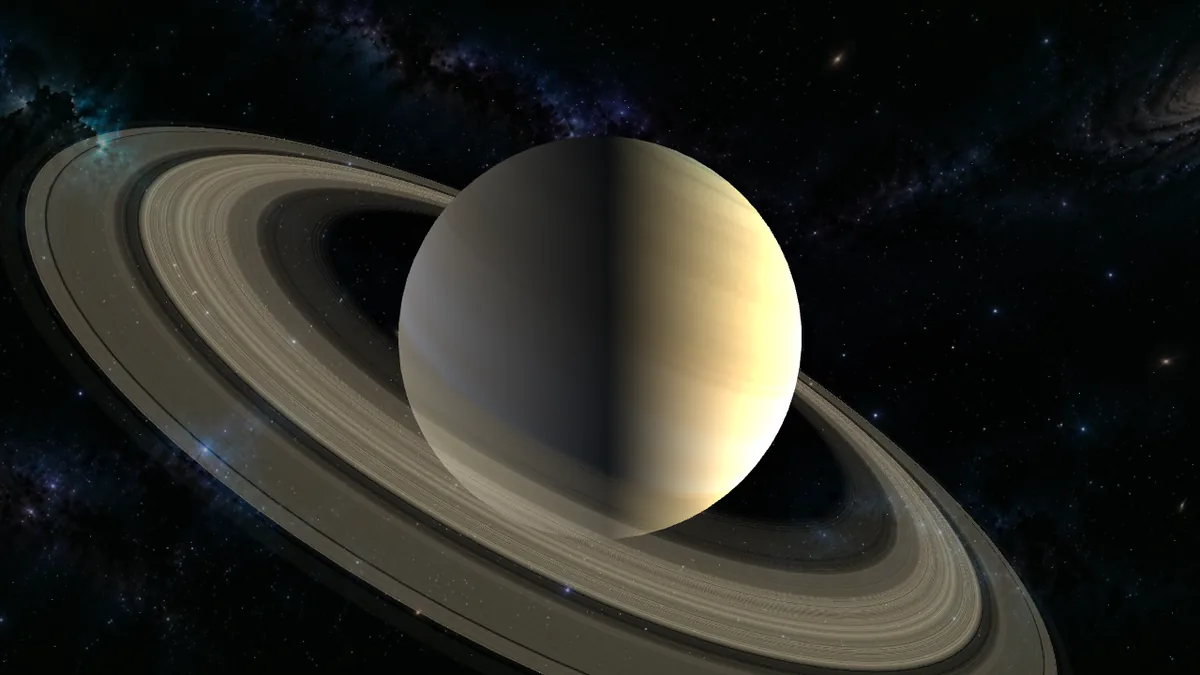
Saturn is the sixth planet from the Sun and famous for its bright rings of ice and rock. It is a gas giant so light for its size that it would float in a big enough bath of water. In the 3D Solar System you can fly to Saturn and turn it to see the rings from every angle.
 Explore in 3D
Saturn quick facts
| Type | Gas giant |
|---|---|
| Diameter | 120,536 km, about 9 Earths across |
| Distance from the Sun | About 1.43 billion km |
| Year | About 29.4 Earth years |
| Day | About 10.7 hours |
| Density | Less than water |
| Moons | Many, including Titan and Enceladus |
| Position | 6th planet from the Sun |
Interesting facts about Saturn
- Saturn's rings are made of countless pieces of ice and rock, from tiny grains to chunks the size of houses.
- The main rings stretch across about 280,000 km but are mostly only about 10 metres thick.
- Saturn is less dense than water, so it would float if there were a bath big enough.
- Its moon Titan has a thick atmosphere and lakes of liquid methane.
- Its moon Enceladus sprays jets of icy water out into space.
What you can do in 3D
Fly to Saturn and turn it slowly to watch the rings tilt, then zoom out to see how far it sits from the Sun compared with the inner planets.
From the Sun outwards
6th planet from the Sun. Tap any body to open its page.
Saturn questions
What are Saturn's rings made of?
Countless pieces of water ice and rock, from dust-sized grains to chunks as big as houses, all orbiting Saturn.
Would Saturn float in water?
In theory, yes. Saturn's average density is lower than water, so it would float in a bath big enough to hold it.
How big is Saturn?
Saturn is 120,536 km across, about 9 times the width of Earth, the second largest planet after Jupiter.
How long is a year on Saturn?
About 29.4 Earth years. A day is short though, only about 10.7 hours.
What is special about Titan?
Titan, Saturn's largest moon, has a thick atmosphere and rivers and lakes of liquid methane, the only moon with liquid on its surface.
The 3D Solar System is made by Julian Neagu, a solo founder in London, as part of VisionVix Simulators. It is free to use in the browser on desktop and phone, with no sign-up. Facts are based on NASA data.