Ear Anatomy in 3D: Outer, Middle and Inner Ear
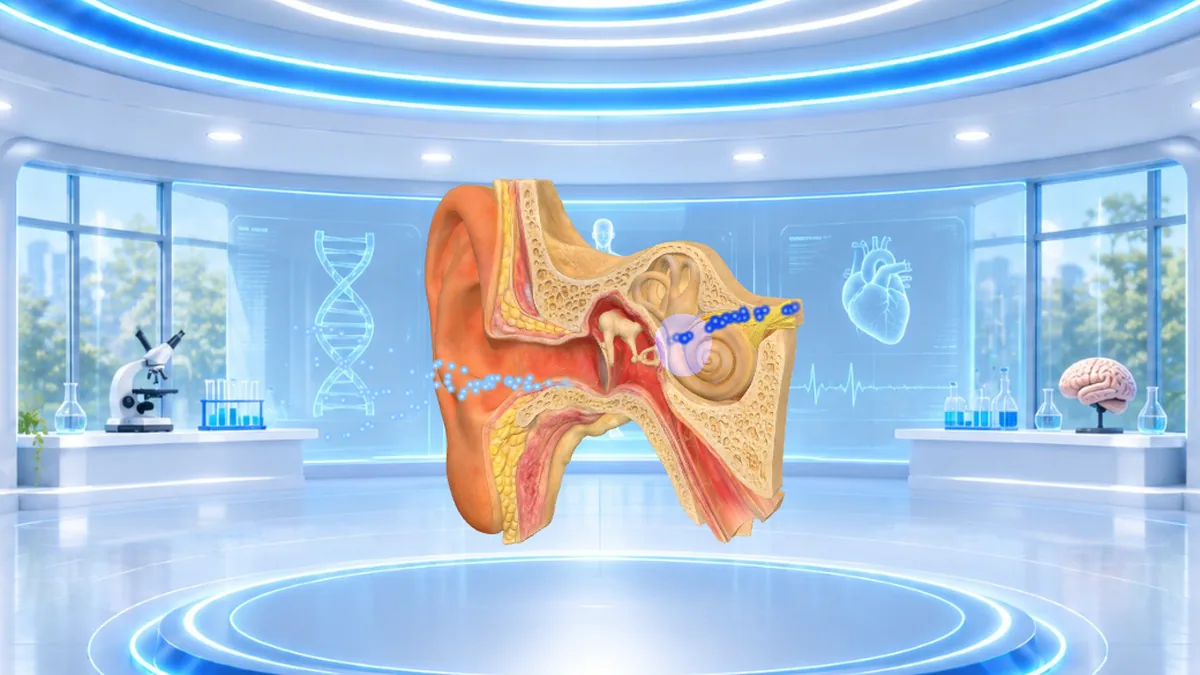
The ear does two jobs: hearing and balance. Sound travels through the outer ear to the eardrum, three tiny bones pass it on, and the spiral cochlea turns it into nerve signals. In the 3D Anatomy simulator you can open the ear and tap each part.
 Explore in 3D
Ear quick facts
| Sections | Outer, middle and inner ear |
|---|---|
| Middle ear bones | Hammer, anvil and stirrup |
| Smallest bone | The stirrup, about 3 mm long |
| Hearing range | About 20 to 20,000 Hz in young adults |
| Balance organ | The vestibular system in the inner ear |
Interesting facts about the ear
- The stirrup in the middle ear is the smallest bone in the human body.
- The eardrum vibrates when sound waves hit it.
- The cochlea is shaped like a snail shell and is filled with fluid.
- Tiny hair cells in the cochlea turn vibrations into nerve signals.
- Three fluid-filled loops in the inner ear sense movement and help you balance.
What you can do in 3D
Open the ear to see the eardrum, the tiny bones and the spiral cochlea, then tap each part to follow how sound travels inwards.
More senses in 3D
Tap any part to open its page.
Ear questions
What are the three parts of the ear?
The outer ear, which collects sound, the middle ear with the eardrum and three tiny bones, and the inner ear with the cochlea and balance organs.
What is the smallest bone in the body?
The stirrup, or stapes, in the middle ear. It is about 3 mm long.
How do we hear?
Sound makes the eardrum vibrate. Three small bones pass the vibration to the cochlea, where hair cells turn it into signals for the brain.
How does the ear help with balance?
Fluid-filled loops in the inner ear sense the head moving and tell the brain which way is up.
What sounds can humans hear?
Young adults can usually hear from about 20 to 20,000 vibrations a second (hertz).
The 3D Anatomy simulator is made by Julian Neagu, a solo founder in London, as part of VisionVix Simulators. It is free to use in the browser on desktop and phone, with no sign-up. This page is for learning and is not medical advice.