Persian Empire Map in 3D: The Achaemenid Empire of Cyrus and Darius
The Achaemenid Persian Empire, founded by Cyrus the Great, was one of the first great empires of the ancient world. It stretched from Egypt and Greece's doorstep to the Indus valley, linked by the famous Royal Road. On the 3D History Globe you can watch it grow under Cyrus and Darius.
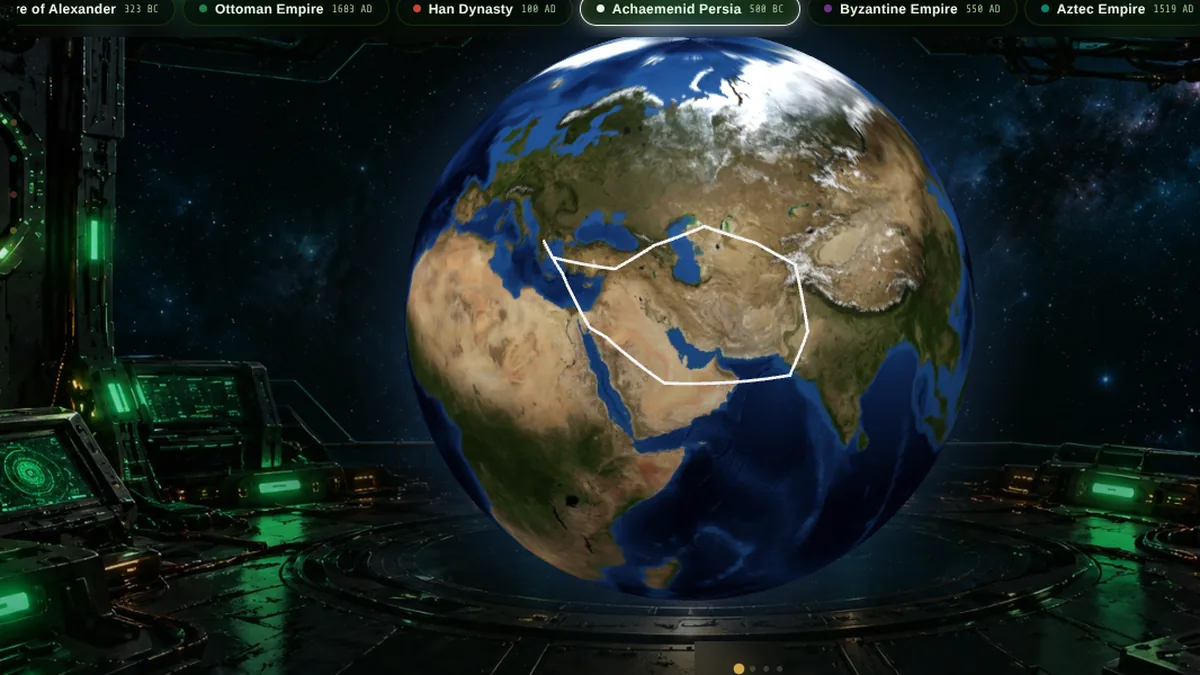 Explore in 3D
Achaemenid Persian Empire quick facts
| Dates | 550 to 330 BC |
|---|---|
| Peak | About 500 BC, under Darius I |
| Capitals | Susa, Persepolis, Pasargadae and others |
| Largest area | About 5.5 million km² |
| Famous rulers | Cyrus the Great, Cambyses II, Darius I, Xerxes I |
Interesting facts
- Cyrus the Great was known for respecting the customs and religions of the peoples he ruled.
- The Cyrus Cylinder records him returning statues to temples and letting deported peoples go home.
- The Royal Road ran about 2,700 km from Susa to Sardis, with stations for royal messengers.
- Darius I divided the empire into provinces called satrapies.
- Persepolis was a grand ceremonial capital, whose ruins still stand in Iran.
Achaemenid Persian Empire timeline
- 550 BCCyrus the Great founds the empire
- 539 BCBabylon falls to Cyrus
- 525 BCCambyses II conquers Egypt
- about 500 BCThe empire reaches its largest size under Darius I
- 480 BCXerxes I invades Greece
- 330 BCAlexander the Great ends the empire
On the History Globe, press play to watch these stages appear one by one, with the borders growing across the map.
More empires in 3D
Achaemenid Persian Empire questions
Who founded the Persian Empire?
Cyrus the Great, around 550 BC.
What was the Royal Road?
A road of about 2,700 km from Susa to Sardis, with stations where royal messengers could change horses.
What is the Cyrus Cylinder?
A clay cylinder recording Cyrus the Great restoring temples and letting deported peoples return home after taking Babylon.
Who ended the Achaemenid Empire?
Alexander the Great conquered it between 334 and 330 BC.
What was Persepolis?
A grand ceremonial capital built mainly by Darius I and Xerxes, now a ruin in southern Iran.
The 3D History Globe is made by Julian Neagu, a solo founder in London, as part of VisionVix Simulators. It is free to use in the browser on desktop and phone, with no sign-up. Map borders are approximate, for learning.