Byzantine Empire Map in 3D: Rome's Eastern Empire
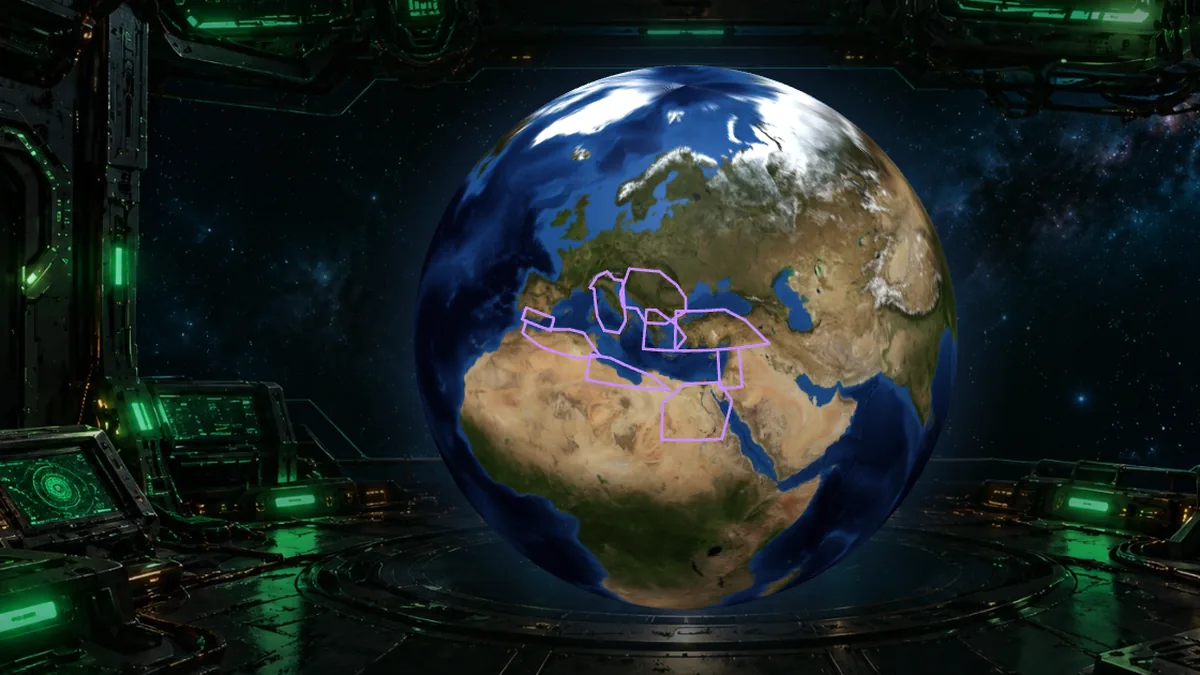
The Byzantine Empire was the eastern half of the Roman Empire, which carried on for almost a thousand years after Rome fell in the west. From its capital Constantinople it kept Greek and Roman learning alive. On the 3D History Globe you can watch it grow back to its greatest size under Justinian.
 Explore in 3D
Byzantine Empire quick facts
| Dates | 330 to 1453 |
|---|---|
| Peak | About 555, under Justinian I |
| Capital | Constantinople (Istanbul) |
| Largest area | About 2.8 million km² |
| Famous emperors | Constantine I, Justinian I, Basil II, Constantine XI |
Interesting facts
- It lasted over a thousand years after the fall of the Western Roman Empire.
- Its people called themselves Romans, and Greek became the main language.
- The Hagia Sophia in Constantinople was the largest church in the world for nearly a thousand years.
- Greek fire, a secret weapon, could keep burning on water.
- Byzantine scholars copied and kept many ancient Greek texts.
Byzantine Empire timeline
- 330Constantine makes Constantinople the new capital
- 476The Western Empire falls but the East carries on
- 537The Hagia Sophia is completed
- about 555Justinian's armies win back Italy and North Africa
- 1204Crusaders capture Constantinople
- 1453The Ottomans take Constantinople and the empire ends
On the History Globe, press play to watch these stages appear one by one, with the borders growing across the map.
More empires in 3D
Byzantine Empire questions
What was the Byzantine Empire?
The eastern half of the Roman Empire, which carried on after the west fell in 476 and lasted until 1453.
What was the capital of the Byzantine Empire?
Constantinople, now Istanbul in Turkey.
When did the Byzantine Empire end?
In 1453, when the Ottoman Turks captured Constantinople.
What was Greek fire?
A secret liquid weapon used by the Byzantine navy that kept burning even on water.
Did the Byzantines call themselves Byzantine?
No. They called themselves Romans. The name Byzantine was given by later historians.
The 3D History Globe is made by Julian Neagu, a solo founder in London, as part of VisionVix Simulators. It is free to use in the browser on desktop and phone, with no sign-up. Map borders are approximate, for learning.